
Trolley
You have no items in your shopping cart

 Budgets
 Dumbers
 Discs
Discs
 Benches
 Racks and Rigs
 Weights Holders
 Isotonic machines
 Calisthenics
 Cardio
 Kettlebells
 Flooring
 Gym Set
 Accessories
 Combat
 ARTI MARZIALI
 CONTAINER GYM
 Tug-Of-War
 Used Gym Equipment
 PILATES MACCHINARI
 GINNASTICA ARTISTICA
 CAMPI DA PADEL
 Prodotti in Pronta Consegna
 Informazioni
 IRONMAN
 Gift Card
- Donatif
- General information
- 0 I like it
- 48 Views
- 0 comments
- gym flooring, safety flooring, gym safety, shock-absorbing materials
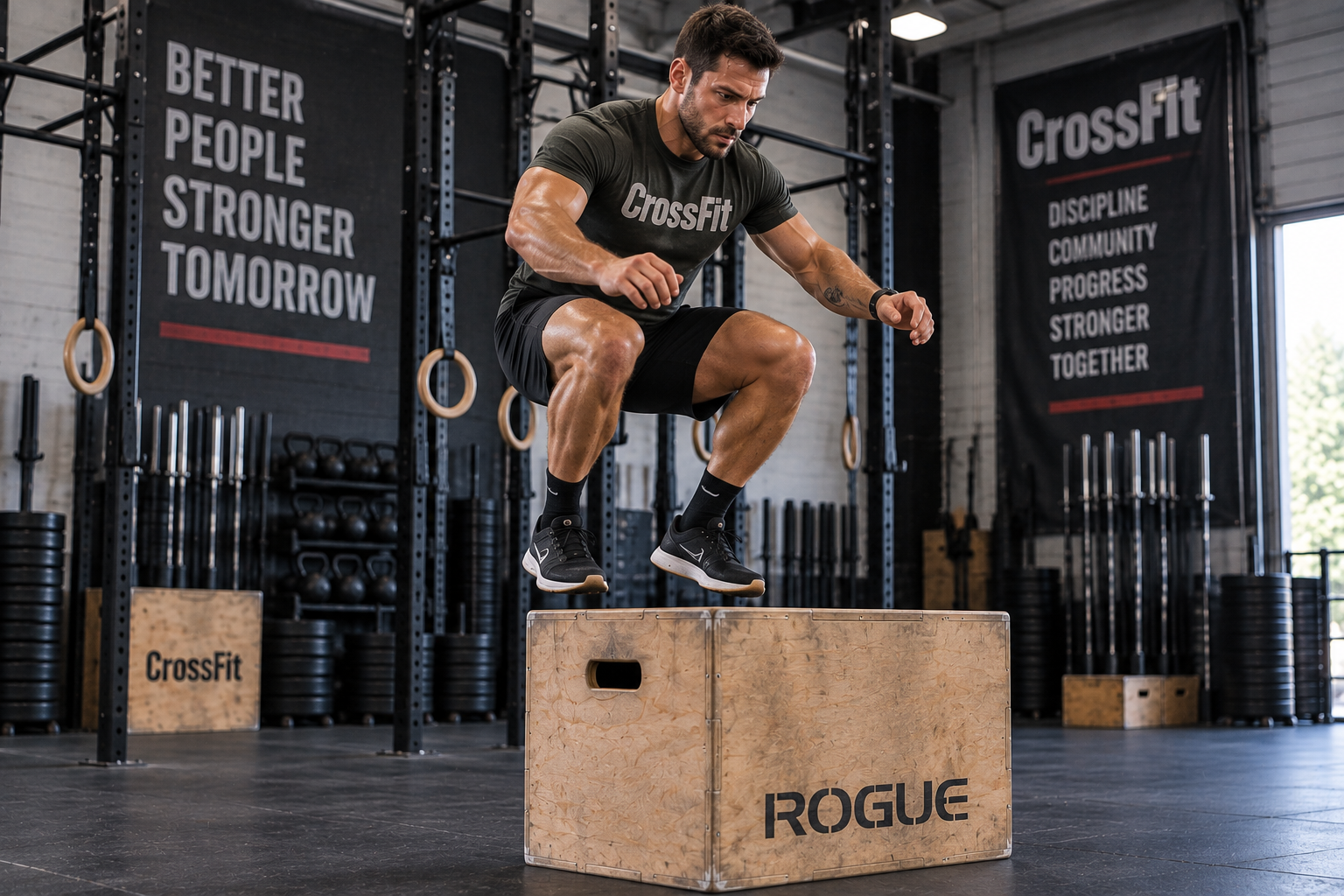
How much space is needed for the box jump
To correctly perform the box jump, you must have a space that allows for a controlled run-up, a stable landing, and a safe descent from the plyo box. The available area must be evaluated together with the dimensions of the box, the type of exercises planned, and the presence of other equipment nearby, so as to guarantee fluid movements without interference.
The required space does not depend exclusively on the height of the box. The workstation setup, the support surface, and the number of users simultaneously utilizing the functional area also influence the design. A correct layout improves the quality of the workout and reduces the risk of collisions or restricted movements.
Before purchasing a plyo box, it is therefore advisable to verify that the environment allows you to perform jumps, landings, and preparatory movements while always maintaining an adequate distance from walls, columns, and other training stations.
- Quick answer
- What the required space depends on
- How to organize the workstation layout
- Comparison table
- Space in a home gym
- Space in a professional gym
- Design errors to avoid
- FAQ
- How to plan space before purchasing
How much space is actually needed for the box jump?
A workstation dedicated to the box jump should allow the user to prepare the jump, land on the box, and step down in a controlled manner without obstacles in the immediate vicinity. The operating area therefore includes not only the volume occupied by the plyo box but also the area necessary for the entire movement.
An effective design improves execution fluidity and allows the box to be used safely even during functional circuits with multiple stations.
To obtain the best result, it is advisable to design the area layout first and subsequently choose the most suitable plyo box.
Why space is fundamental
A workstation that is too cramped limits the quality of the jump, makes landing less natural, and increases the risk of interference with other equipment.
What elements to evaluate
The main criteria concern box dimensions, type of exercises, free area, and overall space organization.
What does the required space depend on?
The dimensions of the workstation change based on the height of the box, the type of exercise, and the user's level.
Plyometric exercises in fact require different movements compared to controlled step-up exercises, making a layout consistent with the training program necessary.
The number of users present simultaneously also influences the organization of the functional area.
Height influence
Boxes with different heights may require different technical approaches and a progression appropriate to the user's capabilities.
Exercise influence
The step-up generally requires a different configuration compared to plyometric jumps performed with higher intensity.
How to organize the workstation layout?
The plyo box should be positioned in a dedicated zone, with sufficient free space in front, behind, and laterally to allow the complete execution of the movement.
Passage areas must remain free so as to avoid interference during individual or group workouts.
When multiple boxes are present, it is useful to maintain a regular arrangement that facilitates activity control and flow management.
Workstation orientation
A linear arrangement makes area organization simpler and favors exercise continuity.
Path management
Internal pathways should allow users to move between different stations without crossing the area designated for jumps.
Comparison table
This summary highlights the main elements to consider when designing the space.
| Element | Influence on layout | To be verified |
|---|---|---|
| Box dimensions | High | Available operating area |
| Height | Medium | User level |
| Material | Limited | Intended use |
| Type of exercise | High | Planned movements |
| Flooring | Important | Stability and protection |
The table shows how workstation sizing derives from the combination of multiple factors and not from a single element.
How to read the comparison
Aspects with the greatest impact should be evaluated as early as the initial phases of designing the functional area.
Priority order
It is advisable to define the workstation layout first and subsequently choose the most suitable plyo box model.
How much space is needed in a home gym?
In domestic environments, it is important to optimize available space while still maintaining a free area dedicated to plyometric exercises.
An orderly arrangement allows the box to be used for other exercises as well without having to continually move the equipment.
It is appropriate to avoid the presence of objects or furnishings that could limit freedom of movement during the jump.
Managing compact environments
Careful design allows you to make the most of available space without compromising workout quality.
Organizing the workstation
Always keeping the area dedicated to the box free facilitates daily use of the equipment.
How much space is needed in a professional gym?
In professional facilities, sizing must consider the simultaneous presence of multiple users and the integration of the plyo box into functional circuits.
Workstations should be distributed uniformly, avoiding overlaps between the operating areas dedicated to jumps and those reserved for other exercises.
Rational design improves area efficiency and facilitates the work of instructors.
Integration with other equipment
The plyo box can be placed next to a plyometric platform or other conditioning stations as long as each activity has its own operating space.
Surface importance
An anti-shock flooring helps improve workstation stability and protects the floor during repeated workouts.
What errors are best avoided?
One of the most frequent errors consists of placing the plyo box too close to other equipment or passage zones.
Another critical issue concerns designing a workstation that does not allow for a natural landing or a controlled descent.
Neglecting surface quality can also limit the comfort and durability of the training area.
Insufficient layout
A poorly functional configuration makes executing exercises more difficult and limits movement fluidity.
Inadequate surface
Flooring not designed for fitness activity can increase wear and reduce the quality of the workstation.
FAQ
Does the box jump require a dedicated zone?
Yes. It is preferable to set up an area free of obstacles that allows jumps and landings to be performed safely.
Does space change with box height?
Height influences execution technique and should be considered together with the workstation layout.
Can the plyo box also be used for other exercises?
Yes. In addition to jumps, it can be used for step-ups, balance work, and other functional exercises.
Is flooring important?
Yes. An adequate surface improves stability and helps protect the floor during continuous use.
How to plan space before purchasing
Properly evaluating available space allows you to choose a plyo box consistent with your training environment and intended goals. Planning the workstation before purchasing allows you to easily integrate the equipment into the existing layout and avoid subsequent modifications.
Both in home gyms and professional gyms, it is advisable to consider the operating area, equipment arrangement, type of exercises, and surface characteristics together before defining the final configuration.
A design based on verifiable criteria allows you to create an efficient, easily manageable workstation suitable for continuous use, enhancing the plyo box as an integral part of the functional area.
Comments (0)