
Trolley
You have no items in your shopping cart

 Budgets
 Dumbers
 Discs
Discs
 Benches
 Racks and Rigs
 Weights Holders
 Isotonic machines
 Calisthenics
 Cardio
 Kettlebells
 Flooring
 Gym Set
 Accessories
 Combat
 ARTI MARZIALI
 CONTAINER GYM
 Tug-Of-War
 Used Gym Equipment
 PILATES MACCHINARI
 GINNASTICA ARTISTICA
 CAMPI DA PADEL
 Prodotti in Pronta Consegna
 Informazioni
 IRONMAN
 Gift Card
- Donatif
- General information
- 0 I like it
- 11 Views
- 0 comments
- gym flooring, safety flooring, gym safety, shock-absorbing materials
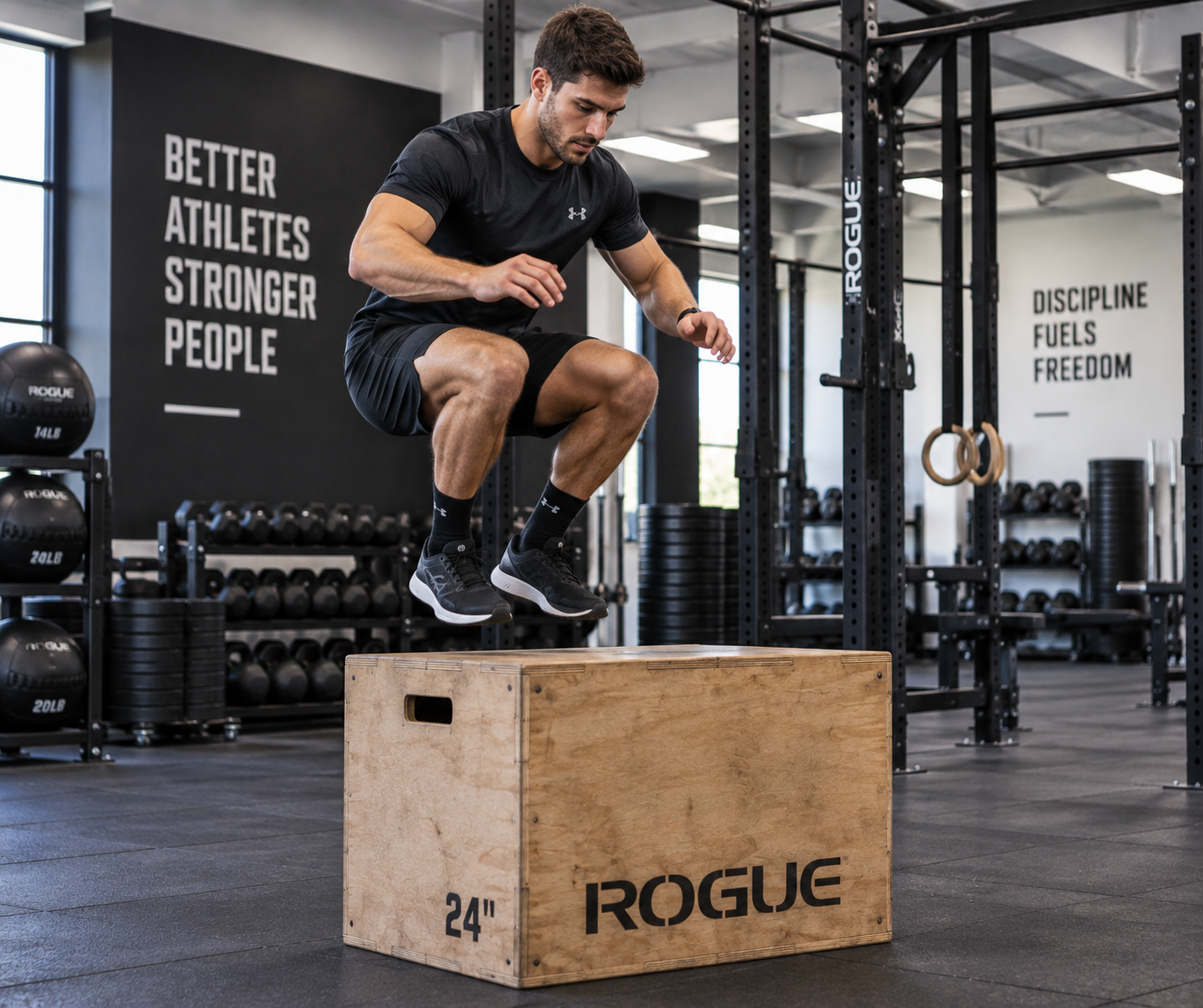
How to choose a plyo box
To choose the most suitable plyo box, it is necessary to evaluate the available heights, material, configuration, usage space, and user level all together. A well-sized box allows you to perform exercises with greater continuity, promotes an orderly technical progression, and makes it possible to integrate the equipment into home gyms, personal training studios, and professional gyms without limiting workout possibilities.
The choice should not be based solely on price or aesthetic appearance. The intended use, session frequency, and functional area layout also affect the most suitable solution. Equipment consistent with the context of use improves workout organization and facilitates the management of plyometric exercises.
Before purchasing, it is therefore advisable to analyze your available space, define your workout goals, and compare the features of different models, avoiding choosing solely based on height or material.
- Quick answer
- Which specs really matter
- How to choose a plyo box
- Comparison table
- Workout compatibility
- Material and configuration
- Purchase mistakes to avoid
- FAQ
- How to evaluate the investment
How to choose the right plyo box?
Choosing a plyo box should start with four main criteria: available heights, construction material, operational space, and type of workout. Evaluating these elements allows you to identify a solution consistent with the users' level and the layout of the area dedicated to plyometric exercises.
A versatile model allows you to tackle different training programs without having to quickly replace the equipment.
To make a truly informed choice, it is useful to compare all technical features before purchasing.
Which criterion to start with?
The first element to consider concerns the users' level and the exercises that will be performed most frequently.
Why does the context matter?
The needs of a home gym can be very different from those of a professional gym or a studio dedicated to functional training.
Which specs really matter?
The features that most affect the choice are the heights, the dimensions of the top surface, the material, and the box configuration.
The stability of the structure and compatibility with the available space are also important aspects to evaluate before purchasing.
Each element should be analyzed according to the intended use and not in isolation.
Importance of heights
Having multiple heights facilitates workout progression and allows the box to be adapted to users with different levels of experience.
Surface dimensions
An adequate surface helps improve comfort during exercise execution and promotes stable support.
How to choose a plyo box based on usage?
Those who use the box mainly for functional training can favor versatile models that allow for different types of exercises.
For programs dedicated to athletic preparation, it may instead be useful to evaluate specific configurations according to the facility's needs.
It is also important to verify that the box can be easily integrated into the layout of the workout area.
Type of workout
Box jumps, step-up exercises, and athletic preparation work may require different configurations.
User level
The choice should allow for gradual technical progression without imposing heights inconsistent with the user's capabilities.
Comparison table
The following table summarizes the main decision-making criteria.
| Feature | What to evaluate | Why it matters |
|---|---|---|
| Heights | Available progression | Adaptability to users |
| Material | Soft or rigid | Context of use |
| Dimensions | Top surface | Comfort during exercises |
| Configuration | 3 in 1 or fixed height | Operational versatility |
| Space | Available area | Proper station organization |
The table highlights how an effective choice depends on the combination of multiple factors rather than a single technical feature.
How to interpret the comparison
When multiple models are similar, it is advisable to prioritize the configuration most consistent with the workout program.
Which criteria carry the most weight?
User level, available heights, and operational space generally represent the most important factors.
How to check workout compatibility?
The plyo box should adapt to the exercises that will be performed most frequently and easily integrate with other equipment present in the functional area.
A versatile solution also allows the box to be used for complementary work in addition to plyometric jumps.
Evaluating this compatibility avoids purchases that are inconsistent with the facility's goals.
Use for step-ups
A plyo box can also be effectively used for controlled step-up exercises and athletic preparation.
Integration into circuits
The box can be integrated with other stations dedicated to functional training while maintaining an orderly distribution of the area.
Which material and configuration to choose?
The choice of material depends on the facility's preferences and the type of users. Some contexts favor soft surfaces, while others prefer rigid structures.
Configuration also affects practical use. 3-in-1 models allow you to easily change the height by rotating the box.
Single-height configurations, on the other hand, are suitable when the training program always provides the same level of work.
Soft or rigid
Both solutions can be valid as long as they are consistent with the type of workout planned.
3-in-1 configuration
The ability to use different heights makes the box particularly versatile in environments frequented by users with different levels.
Which mistakes are best avoided?
One of the most common mistakes is choosing the plyo box solely based on price without considering usage and available space.
Another critical issue concerns choosing a model with features inconsistent with the users' level.
Neglecting the quality of the support surface can also limit the effectiveness of the station in the long run.
Focusing only on the material
Material represents an important criterion but should be evaluated together with configuration, dimensions, and intended use.
Ignoring the flooring
An anti-shock gym flooring helps improve station stability and protects the floor during repeated workouts.
FAQ
Is a 3-in-1 plyo box better?
It can be a practical solution when you want to work with multiple heights using a single piece of equipment.
Does material or height matter more?
Both are important, but they should be evaluated together with the type of workout and the user level.
Is the plyo box also suitable for beginners?
Yes, by choosing appropriate heights and following a consistent technical progression.
Is a lot of space required?
Space depends on the type of exercises planned and the layout of the workout area.
How to evaluate the investment before purchasing
Purchasing a plyo box means choosing equipment that will adapt over time to different training programs. Evaluating heights, material, configuration, available space, and type of users all together allows you to make a choice that is truly consistent with the facility's needs.
For professional gyms, it may be useful to provide multiple configurations dedicated to different levels of experience, while in home gyms, a versatile solution generally allows you to cover a greater number of exercises without increasing clutter.
Carefully analyzing these criteria before purchasing allows you to invest in a functional plyo box that is easily integrated into the workout area and suitable for continuous use over time.
Comments (0)