
Trolley
You have no items in your shopping cart

 Budgets
 Dumbers
 Discs
Discs
 Benches
 Racks and Rigs
 Weights Holders
 Isotonic machines
 Calisthenics
 Cardio
 Kettlebells
 Flooring
 Gym Set
 Accessories
 Combat
 ARTI MARZIALI
 CONTAINER GYM
 Tug-Of-War
 Used Gym Equipment
 PILATES MACCHINARI
 GINNASTICA ARTISTICA
 CAMPI DA PADEL
 Prodotti in Pronta Consegna
 Informazioni
 IRONMAN
 Gift Card
- Donatif
- General information
- 0 I like it
- 486 Views
- 0 comments
- gym flooring, safety flooring, gym safety, shock-absorbing materials
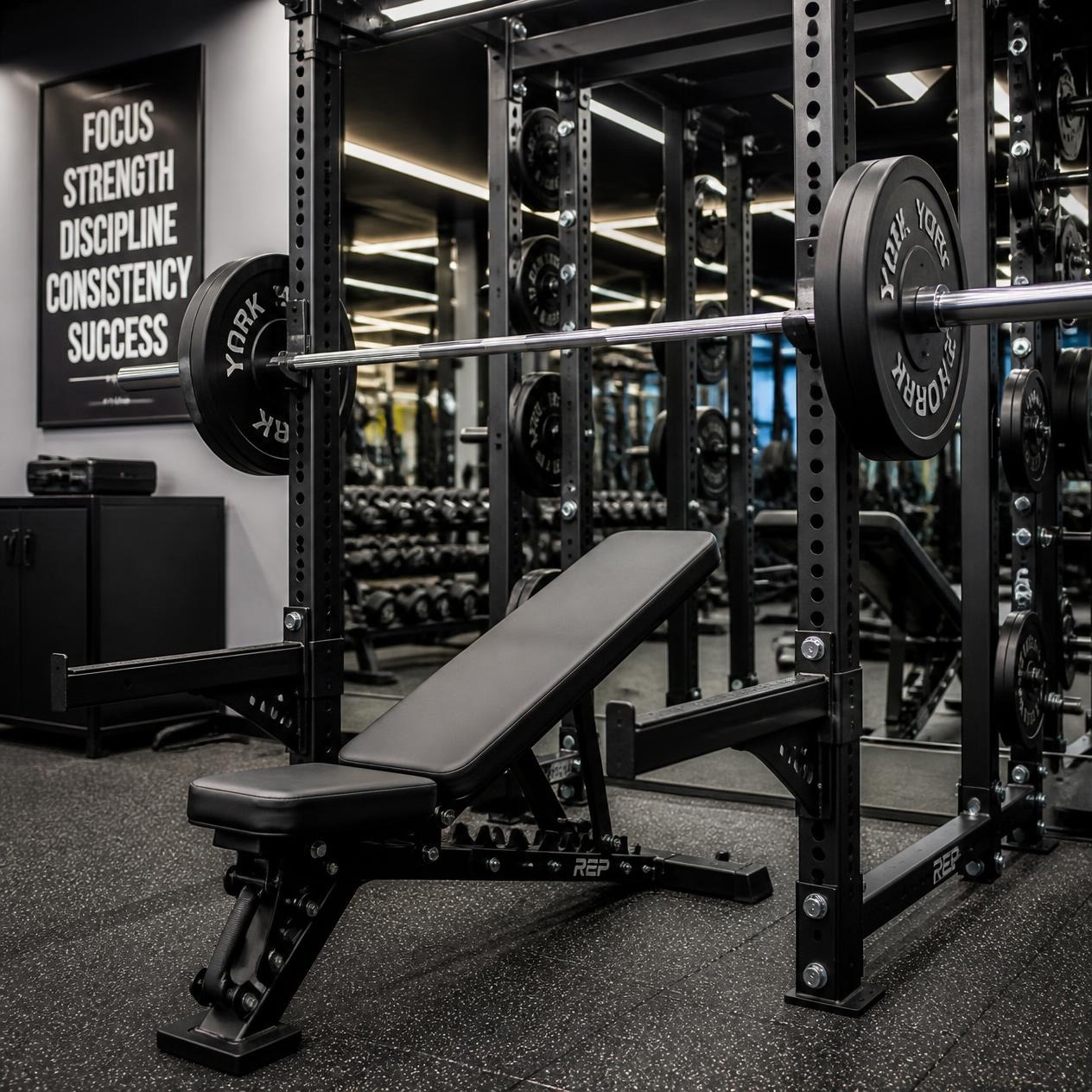
Gym bench with barbell rack: safety and maximum load capacity
When it comes to barbell training, the quality of the equipment does not just affect performance; it represents one of the main safety factors. A gym bench with a barbell rack designed to support heavy loads allows you to train with greater peace of mind, reducing wobbling, instability, and structural deformation even during the most demanding sessions.
Many users tend to focus exclusively on the design or price of the equipment, neglecting technical aspects such as steel thickness, weld quality, load distribution, and the actual structural capacity of the frame. In reality, it is precisely these elements that determine the reliability of the bench in the long term and safety during exercises like the flat bench press, incline press, and military press.
In this guide, we analyze how to evaluate a bench with a barbell rack, which features actually affect stability, how to correctly interpret data regarding maximum load capacity, and why investing in a professional model is a strategic choice for those who want to train with significant loads in both a home gym and a professional gym.
- Why the structure is fundamental
- How to evaluate maximum load capacity
- The elements that determine stability
- Materials and build quality
- The advantages of an integrated rack
- Good usage practices
- Why choose a professional model
Why the structure is fundamental
During a barbell exercise, the bench is subjected to dynamic stresses much higher than the simple weight declared on the plates. In fact, each phase of the repetition generates forces that are distributed across the frame, the supports, and the weld points.
A properly designed structure maintains its alignment even during explosive movements or heavy loads, avoiding flexing, vibrations, and oscillations that could compromise the quality of the exercise and increase the risk of losing control of the barbell.
For this reason, professional benches are built with geometries designed to distribute stresses uniformly, offering a stable base for both the athlete and the barbell support system.
Force distribution
A wide and well-designed base improves the overall balance of the machine and helps maintain constant stability during every repetition.
Reliability over time
A properly dimensioned frame retains structural rigidity even after years of intensive use, reducing the probability of premature wear.
How to evaluate maximum load capacity
The weight bench maximum load capacity represents one of the most important parameters when choosing equipment, but it must be interpreted correctly. The value indicated by the manufacturer generally includes the weight of the user and that of the barbell with the plates, which is why it is essential to always check the technical specifications.
Training constantly near the declared maximum limit is not the ideal condition. A good practice is to choose a bench with a capacity higher than the loads normally used, so as to maintain an adequate safety margin and preserve the structure over time.
Professional equipment is designed precisely to ensure high performance even during continuous use, offering greater reliability compared to entry-level models intended for occasional use.
Static and dynamic loads
During movement, the forces generated can be higher than the weight simply resting on the structure. For this reason, it is important to consider the design quality in addition to the numerical data of the load capacity.
Why a safety margin is needed
Choosing an oversized bench relative to your needs reduces wear and increases peace of mind during the most intense workouts.
The elements that determine stability
Stability depends on numerous factors that work together. In addition to the weight of the structure, the width of the base, the arrangement of the support points, the quality of the welds, and the precision of the joints between the various components all play a role.
A stable bench eliminates micro-movements that could negatively influence the barbell's trajectory, improving the athlete's concentration and the overall quality of the workout.
The adjustment system for the backrest and seat must also ensure there is no mechanical play, maintaining the same rigidity in every configuration.
Support base
High gym bench stability stems from an accurate design of the base, capable of distributing weight uniformly without creating imbalance points.
Structural rigidity
Precise joints, quality hardware, and professional welds allow the machine's behavior to remain constant throughout its useful life.
Materials and build quality
The thickness of the steel tubing represents one of the most important indicators of build quality. Properly dimensioned profiles increase resistance to bending and improve the structure's ability to support heavy loads without deformation.
Alongside steel, the quality of the paint, the precision of CNC machining, and the resistance of the padding are also of great importance—elements that contribute to the durability of the equipment and user satisfaction.
A construction with attention to detail also offers a better feeling of solidity, a feature particularly appreciated by users who perform strength-oriented workouts.
Steel thickness
More robust profiles allow for better stress distribution and reduce deformation under load, improving safety and movement precision.
Professional finishes
Anti-corrosion treatments, resistant coatings, and high-density padding maintain high aesthetic and functional performance even after years of use.
The advantages of an integrated rack
A professional bench with an integrated rack allows you to perform numerous exercises with greater practicality, eliminating the need to purchase separate structures for barbell support.
Adjustable systems allow you to quickly adapt the height of the supports to different exercises and the user's anthropometric characteristics, improving ergonomics and safety during the initial positioning of the barbell.
This solution is particularly interesting in home gyms where available space is limited and every square meter must be utilized as efficiently as possible.
Greater functionality
With a single machine, it is possible to perform flat, incline, and decline bench presses, as well as numerous variations of barbell exercises, reducing the overall footprint.
User adaptability
Adjustable supports make it easy to find the ideal position to start every exercise with maximum control.
Good usage practices
Even the best professional bench requires correct usage. Before every workout, it is advisable to check the tightness of the hardware, check the stability of the structure, and ensure that the adjustment systems are perfectly locked.
During exercises with heavy loads, it is appropriate to use adequate safety devices and, when necessary, train with an experienced spotter capable of intervening in case of difficulty.
Periodic maintenance also allows you to preserve the quality of the equipment over time, preventing wear on components subject to greater stress.
Periodic checks
Regularly inspecting the frame, supports, and padding helps to identify any signs of wear in a timely manner.
Technique before load
Increasing weight progressively only after having consolidated correct execution reduces the risk of errors and improves the effectiveness of the workout.
Why choose a professional model
Purchasing a quality bench means investing in your own safety and the continuity of your workouts. A professional structure offers greater stability, superior durability, and predictable behavior even when using significant loads—essential characteristics for those who practice powerlifting, bodybuilding, or strength training.
For those who wish to build a reliable home gym or equip a commercial gym, choosing a gym bench with a barbell rack designed to high standards represents a long-term decision. Quality materials, careful design, and attention to construction details translate into a safer and more professional training experience.
The value of a bench is not measured exclusively by its aesthetic appearance, but by its ability to support every workout with constant reliability. Carefully evaluating load capacity, stability, materials, and the quality of the integrated rack allows you to choose equipment capable of accompanying the athlete's evolution over the years, offering the peace of mind necessary to focus exclusively on your performance.
Comments (0)