
Trolley
You have no items in your shopping cart

 Budgets
 Dumbers
 Discs
Discs
 Benches
 Racks and Rigs
 Weights Holders
 Isotonic machines
 Calisthenics
 Cardio
 Kettlebells
 Flooring
 Gym Set
 Accessories
 Combat
 ARTI MARZIALI
 CONTAINER GYM
 Tug-Of-War
 Used Gym Equipment
 PILATES MACCHINARI
 GINNASTICA ARTISTICA
 CAMPI DA PADEL
 Prodotti in Pronta Consegna
 Informazioni
 IRONMAN
 Gift Card
- Donatif
- General information
- 0 I like it
- 477 Views
- 0 comments
- gym flooring, safety flooring, gym safety, shock-absorbing materials
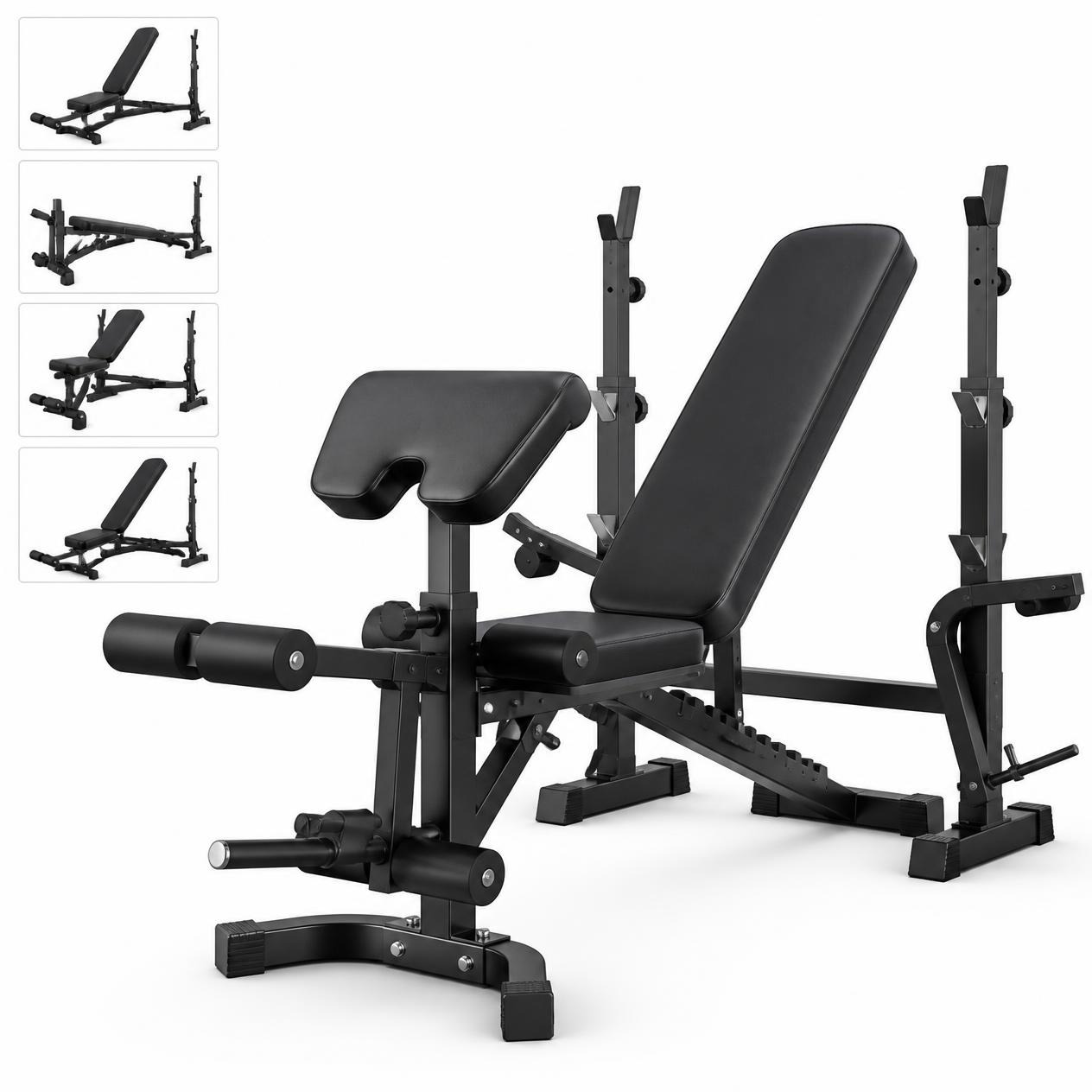
Multifunctional gym bench vs. Rack: which one to choose for your Home Gym?
Creating an efficient home gym means making decisions that influence both the quality of your training and the use of available space. Among the most frequent dilemmas is the choice between a multifunctional gym bench and a system composed of a rack and an independent bench. Both solutions allow you to train for strength and hypertrophy, but they respond to different needs in terms of modularity, expansion possibilities, footprint, and financial investment.
In recent years, Home Gyms have seen significant growth thanks to the spread of remote working and the search for greater flexibility. Those who train at home want to achieve professional results without sacrificing precious square footage. For this reason, the evaluation of equipment cannot be limited to the initial price, but must also consider future evolution, variety of exercises, safety, and long-term durability.
In this guide, we analyze in detail the advantages and disadvantages of the two solutions, comparing footprints, training possibilities, costs, and growth prospects. The goal is to help those with limited space identify the smartest investment based on their needs and understand why modularity often represents an advantage over fully integrated stations.
- Differences between multifunctional bench and rack
- Footprint analysis
- Versatility of exercises
- The value of modularity
- Costs and long-term investment
- Which solution to choose based on your profile
- Mistakes to avoid
- How to make the best decision
Differences between multifunctional bench and rack
A multifunctional bench generally integrates multiple stations within the same structure. It can include barbell supports, pulley systems, leg extensions, leg curls, and other accessories that allow you to train different muscle groups using a single machine. The main advantage consists of the possibility of having numerous functions concentrated in a relatively small area.
A rack, on the other hand, represents a modular structure designed primarily for free-weight barbell exercises. Combined with an adjustable bench, it allows you to perform squats, presses, military presses, and numerous other variations. Unlike the multifunctional station, the rack can be progressively expanded with dedicated accessories, adapting to the evolution of your training.
This design difference directly influences the way you train. Integrated stations prioritize immediate practicality, while the rack focuses on freedom of configuration, higher load capacity, and the possibility of long-term customization.
How a multifunctional station works
Multifunctional stations are designed to offer a ready-to-use solution. Each component is integrated into the same structure and allows you to quickly switch from one exercise to another without adding further equipment. This feature is particularly appreciated by those who want a simple and immediate setup.
How a rack system works
The rack is born as a modular platform. The bench, supports, safety bars, and accessories can be chosen separately, allowing you to build a personalized gym based on the available budget and future goals.
Footprint analysis
One of the most important elements in designing a Home Gym is space management. You must not only consider the dimensions declared by the manufacturer, but also the area required to correctly use the equipment, load plates, move safely, and perform exercises with freedom.
Many people believe that a multifunctional station always takes up less space than a rack. In reality, the comparison depends on the chosen configuration and the possibility of using foldable accessories or modular components.
Before purchasing, it is useful to design the room layout considering ceiling height, door opening, lateral space, and the area intended for barbell movements.
Evaluating multifunctional station footprint
Multifunctional stations concentrate many functions in the same frame but may require additional space for the correct use of pulleys and lever movements. For this reason, it is important to always check the operational footprint in addition to the structural one.
Making the most of every square meter
Careful planning allows you to obtain a functional gym even in small environments. The arrangement of equipment, plates, and accessories significantly affects daily practicality.
Versatility of exercises
From the point of view of variety, both solutions allow you to train the entire body. However, the way exercises are performed and the possibility of expanding the number of available movements change.
The multifunctional station offers numerous guided exercises already integrated. This makes it easier for those who train alone and want to quickly switch from one exercise to another without continuously changing the equipment configuration.
The rack, on the other hand, enhances work with free weights, favoring a more complete development of coordination, stability, and functional strength.
Advantages of integrated machines
Guided trajectories are particularly useful for beginners and allow you to train with greater safety when a spotter is not present.
Freedom of free weights
The rack allows you to use Olympic barbells, dumbbells, and numerous accessories, offering a higher level of customization and easily adapting to advanced strength and hypertrophy programs.
The value of modularity
One of the main strengths of modern rack systems is the possibility to grow along with the user. The equipment purchased today can be expanded tomorrow without completely replacing the existing setup.
This approach represents an important advantage for those who want to gradually build a professional Home Gym by distributing the investment over time.
Modularity also allows you to replace individual components when training goals change or new features are desired.
Progressive expansion
Accessories such as dip stations, pulleys, jammer arms, plate storage, and safety systems can be added later while keeping the main structure.
Why modularity is an advantage
A modular platform avoids having to buy a new machine when the user's needs increase. To learn more about solutions dedicated to Home Gyms, you can consult multifunctional gym bench, evaluating systems designed to evolve over time along with your training.
Costs and long-term investment
The initial price is only part of the economic evaluation. It is necessary to consider the durability of the structure, quality of materials, possibility of upgrading, and residual value of the equipment.
A multifunctional station may be convenient in the short term because it concentrates many functions in a single solution. However, any structural limitations might require a complete replacement when the user's goals change.
The modular rack, on the other hand, tends to distribute the investment over several phases, allowing you to buy accessories only when really necessary.
Initial evaluation
Those with a defined budget should compare not only the cost of the machine but also that of any essential accessories needed to complete their training program.
Long-term vision
A quality modular structure maintains its value longer and allows for progressive updates without starting from scratch.
Which solution to choose based on your profile
The answer to the question better rack or multifunctional depends above all on the type of user. Those who want quick and guided workouts may appreciate the practicality of the integrated station, while strength and bodybuilding enthusiasts generally prefer the freedom offered by the rack.
The time available also influences the choice. A multifunctional machine reduces configuration changes, while a rack requires more organization but offers practically unlimited possibilities.
For professionals with little time and urban fitness enthusiasts, the choice should take into account the relationship between daily practicality and the possibility of future growth.
Beginner users
Those starting to train can benefit from an intuitive and simple solution to use, with guided movements and immediate adjustments.
Advanced users
Expert athletes and powerlifters find the rack to be the ideal platform to develop complex programs and manage heavy loads in total safety.
Mistakes to avoid
One of the most frequent mistakes is buying exclusively based on price, without considering the actual operational space and the possibility of expanding the gym in the future.
Another mistake is underestimating build quality. The frame, welds, safety systems, and finishes determine durability, stability, and comfort during use.
Finally, many people choose equipment that is oversized for the available space, making the Home Gym impractical and limiting freedom of movement.
Plan before you buy
Drawing the room layout allows you to identify the most efficient solution, avoiding impulsive purchases.
Choose reliable materials
A sturdy structure ensures greater safety, less maintenance, and a more satisfying training experience over the years.
How to make the best decision
The choice between a multifunctional gym bench and a rack cannot be reduced to a simple comparison of price or the number of available exercises. It is necessary to evaluate space, goals, growth prospects, and frequency of use.
Those looking for an immediate and compact solution can find a valid ally in the multifunctional station, while those who want to build a Home Gym destined to evolve over time will benefit more from a modular platform. The availability of accessories, build quality, and the possibility of upgrading should also influence the final decision.
Considering all these factors, a modular solution often represents the most flexible investment for those who want to achieve professional performance and make the most of space-saving gym equipment without giving up the possibility of expanding their home gym over the years.
Comments (0)