
Trolley
You have no items in your shopping cart

 Budgets
 Dumbers
 Discs
Discs
 Benches
 Racks and Rigs
 Weights Holders
 Isotonic machines
 Calisthenics
 Cardio
 Kettlebells
 Flooring
 Gym Set
 Accessories
 Combat
 ARTI MARZIALI
 CONTAINER GYM
 Tug-Of-War
 Used Gym Equipment
 PILATES MACCHINARI
 GINNASTICA ARTISTICA
 CAMPI DA PADEL
 Prodotti in Pronta Consegna
 Informazioni
 IRONMAN
 Gift Card
- Donatif
- General information
- 0 I like it
- 388 Views
- 0 comments
- gym flooring, safety flooring, gym safety, shock-absorbing materials
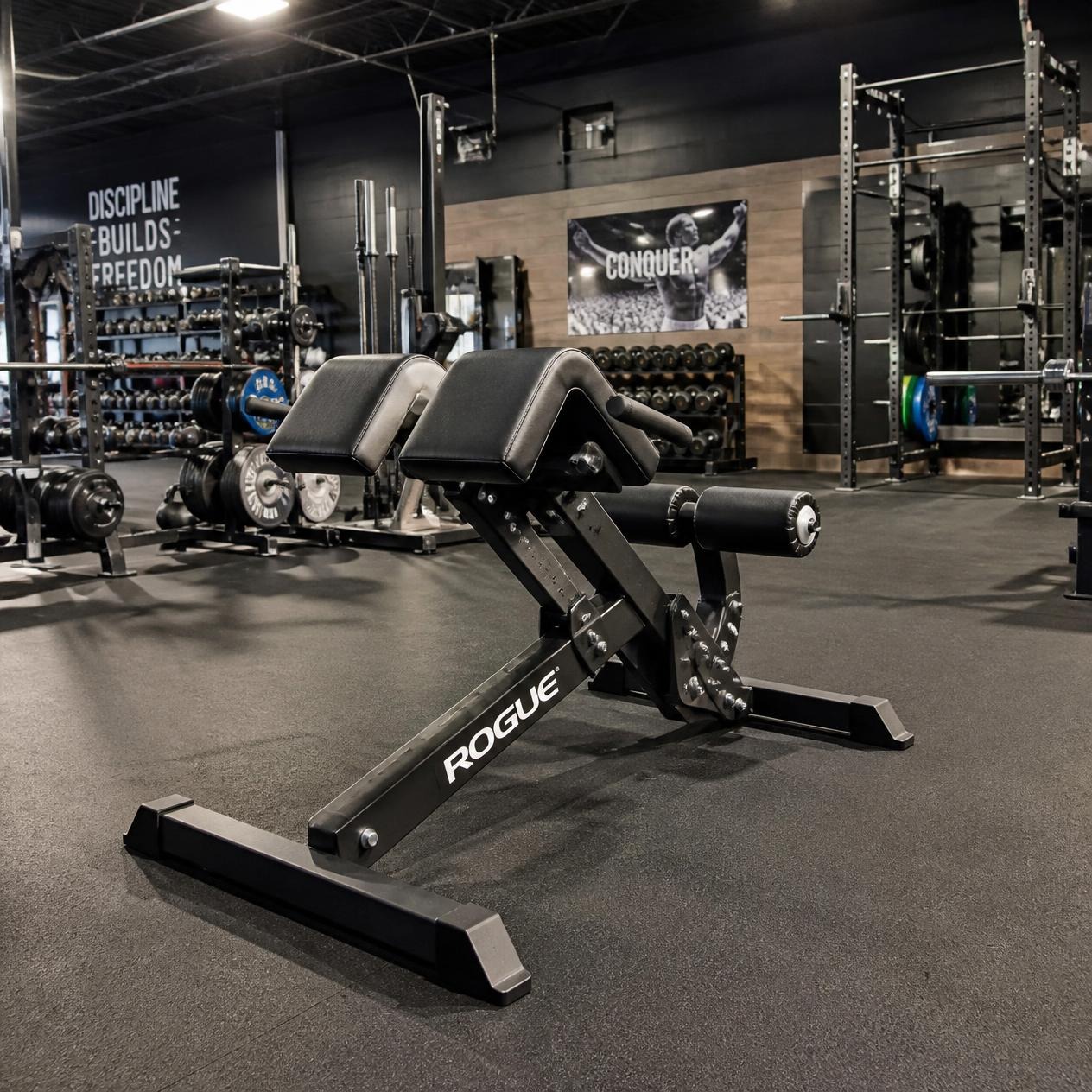
Hyperextension bench and core: the importance of lumbar stability
Strong lumbar muscles and a stable core represent the foundation of any effective training program. Whether the goal is to increase strength, improve posture, prevent injuries, or boost athletic performance, neglecting the posterior chain means limiting the potential of the entire body. Among the most effective equipment for developing this area, the hyperextension bench plays a leading role thanks to its ability to isolate the spinal extensor muscles and engage the glutes, hamstrings, and abdominals in a controlled manner.
In recent years, attention to back health has grown significantly. More and more people spend many hours sitting, developing muscle weakness, stiffness, and postural alterations that can negatively affect quality of life and training efficiency. Incorporating specific exercises for lumbar strengthening into your routine allows you to improve trunk stability and reduce the risk of overloading during daily and athletic movements.
In this guide, we analyze how the hyperextension bench works, its benefits for the core, injury prevention, the criteria for choosing a professional adjustable model, and why it represents one of the most important pieces of equipment in both commercial gyms and home gyms. Understanding the biomechanics of the exercise helps you harness the full potential of this tool in complete safety.
- What is the hyperextension bench
- The role of the core in stability
- Benefits for the lumbar area
- The most effective exercises
- How to choose an adjustable bench
- Errors to avoid and safety
- Why it represents a strategic investment
What is the hyperextension bench
The hyperextension bench is equipment designed to allow controlled extension of the torso through hip movement. Thanks to padded supports for the pelvis and ankles, it allows you to perform exercises in a stable manner, maintaining the correct alignment of the spine throughout the entire trajectory.
Contrary to what the name suggests, the goal is not to hyperextend the back, but to strengthen the extensor musculature through a controlled and physiological movement. The exercise mainly involves the spinal erectors, glutes, hamstrings, and, indirectly, all the stabilizing muscles of the trunk.
In professional versions, the structure is designed to ensure high stability, ergonomic adjustments, and adaptability to users of different heights, which are fundamental characteristics for achieving correct execution.
Construction features
A sturdy structure, non-slip bases, high-density padding, and quick adjustment systems allow the machine to be used safely even during intensive training.
Differences compared to other equipment
Unlike many bodyweight exercises, the bench offers constant support that facilitates movement control and allows you to focus on muscle activation without compensations.
The role of the core in stability
The core does not coincide exclusively with the abdominals. It actually includes a set of deep and superficial muscles that stabilize the spine, pelvis, and trunk during any athletic gesture or daily movement.
Good core stability improves the transmission of forces between the upper and lower body, increasing efficiency, balance, and motor control. This translates into better training quality and a reduction in stress on the joints.
Regularly training this region means creating a solid base for squats, deadlifts, presses, running, and numerous sports disciplines, reducing the risk of compensatory movements that can promote pain and injury.
Athletic performance
A stable trunk improves the ability to develop strength and transfer energy during explosive movements, changes of direction, and complex lifts.
Daily posture
Efficient core musculature helps maintain better posture during work activities and in everyday life, reducing fatigue in the lumbar area.
Benefits for the lumbar area
One of the main advantages of the hyperextension bench consists of the gradual strengthening of the muscles that support the spine. When these areas become stronger, the back is better able to handle daily and athletic stresses.
A proper training program can help decrease the feeling of stiffness due to a sedentary lifestyle and improve the muscular endurance of the lower back. Naturally, it is always advisable to consult a healthcare professional in the presence of pathologies or persistent pain.
The simultaneous involvement of the glutes and hamstrings also makes the exercise extremely effective for developing a balanced posterior chain, an element often neglected compared to the anterior musculature of the body.
Injury prevention
More resistant lumbar musculature helps improve stability during complex movements, reducing the risk of overloading resulting from incorrect techniques or muscle weakness.
Muscle balance
The harmonious development of the posterior chain allows you to compensate for any imbalances due to training programs focused exclusively on the chest, shoulders, and quadriceps.
The most effective exercises
Torso extension represents the main movement, but a professional bench allows you to perform numerous variations dedicated to strengthening the core and posterior musculature.
By modifying the range of motion, the position of the arms, or using weights, it is possible to adapt the intensity to the user's capabilities, making the equipment suitable for both beginners and advanced athletes.
Progression must always prioritize technical control over increasing the load, so as to obtain the maximum benefit with the minimum risk.
Specific work on the back
The lumbar bench allows you to develop the spinal extensors while maintaining a natural and controlled movement, favoring better support for the spine.
Training variations
Among the most effective lower back exercises are bodyweight extensions, isometric versions, movements with a plate on the chest, and unilateral variations to increase neuromuscular control.
How to choose an adjustable bench
Construction quality is the first element to evaluate. A professional bench must offer a sturdy steel frame, precise welds, and a wide base that eliminates wobbling during exercise.
Equally important is the presence of quick adjustments to adapt the height of the support and the position of the leg rollers to people of different heights. This ensures correct positioning of the pelvis relative to the fulcrum of the movement.
The padding must offer uniform support without being excessively soft, while the coverings should be easy to clean and resistant to the wear typical of professional environments.
Customized ergonomics
The ability to quickly adapt the machine improves comfort, safety, and training effectiveness, making it ideal for gyms frequented by users with different anthropometric characteristics.
Professional materials
Investing in core training equipment built with quality materials means achieving greater durability, less maintenance, and a superior training experience.
Errors to avoid and safety
The most common error consists of excessively extending the spine instead of focusing on hip extension. This unnecessarily increases lumbar stress without offering additional benefits.
It is important to keep the neck in a neutral position, control the descent phase, and avoid explosive movements or momentum that reduce muscle work and increase the risk of losing control.
The choice of load must also be progressive. Before adding weights, it is essential to perfectly master the bodyweight technique and develop good muscular endurance.
Correct technique
Regular breathing, controlled speed, and maintaining body alignment allow you to achieve better results while preserving joints and muscles.
Training progression
The increase in intensity should happen gradually, prioritizing the quality of the movement over the simple increase in the weight used.
Why it represents a strategic investment
For a modern gym, the presence of a hyperextension bench represents not only added value but a concrete response to the needs of users who are increasingly attentive to prevention, back health, and the quality of movement. It is a versatile piece of equipment that can be used in programs dedicated to general fitness, athletic preparation, and muscle strengthening.
From an economic point of view, a professional machine offers long durability, reduced maintenance, and a high ratio between initial investment and value generated over time. Furthermore, it expands the training possibilities available, increasing the qualitative perception of the gym's functional area.
Choosing a quality adjustable bench means offering users a tool capable of improving stability, core strength, and control of the lumbar area. An ergonomic, sturdy structure designed according to biomechanical principles allows you to train with greater effectiveness, contributing to injury prevention and the development of a solid base on which to build any physical improvement journey.
Comments (0)