
Trolley
You have no items in your shopping cart

 Budgets
 Dumbers
 Discs
Discs
 Benches
 Racks and Rigs
 Weights Holders
 Isotonic machines
 Calisthenics
 Cardio
 Kettlebells
 Flooring
 Gym Set
 Accessories
 Combat
 ARTI MARZIALI
 CONTAINER GYM
 Tug-Of-War
 Used Gym Equipment
 PILATES MACCHINARI
 GINNASTICA ARTISTICA
 CAMPI DA PADEL
 Prodotti in Pronta Consegna
 Informazioni
 IRONMAN
 Gift Card
- Donatif
- General information
- 0 I like it
- 535 Views
- 0 comments
- gym flooring, safety flooring, gym safety, shock-absorbing materials
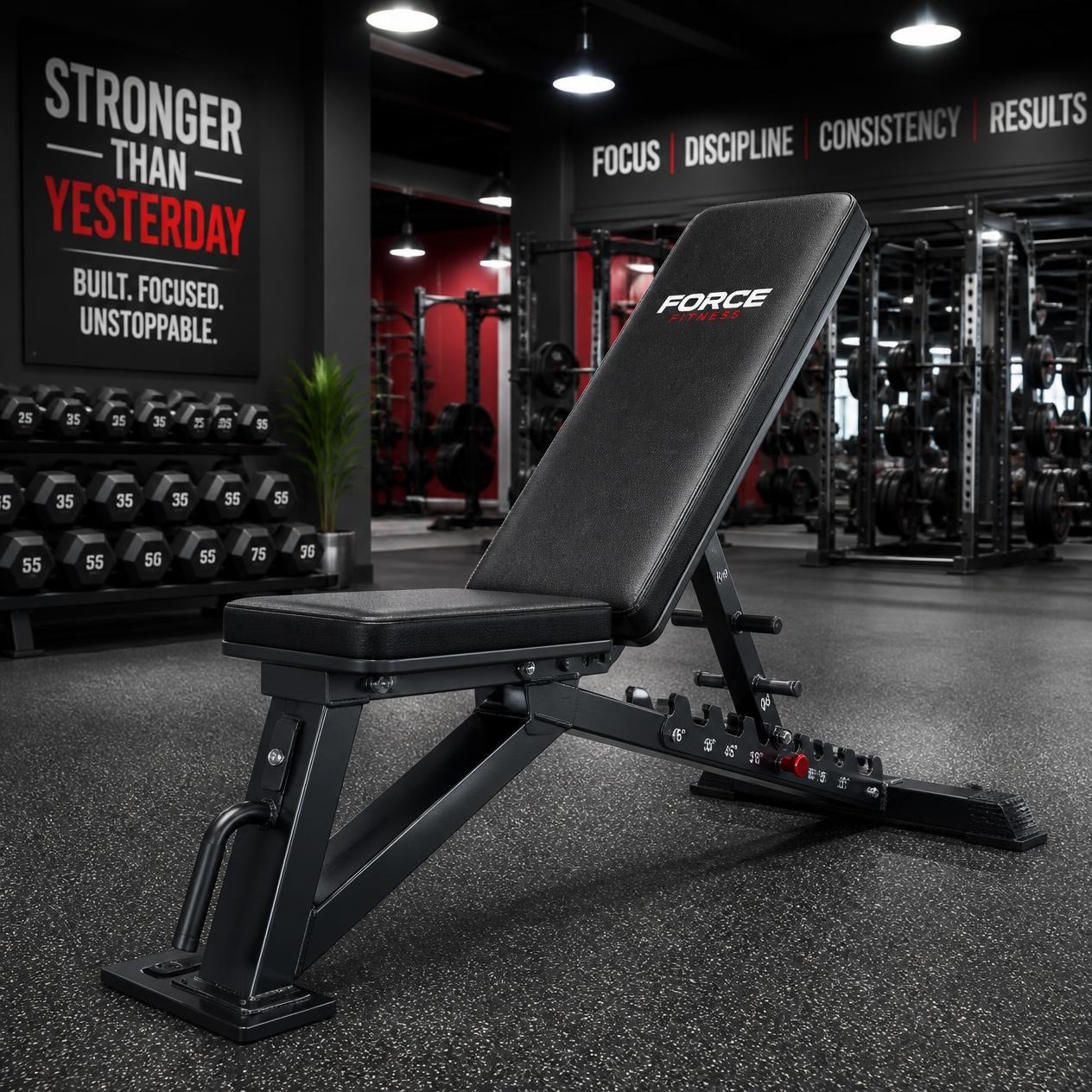
Gym adjustable bench: the 5 fundamental angles for hypertrophy
The gym adjustable bench represents one of the most versatile tools in any weight room, whether professional or dedicated to advanced home training. The ability to precisely modify the backrest incline allows you to vary muscle involvement, distribute loads differently, and build more effective training programs for hypertrophy development. However, there is still much confusion about which angles are truly useful and how to interpret them during programming.
Many athletes believe that setting a bench to 30 degrees always means getting the same stimulus, regardless of the model used. In reality, the quality of the adjustment mechanism, structural stability, and construction precision deeply affect the execution of the exercise. Even a minimal difference in the actual incline can change muscle fiber recruitment and influence comfort, safety, and the ability to develop strength.
For gym owners, personal trainers, and sports science students, understanding these aspects means being able to select better equipment and offer more effective workouts. In this guide, we analyze the five fundamental angles of the adjustable bench, their biomechanical impact, and why the precision of adjustment systems is a determining factor in choosing a professional bench.
- Why bench angles are important
- The five fundamental angles
- Why mechanical stability really matters
- The most common mistakes
- How to choose a professional bench
- Application in hypertrophy programming
- Benefits for gyms and fitness centers
- Investing in equipment quality
Why bench angles are important
The incline modifies the relationship between joints, the resistance vector, and muscle pull lines. This leads to a different distribution of work between the pectoralis major, anterior deltoid, triceps brachii, and stabilizer muscles. Changing just a few degrees can therefore significantly alter the perception of effort and the effectiveness of the training stimulus.
From a biomechanical point of view, there is no universally best angle. Each incline serves a precise goal: emphasizing the clavicular portion of the pectoral, improving joint safety, increasing the range of motion, or favoring better force expression. For this reason, professional adjustable benches offer numerous well-defined positions rather than a few approximate adjustments.
Biomechanics of movement
During a barbell or dumbbell press, the direction of the push relative to the torso directly influences muscle work. A progressive variation of the incline allows you to modify the relative contribution of different anatomical structures without completely changing the exercise.
Why every degree counts
Two benches stated to be at 30 degrees might not actually offer the same incline if the adjustment system has high tolerances. Construction precision therefore becomes a fundamental requirement to ensure training repeatability and consistent results over time.
The five fundamental angles
Complete hypertrophy programming benefits from the use of different inclines. Each position offers specific advantages and allows you to build richer sessions while avoiding excessive adaptation to the same motor pattern.
The goal is not to find the perfect angle, but to understand which incline to use in relation to the athlete's level, the chosen exercise, and the periodization phase.
0 degrees: the flat bench
The horizontal position remains the reference for developing general strength and the pectoralis major. It generally allows for the use of the highest loads while maintaining a stable and reproducible movement. The flat bench incline therefore represents the starting point for evaluating every other variant.
15 degrees: controlled transition
A slight incline reduces the involvement of the sternal portion of the pectoral and progressively increases that of the upper part, while still maintaining mechanics very similar to the traditional bench press.
30 degrees: the ideal compromise
For many trainers, it represents the best balance between clavicular head activation and limiting the work of the anterior deltoid. However, as mentioned, 30 nominal degrees do not always correspond to 30 real degrees: the quality of the adjustment becomes decisive.
45 degrees: greater shoulder involvement
Increasing the incline further progressively grows the contribution of the anterior deltoid. This position is applied especially in programs that want to integrate chest and shoulder work while maintaining a stable trajectory.
75-85 degrees: almost vertical
High inclines transform the bench into an ideal support for military presses with dumbbells, shoulder exercises, and numerous complementary variants, significantly expanding the equipment's versatility.
Why mechanical stability really matters
One of the most underestimated aspects concerns the quality of the adjustment system. During the execution of heavy exercises, any micro-movement of the backrest modifies the perception of stability and forces the body to increase the work of stabilizer muscles, reducing the efficiency of the technical gesture.
A structure designed with robust materials, precise hinges, and reliable locking systems maintains the set incline even after thousands of usage cycles. This is a fundamental requirement in high-traffic gyms.
Construction tolerances
Dimensional tolerances directly influence the precision of the incline. Carefully designed mechanisms reduce structural play, vibrations, and wear, ensuring constant performance over time.
Safety during training
A stable bench improves force transmission, increases the athlete's confidence, and reduces the risk of unwanted compensations, especially when using heavy loads.
The most common mistakes
Many users always use the same incline regardless of the training goal. This habit limits the variety of stimuli and can slow down progress in the medium term.
Another mistake is adjusting the bench based solely on visual perception, without knowing the actual incline or without verifying that the mechanism is completely locked before the exercise.
Training at the same angle always
Alternating inclines allows you to better distribute joint loads, involve different muscle groups, and make programming more complete.
Excessive loads without technical control
Increasing weight should not compromise execution. Precise adjustment facilitates maintaining the correct trajectory and improves the quality of repetitions.
How to choose a professional bench
Choosing an adjustable bench should consider much more than just the number of available inclines. Materials, weld quality, load capacity, ergonomics, and the precision of the adjustment system directly affect the longevity of the investment.
For a professional gym, it is advisable to look toward models designed for intensive use, capable of maintaining stability even during consecutive sessions with different users.
Essential features
High-strength steel frame, high-density padding, quick adjustments, transport wheels, and large load capacity are essential elements for a professional facility.
The importance of a specialized manufacturer
Relying on an experienced manufacturer allows you to obtain equipment designed specifically for the fitness sector. To explore the range of professional equipment, you can consult gym adjustable bench, evaluating solutions developed to ensure mechanical precision and long durability.
Application in hypertrophy programming
Integrating multiple inclines within the microcycle allows you to increase the variety of stimuli without completely changing the exercise selection. This strategy favors more complete muscle fiber recruitment and improves the overall quality of the program.
Different angles can be distributed between sessions dedicated to strength, metabolic hypertrophy, and accessory work, easily adapting to both beginners and advanced athletes.
Use of dumbbells
Adjustable bench exercises with dumbbells allow for greater joint freedom and more natural trajectory control, proving particularly effective in muscle development phases.
Programmed variability
Instead of constantly changing exercises, strategically modifying the incline allows you to obtain new stimuli while maintaining high technical quality of movement.
Benefits for gyms and fitness centers
A quality adjustable bench improves the user experience and expands the number of performable exercises while occupying a relatively small space. This helps maximize the profitability of the weight area.
Professional equipment also reduces maintenance interventions, downtime, and replacement costs, offering greater operational continuity even in high-traffic facilities.
Training experience
Intuitive, stable, and fast adjustment improves comfort during training and makes the transition between one exercise and another easier.
Longevity of the investment
Robust components and careful design ensure years of intensive use while maintaining operational precision and safety.
Investing in equipment quality
The choice of an adjustable bench should not be based solely on the initial price. Incline precision, mechanism quality, structural stability, and long-term reliability directly affect the value of the investment and user satisfaction.
Understanding the role of the five fundamental angles allows you to fully exploit the equipment's potential, program more effective workouts, and make the most of every available degree. For gyms and fitness centers, investing in a bench designed with high mechanical precision means offering a superior experience, improving training quality, and differentiating themselves through truly professional equipment.
Comments (0)