
Trolley
You have no items in your shopping cart

 Budgets
 Dumbers
 Discs
Discs
 Benches
 Racks and Rigs
 Weights Holders
 Isotonic machines
 Calisthenics
 Cardio
 Kettlebells
 Flooring
 Gym Set
 Accessories
 Combat
 ARTI MARZIALI
 CONTAINER GYM
 Tug-Of-War
 Used Gym Equipment
 PILATES MACCHINARI
 GINNASTICA ARTISTICA
 CAMPI DA PADEL
 Prodotti in Pronta Consegna
 Informazioni
 IRONMAN
 Gift Card
- Donatif
- General information
- 0 I like it
- 557 Views
- 0 comments
- gym flooring, safety flooring, gym safety, shock-absorbing materials
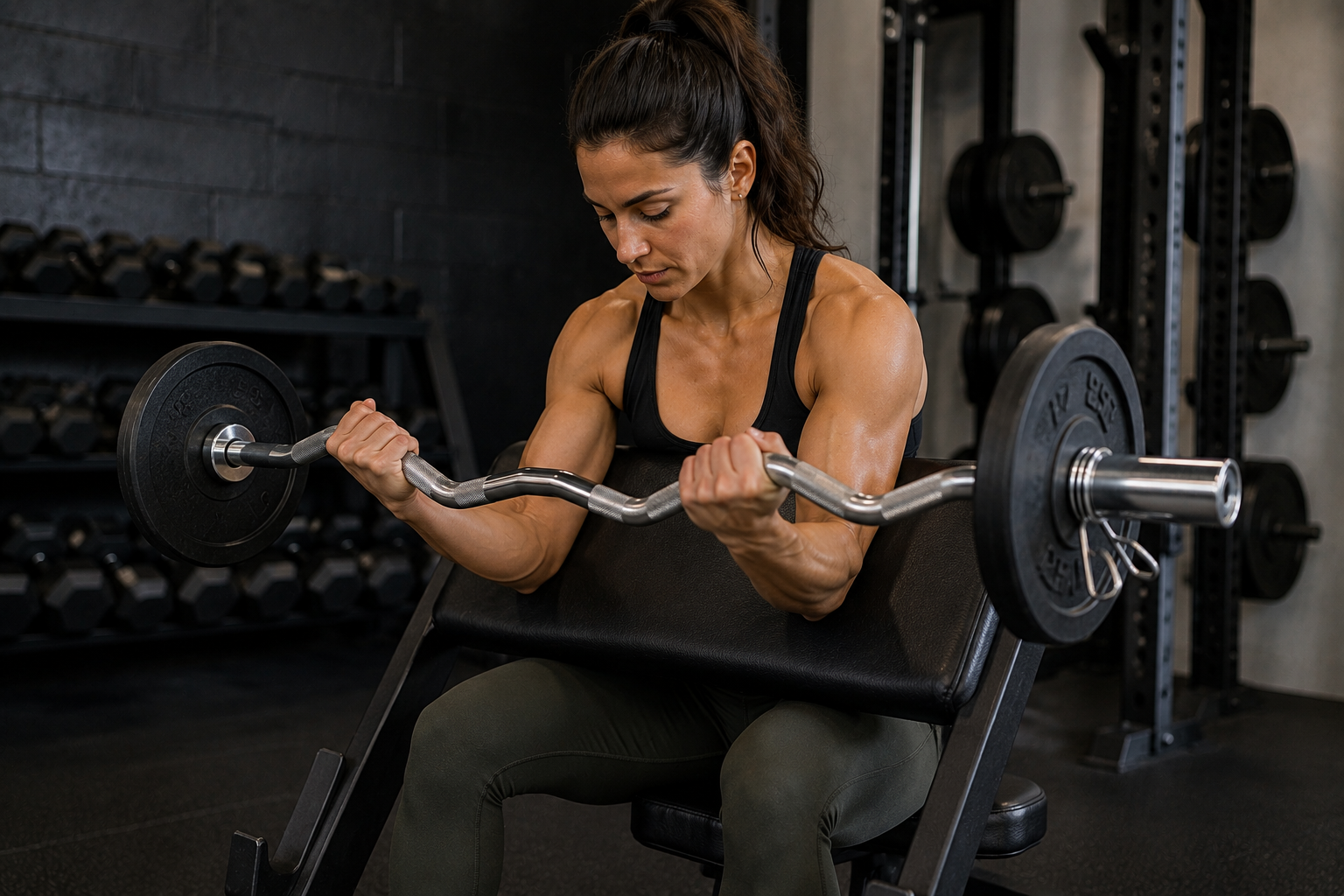
EZ Curl Bar vs. Straight Bar: When to use which?
When it comes to training biceps, triceps, and arm muscles, one of the most frequent questions concerns the choice between the straight bar and the curved bar, commonly called the EZ bar. Although both allow you to perform many of the same exercises, their geometry significantly alters hand position, muscle engagement, and joint stress on the wrists, elbows, and shoulders.
Understanding when to use a curved bar and when to prefer a straight model allows you to improve the quality of your training, increase comfort during execution, and reduce the risk of joint strain. The choice does not depend only on experience level, but also on individual mobility, goals, and the type of exercises performed.
In this guide, we will analyze the biomechanical differences between the two types of bars, the specific advantages of each solution, and the cases in which one is more effective than the other, helping you choose the most suitable equipment to develop strength and muscle mass without compromising joint health.
- Differences between the curved bar and the straight bar
- How movement biomechanics change
- The benefits of the EZ bar
- When to choose the straight bar
- The best exercises for each bar
- How to reduce stress on wrists and elbows
- The most common mistakes to avoid
- How to choose the most suitable bar
Differences between the curved bar and the straight bar
The main difference concerns the shape of the grip. The straight bar features a linear shaft that forces the hands to maintain a completely pronated or supinated grip. The EZ bar, on the other hand, uses a series of angles that allow for a more natural position of the wrists during the execution of exercises.
This seemingly simple modification significantly influences joint comfort and the engagement of certain muscle groups. Many athletes choose the EZ bar precisely to reduce the tension felt during isolation exercises.
Both tools are extremely effective, but they respond to different needs and can be used in a complementary way within the same training program.
The shape of the grip
The curves of the EZ bar allow you to keep your hands and wrists in a position between supination and a neutral grip, reducing forced rotation of the joints.
This makes execution more comfortable, especially for those with mobility limitations or previous joint discomfort.
Differences in muscle activation
The different angles slightly modify the work of the biceps, brachialis, and brachioradialis, influencing the distribution of effort during the exercise.
Although these are relatively small variations, they can be useful for diversifying training stimuli.
How movement biomechanics change
Hand position directly influences the path of the bar and joint mechanics. With a straight bar, the wrists remain fully rotated, a situation that some people tolerate without difficulty while others find uncomfortable during intense training.
The EZ bar instead allows for a more natural grip, reducing tension on the joints during the elbow flexion phase.
This feature makes the movement more fluid for many users, especially during exercises with numerous repetitions or high loads.
Engagement of elbows and forearms
A more natural grip often allows for better distribution of forces along the forearm, improving comfort during movement.
Individual response can still vary based on mobility and anatomical structure.
Importance of mobility
Those with good wrist and shoulder mobility can effectively use both types of bars, while those with limitations often tend to prefer the EZ model.
Evaluating your own physical characteristics helps you choose the most suitable equipment.
The benefits of the EZ bar
The main strength of the EZ bar consists of its ergonomics. The angled grip reduces stress on the joints while maintaining high effectiveness during exercises for biceps and triceps.
This solution is used by both beginners and advanced athletes who wish to train consistently while limiting joint discomfort.
Furthermore, the EZ bar allows for the introduction of new exercise variations that enrich training programming.
The main EZ bar benefits
Among the most appreciated advantages are a more comfortable grip, better tolerability during isolation exercises, and a feeling of greater naturalness in movements.
These aspects contribute to making the EZ bar a very popular choice in gyms.
Excellent for isolation exercises
The EZ bar is frequently used for curls, french presses, and tricep extensions, where comfort and movement control take on particular importance.
Its ergonomics facilitate the execution of high-volume sets.
When to choose the straight bar
The straight bar continues to represent a fundamental tool in strength and hypertrophy training. It offers a uniform grip and allows for the development of solid technique during numerous fundamental exercises.
Many athletes prefer the straight model for exercises in which they wish to maximize movement control and maintain a constant hand position.
The choice always depends on personal goals and the response of your own joints.
Strength development
The straight bar is commonly used in compound exercises and represents a standard in strength disciplines.
Even during curls, it remains an extremely effective solution for many users.
Maximum grip stability
The linear shape guarantees a uniform grip throughout the execution, a feature appreciated by those seeking very precise technique.
Training with both types expands programming possibilities.
The best exercises for each bar
Each type of bar finds its ideal application in specific exercises. Using them in a complementary way allows you to obtain a greater variety of stimuli and improve the overall quality of training.
The choice should always take into account personal comfort, technique, and program goals.
Alternating different grips also represents a valid method to avoid monotony and better distribute joint stress.
The best straight bar exercises
Traditional curls, rows, military presses, and numerous compound exercises are commonly performed with the straight bar thanks to its versatility.
The linear structure allows for very precise control of the movement.
When to use the EZ bar
French presses, EZ curls, and tricep variations represent some of the exercises in which the curved bar best expresses its ergonomic characteristics.
The angled grip improves comfort, especially in high-volume sets.
How to reduce stress on wrists and elbows
Joint comfort depends on numerous factors: technique, mobility, choice of equipment, and load progression. Using the correct bar is only one of the elements to consider.
It is important to avoid rapid weight increases and always maintain controlled technique throughout the entire movement.
Proper warm-up also helps prepare joints and muscles for more demanding exercises.
Managing wrist pain with barbell curls
If discomfort in the wrists appears during curls, it may be useful to experiment with a different grip or temporarily use the EZ bar, always maintaining correct technique.
If the pain persists, it is advisable to consult a qualified professional for a specific evaluation.
The importance of execution
Controlled movements, appropriate loads, and correct posture significantly reduce stress on the joints during isolation exercises.
The quality of execution remains the main prevention factor.
The most common mistakes to avoid
Many athletes choose the bar exclusively based on habits or gym availability, without evaluating which solution is actually more suitable for their physical characteristics.
Another mistake consists of using excessive loads while sacrificing technique, unnecessarily increasing joint stress.
Alternating the two tools and monitoring your own sensations allows you to achieve better results while maintaining high comfort during workouts.
Always using the same bar
Periodically varying equipment helps to diversify muscle stimuli and reduce repetitive overload on the same joint structures.
Balanced programming offers benefits for both strength and hypertrophy.
Neglecting technique
The choice of bar cannot compensate for incorrect execution. Movement control must always represent the priority during every exercise.
Accurate technique improves results and safety.
How to choose the most suitable bar
The choice between a curved bar and a straight bar depends on the type of training, the exercises performed, and individual characteristics. The EZ model generally offers greater joint comfort during isolation movements, while the straight bar remains a reference for versatility and strength development.
Integrating both solutions into your gym allows you to approach every exercise with the most suitable equipment. To compare models dedicated to strength and hypertrophy training, you can consult the range of professional Donatif bars, designed to meet the needs of home gyms and professional facilities.
Understanding the characteristics of each bar allows you to plan more effective workouts, improve comfort during execution, and develop strength and muscle mass with greater consistency over time.
Comments (0)