
Trolley
You have no items in your shopping cart

 Budgets
 Dumbers
 Discs
Discs
 Benches
 Racks and Rigs
 Weights Holders
 Isotonic machines
 Calisthenics
 Cardio
 Kettlebells
 Flooring
 Gym Set
 Accessories
 Combat
 ARTI MARZIALI
 CONTAINER GYM
 Tug-Of-War
 Used Gym Equipment
 PILATES MACCHINARI
 GINNASTICA ARTISTICA
 CAMPI DA PADEL
 Prodotti in Pronta Consegna
 Informazioni
 IRONMAN
 Gift Card
- Donatif
- General information
- 0 I like it
- 515 Views
- 0 comments
- gym flooring, safety flooring, gym safety, shock-absorbing materials
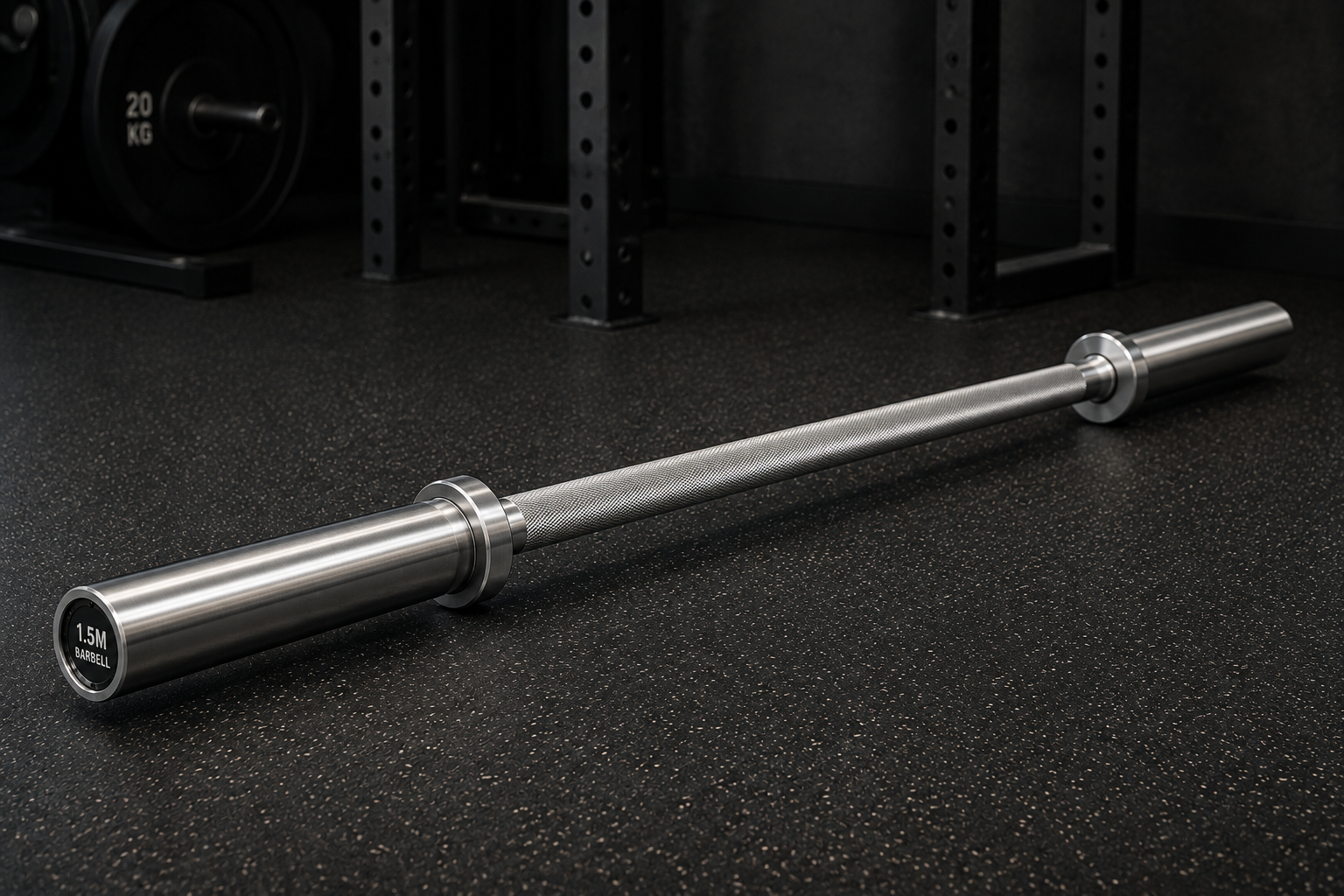
2-Meter or 1.5-Meter Barbell? A Guide to Sizes for Restricted Spaces
When designing a Home Gym, one of the most important decisions concerns the choice of gym barbell length. Many enthusiasts focus on the maximum supported weight or the quality of the steel, neglecting a fundamental aspect: the dimensions of the barbell must be compatible with the available space and the equipment used. A barbell that is too long can make movements difficult in small environments, while one that is too short could limit its use with standard racks and supports.
The choice between a 150 cm model and a 200 cm one does not depend solely on the room's surface area. It is also necessary to evaluate the width of the rack, the exercises you intend to perform, the amount of weight that will be loaded, and any future developments of your home gym. A correct decision allows you to train more safely, fluidly, and efficiently, avoiding purchases that could prove unsuitable after a few months.
In this guide, we analyze the main differences between barbells of different lengths, explaining when it is better to choose a compact model and when, instead, a traditional Olympic barbell represents the smartest investment for a Home Gym destined to grow over time.
- Why barbell length is important
- 150 cm vs 200 cm barbell
- Compatibility with racks and supports
- How to evaluate available space
- Impact on training performance
- How to choose the right barbell
- Thinking about future Home Gym developments
- Evaluating the best investment
Why barbell length is important
The length of the barbell directly affects the practicality of use, compatibility with the rack, and freedom of movement during exercises. A longer model generally offers more space for loading plates and better compatibility with professional equipment.
Conversely, a compact barbell allows you to train more easily in small rooms, garages, storage rooms, or multi-purpose areas where every available centimeter must be used carefully.
The ideal choice therefore arises from the balance between footprint, functionality, and the possibility of evolving your fitness area.
The actual footprint during exercises
In addition to the length of the barbell, it is important to consider the space needed to load the plates, move safely, and store the equipment when it is not being used.
Accurate planning avoids situations where the barbell hits walls, furniture, or other equipment during training.
Comfort and ease of use
A configuration proportional to the available space improves the training experience and makes the operations of mounting, unloading, and storing weights simpler.
This contributes to keeping the Home Gym tidy and functional.
150 cm vs 200 cm barbell
The comparison between a short barbell and a traditional one represents one of the most common doubts among those building a home gym. Both solutions have strengths and limitations that must be evaluated based on the intended use.
A 150 cm model favors compactness and ease of management, while a 200 cm one is closer to the standards of professional gyms.
The decision does not only concern the available space but also the exercises you wish to perform and the potential use of specific racks or supports.
When to choose a compact barbell
In the 150 cm vs 200 cm barbell comparison, the shorter model is particularly interesting for those who have limited environments and mainly perform exercises without a rack.
Greater maneuverability also facilitates transport and storage.
When the 2-meter model is better
The long barbell generally offers greater compatibility with professional equipment and more space for loading plates.
This feature becomes important for those who foresee a significant progression of loads over time.
Compatibility with racks and supports
One of the most important aspects concerns the correct resting of the barbell on the supports. A model that is too short might not be compatible with some standard racks, compromising safety and practicality.
Before purchasing, it is essential to check the distance between the rack uprights and compare it with the usable length of the barbell.
This simple check avoids errors that could make it impossible to use the equipment correctly.
Barbells for compact racks
Those who use a barbell for a narrow rack should carefully check the manufacturer's technical specifications to ensure full compatibility.
The dimensions of the rack are, in fact, a determining element in the choice of the model.
Why correct support is fundamental
An adequate support surface increases stability and safety during all phases of training.
A correctly supported barbell also facilitates the operations of loading and unloading plates.
How to evaluate available space
It is not enough to measure the length of the room. It is necessary to consider the space needed to move around the barbell, insert the plates, and perform the exercises without obstacles.
A well-designed Home Gym always leaves a safety margin around the main equipment.
Doors, windows, and furniture can also influence the choice of the most suitable length.
Measuring the environment correctly
Before purchasing, it is advisable to take all useful dimensions of the room, including any protrusions or structural elements.
Accurate planning reduces the risk of buying an impractical barbell.
Organizing the Home Gym
A rational arrangement of equipment improves comfort and safety during training.
Even small environments can become extremely functional with proper design.
Impact on training performance
The length of the barbell can also influence the quality of exercise execution. Using a tool compatible with your setup allows for more fluid movements and easier load management.
For those who perform fundamental exercises with a rack, compatibility plays an even more important role.
Well-dimensioned equipment also allows for a more natural progression over the years.
Barbell and flat bench
The flat bench barbell measurements must be evaluated by considering both the width of the bench and that of any lateral supports.
A correct configuration improves comfort and safety during the exercise.
Preparing for heavier loads
Those who plan to progressively increase weights should consider a solution that does not limit future developments.
Thinking ahead allows you to avoid premature replacements.
How to choose the right barbell
The choice should start with personal goals. A beginner who trains in a small space might prioritize practicality and limited footprint, while an athlete with a full rack might prefer a standard-sized barbell.
It is also important to evaluate build quality, sleeve diameter, load capacity, and compatibility with the plates you already own.
A well-considered purchase represents a reliable foundation for all future evolution of the Home Gym.
Do not consider only the price
The initial cost is only one of the elements to evaluate. Durability, versatility, and future usage possibilities weigh more heavily on the overall value of the investment.
A choice based exclusively on immediate savings can lead to additional costs in the long run.
Rely on a specialized retailer
Receiving technical guidance on the most suitable configuration allows you to avoid errors and purchase a barbell that is truly compatible with your space.
Qualified advice facilitates the choice, especially for those creating their first Home Gym.
Thinking about future Home Gym developments
Many enthusiasts start with a small fitness corner and progressively expand their equipment. For this reason, it is useful to evaluate not only current needs but also future ones.
A barbell compatible with any racks, benches, and additional accessories allows you to easily expand your home gym without having to replace the main elements.
Modularity is one of the factors that contributes most to the value of the investment over time.
A choice that grows with you
Purchasing equipment prepared for future expansions offers greater flexibility and reduces the need for new purchases.
This approach allows you to build a Home Gym in a gradual but consistent way.
Solutions designed for every space
To compare barbells of different sizes and configurations, you can consult the range of barbells and plates offered by Donatif, designed to adapt to both compact Home Gyms and more complete installations.
A conscious choice allows you to optimize space without sacrificing training quality.
Evaluating the best investment
The choice between a 150 cm barbell and a 200 cm one depends on the balance between available space, type of training, and growth prospects for your home gym. A compact model often represents the ideal solution for very small environments, while the standard format offers greater compatibility with professional racks and long-term usability.
Carefully analyzing room dimensions, equipment characteristics, and future goals allows you to make a truly effective purchase, avoiding compromises that could limit the quality of your workouts.
Investing in the correct barbell means building a Home Gym that is more functional, safe, and ready to accompany the evolution of your performance over time.
Comments (0)