
Trolley
You have no items in your shopping cart

 Budgets
 Dumbers
 Discs
Discs
 Benches
 Racks and Rigs
 Weights Holders
 Isotonic machines
 Calisthenics
 Cardio
 Kettlebells
 Flooring
 Gym Set
 Accessories
 Combat
 ARTI MARZIALI
 CONTAINER GYM
 Tug-Of-War
 Used Gym Equipment
 PILATES MACCHINARI
 GINNASTICA ARTISTICA
 CAMPI DA PADEL
 Prodotti in Pronta Consegna
 Informazioni
 IRONMAN
 Gift Card
- Donatif
- General information
- 0 I like it
- 9 Views
- 0 comments
- gym flooring, safety flooring, gym safety, shock-absorbing materials
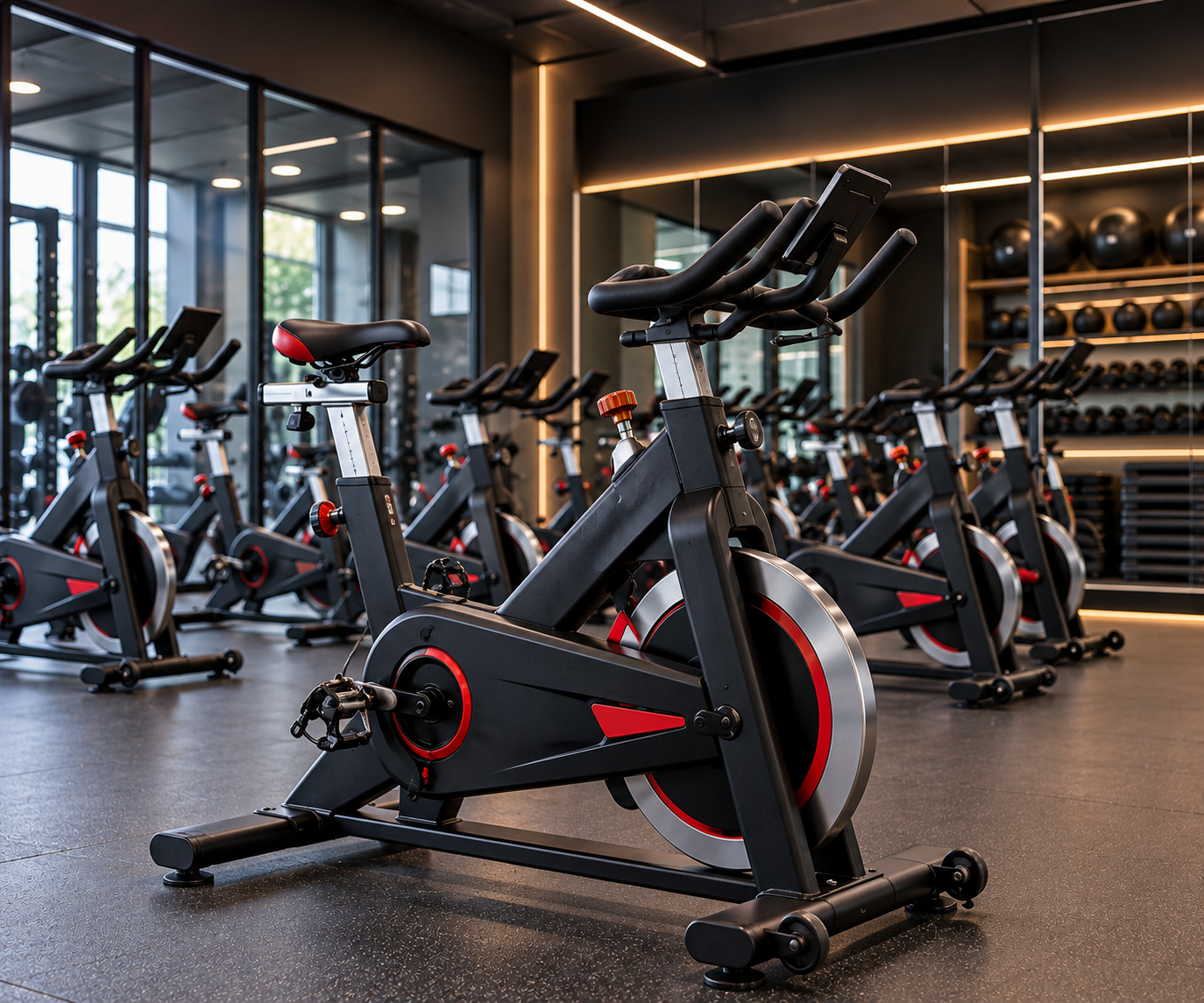
Indoor cycling vs spinning: differences, use and selection criteria
Indoor cycling and spinning are often used as synonyms, but they do not mean exactly the same thing. Indoor cycling is the generic term that identifies the discipline practiced on stationary bikes, while Spinning is a registered trademark that identifies a specific training program, dedicated equipment, and training courses for instructors. Understanding this distinction allows you to choose the activity and equipment using verifiable criteria while avoiding terminological confusion.
From a practical standpoint, both solutions involve cardiovascular workouts on bikes designed to simulate pedaling, but the term indoor cycling can be used to describe programs developed by different manufacturers or instructors, while Spinning exclusively identifies the method developed and marketed by its respective brand.
This guide analyzes differences, usage methods, selection criteria, safety aspects, and the most frequent errors. When applicable, it is appropriate to consult bike manuals, technical documentation from manufacturers, and official materials of the programs adopted by the gym, which represent the primary sources for adjustments, maintenance, and correct use.
- What is the difference between indoor cycling and spinning
- How they work
- When to choose one solution or the other
- What criteria to evaluate
- How to use the bike correctly
- Errors to avoid
- Safety and maintenance
- How to evaluate the choice
What is the difference between indoor cycling and spinning?
Indoor cycling identifies the discipline in a general sense. It includes workouts performed on stationary bikes with programs developed by different manufacturers, fitness centers, or instructors.
Spinning, on the other hand, is a registered trademark that identifies a specific training system with protocols, training, and equipment associated with the brand.
From the user's perspective, the experience may seem similar, but from a terminological standpoint, the distinction is important because one represents a discipline and the other a commercial brand.
Indoor cycling as a discipline
The term is used to describe any indoor bike training program regardless of the equipment manufacturer or the method adopted.
Spinning as a brand
The term Spinning should be used to refer to programs and equipment officially connected to the registered trademark.
How do indoor cycling and spinning work?
Both involve workouts on stationary bikes with resistance adjustment and rhythm variations during the session.
The practical methods depend on the program followed by the instructor and the configuration of the bike used.
Specific features must always be verified in the bike manufacturer's technical documentation and in the official materials of the adopted program.
Dedicated bikes
The bikes allow saddle and handlebar adjustments to adapt the position to the user's characteristics.
Conduct of the lesson
Sessions can be individual or organized as a group lesson guided by an instructor.
When to choose indoor cycling and when spinning?
From the perspective of physical activity, the choice depends primarily on the gym attended, the proposed method, and personal preferences.
Those who wish to participate in an official program can lean toward classes that use the Spinning brand, while those simply looking for indoor bike workouts can choose any indoor cycling program consistent with their goals.
The most important element remains the quality of teaching, programming, and bike configuration.
When to favor a structured program
An organized method with trained instructors and defined progressions can facilitate continuity and uniformity in lessons.
When indoor cycling is sufficient
For many users, the term indoor cycling already identifies all the activities necessary to perform an effective workout on a stationary bike.
What criteria to evaluate before choosing?
The decision should be based on practical and verifiable elements rather than just the class name.
It is useful to compare bike quality, instructor skills, class organization, schedule availability, and training goals.
Room comfort and equipment maintenance also affect the overall experience.
Summary comparison
1. Indoor cycling identifies the discipline.
2. Spinning identifies a registered trademark.
3. Both use dedicated bikes.
4. Both can include progressive workouts.
5. Quality also depends on instructors and equipment.
6. Bike adjustments remain fundamental.
7. Safety depends on the correct configuration of the station.
Evaluate the context
The choice should be consistent with personal experience, training goals, and the organization of the sports facility.
How to use the bike correctly?
Before starting each workout, it is necessary to adjust the saddle and handlebars according to the manufacturer's instructions.
Adjustments must be adapted to the user and verified before pedaling begins.
A correct position improves comfort and workout continuity.
Saddle adjustment
The saddle must be set using exclusively the systems provided by the bike manufacturer.
Handlebar adjustment
The handlebars must allow a stable and natural grip during all phases of the workout.
What errors should be avoided?
The most common mistake is considering indoor cycling and Spinning to be technically identical terms without distinguishing between discipline and brand.
Another critical issue involves starting the workout without correctly adjusting the bike or without adapting the resistance to one's capabilities.
It is also advisable to avoid unauthorized modifications to the equipment or the use of accessories incompatible with the installed model.
Confusing terminology
Understanding the distinction between discipline and brand helps to correctly interpret classes, programs, and technical documentation.
Neglecting technique
A correct bike configuration remains a priority regardless of the program followed.
What safety and maintenance aspects should be considered?
Bikes must undergo periodic checks following the maintenance plan provided by the manufacturer.
Before each use, it is advisable to check adjustments, structural stability, and the proper functioning of the resistance systems.
Regular surface cleaning also helps maintain the efficiency and longevity of the equipment.
Periodic checks
Preventive checks make it possible to promptly identify any anomalies before classes begin.
Manufacturer manuals
Manuals represent the main reference for adjustments, maintenance, and the correct use of the bikes.
How to evaluate the choice between indoor cycling and spinning?
For most users, the evaluation should focus on the quality of the bikes, room organization, instructor preparation, equipment maintenance, and the consistency of the program with personal goals. The simple name of the class alone does not represent a sufficient criterion.
To explore solutions dedicated to cardiovascular training, you can consult the cardio machines category, which is useful for comparing different types of equipment dedicated to fitness areas.
Before choosing a bike or designing a room, it is advisable to consult manuals, technical datasheets, and official manufacturer instructions, which represent the primary sources for configuration, adjustments, maintenance, and usage requirements. An approach based on verifiable criteria makes it possible to correctly evaluate both indoor cycling programs and classes that adopt the Spinning brand without confusing discipline, equipment, and commercial naming.
FAQ: Is Spinning a generic term?
No. Spinning is a registered trademark, while indoor cycling is the generic term that identifies the discipline.
FAQ: Is it possible to practice indoor cycling without participating in a Spinning class?
Yes. Indoor cycling includes numerous programs and training methods that do not necessarily refer to the Spinning brand.
Comments (0)