
Trolley
You have no items in your shopping cart

 Budgets
 Dumbers
 Discs
Discs
 Benches
 Racks and Rigs
 Weights Holders
 Isotonic machines
 Calisthenics
 Cardio
 Kettlebells
 Flooring
 Gym Set
 Accessories
 Combat
 ARTI MARZIALI
 CONTAINER GYM
 Tug-Of-War
 Used Gym Equipment
 PILATES MACCHINARI
 GINNASTICA ARTISTICA
 CAMPI DA PADEL
 Prodotti in Pronta Consegna
 Informazioni
 IRONMAN
 Gift Card
- Donatif
- General information
- 0 I like it
- 25 Views
- 0 comments
- gym flooring, safety flooring, gym safety, shock-absorbing materials
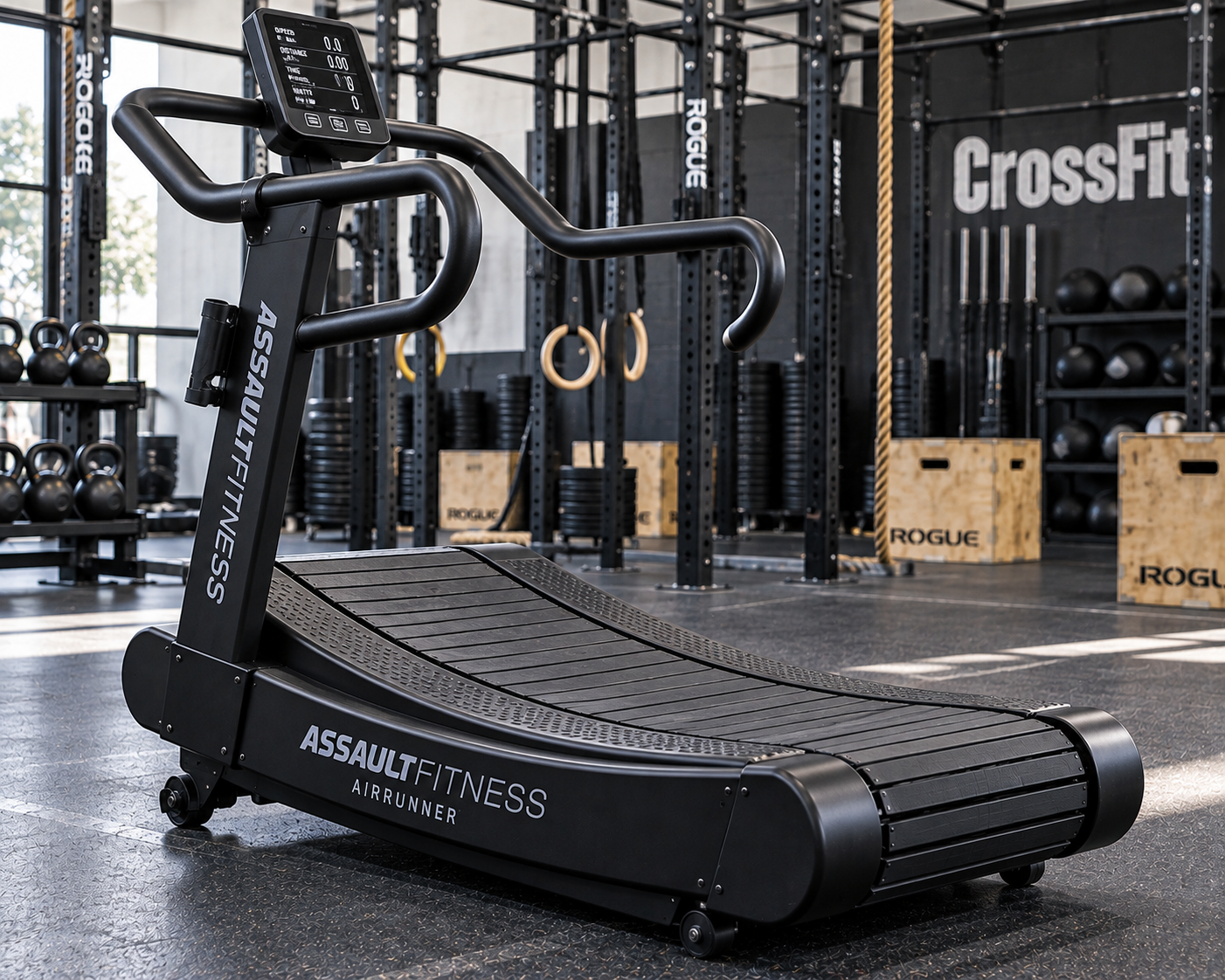
Curved treadmill for CrossFit boxes: selection and configuration criteria
The curved treadmill represents an increasingly widespread solution in CrossFit boxes thanks to the possibility of performing high-intensity workouts, sprints, metabolic work, and specific preparations without the use of an electric motor. However, designing the dedicated area requires careful evaluation of available space, workstation configuration, workflow, and scheduled maintenance.
A CrossFit box is characterized by dynamic activities, group workouts, and frequent exercise changes. For this reason, the positioning of the curved treadmill must facilitate athlete circulation, ensure safety during running, and allow efficient equipment management.
This guide gathers verifiable criteria for choosing and configuring a curved treadmill intended for a CrossFit box, analyzing space requirements, layout, configuration, maintenance, and main design errors to avoid.
- Quick answer
- What requirements the box must have
- How to organize space and layout
- How to configure the curved treadmill
- Safety and maintenance
- Design errors to avoid
- Comparison criteria
- How to evaluate the investment
How to choose a curved treadmill for a CrossFit box?
The choice should start from the analysis of the number of users, the type of workouts, and the space actually available. It is advisable to compare construction characteristics, technical documentation, availability of spare parts, assistance, and maintenance plan before purchase.
Effective design also considers the arrangement of other equipment present in the box and ease of access during workouts.
Evaluating the total cost of ownership allows for a more conscious choice compared to the initial price alone.
What is the first criterion?
The operational context of the box represents the starting point for defining configuration and number of workstations.
Why design before purchase?
Preventive planning allows integrating the treadmill with the rest of the functional area, avoiding subsequent modifications.
What requirements must a dedicated area have?
The zone destined for the curved treadmill should allow smooth movements before, during, and after training while keeping paths clear and easily accessible.
The characteristics of the running surface, curvature, and resistance system should be evaluated using the specifications declared by the manufacturer.
Consistent design facilitates the management of individual sessions and group workouts.
Why does accessibility matter?
An orderly arrangement improves athlete flow and facilitates coach work.
Why check adjustments?
Consulting technical documentation allows understanding the usage methods foreseen by the manufacturer.
How to organize space and layout?
The layout should provide adequate operating space around each machine and paths that do not interfere with other training stations.
The flooring must be stable and suitable for the intended context of use, following the manufacturer's indications for installation and support.
It is advisable to maintain an arrangement that favors supervision by coaches and rapid transition between exercises.
How much does space matter?
A well-organized space improves safety, comfort, and operational management of the box.
Why plan flows?
Reducing interference between different stations makes the execution of workouts more efficient.
How to configure the curved treadmill?
The configuration should be consistent with training objectives and the type of sessions planned.
During evaluation, it is useful to consider activities such as sprints and technical running, verifying the model's compatibility with the facility's training program.
To complete the conditioning-dedicated area, it is possible to integrate the treadmill with other professional cardio machines depending on the services offered.
Why is it used in CrossFit?
It can be inserted into different training protocols according to the facility's programming.
Is it suitable for Hyrox preparation?
Compatibility depends on the model's characteristics and the objectives of the sports programming.
How to manage safety and maintenance?
Scheduled maintenance helps keep the treadmill efficient and available during daily activities.
Checks should follow the manufacturer's instructions and include verifications of general status, components subject to wear, and correct operation.
Recording interventions facilitates maintenance planning over time.
Why set up a maintenance plan?
Preventive management reduces the risk of machine downtime and improves box organization.
Why check spare parts and assistance?
Availability of parts and technical support affect the operational continuity of the equipment.
Which design errors to avoid?
Among the most frequent errors are too compact an arrangement of workstations, failure to plan movement paths, and choosing equipment based exclusively on price.
It is also appropriate to avoid neglecting maintenance, technical documentation, and the intended use foreseen by the manufacturer.
Complete design simultaneously considers use, safety, and operational management.
Why avoid a congested layout?
A balanced arrangement facilitates training, safety, and supervision.
Why not evaluate only the initial cost?
The total cost includes maintenance, assistance, and operational continuity.
Which criteria to compare?
| Criterion | Why it is important |
|---|---|
| Curvature | Affects the running mode |
| Surface | Determines the available area for support |
| Resistance | Contributes to training modalities |
| Required space | Facilitates layout design |
| Maintenance | Affects operational continuity |
| Assistance and spare parts | Support management over time |
Why use a checklist?
It allows comparing different models using uniform and verifiable criteria.
What documents to request?
Technical sheets, manuals, warranty conditions, and maintenance information constitute the basis for an objective comparison.
How to evaluate the investment?
The choice of the curved treadmill should consider construction quality, technical documentation, maintenance, availability of spare parts, and compatibility with the CrossFit box's objectives.
A well-designed configuration improves workout management, facilitates staff work, and helps keep the conditioning-dedicated area efficient in the long term.
Comparing solutions using verifiable technical data and following the manufacturer's instructions represents the most reliable method for making an informed choice.
What is the first step in design?
Analyze available space, number of users, and planned training modalities before choosing equipment.
Which elements most impact management?
Layout, scheduled maintenance, assistance, availability of spare parts, and space organization are among the main aspects to consider.
Comments (0)