
Trolley
You have no items in your shopping cart

 Budgets
 Dumbers
 Discs
Discs
 Benches
 Racks and Rigs
 Weights Holders
 Isotonic machines
 Calisthenics
 Cardio
 Kettlebells
 Flooring
 Gym Set
 Accessories
 Combat
 ARTI MARZIALI
 CONTAINER GYM
 Tug-Of-War
 Used Gym Equipment
 PILATES MACCHINARI
 GINNASTICA ARTISTICA
 CAMPI DA PADEL
 Prodotti in Pronta Consegna
 Informazioni
 IRONMAN
 Gift Card
- Donatif
- General information
- 0 I like it
- 7 Views
- 0 comments
- gym flooring, safety flooring, gym safety, shock-absorbing materials
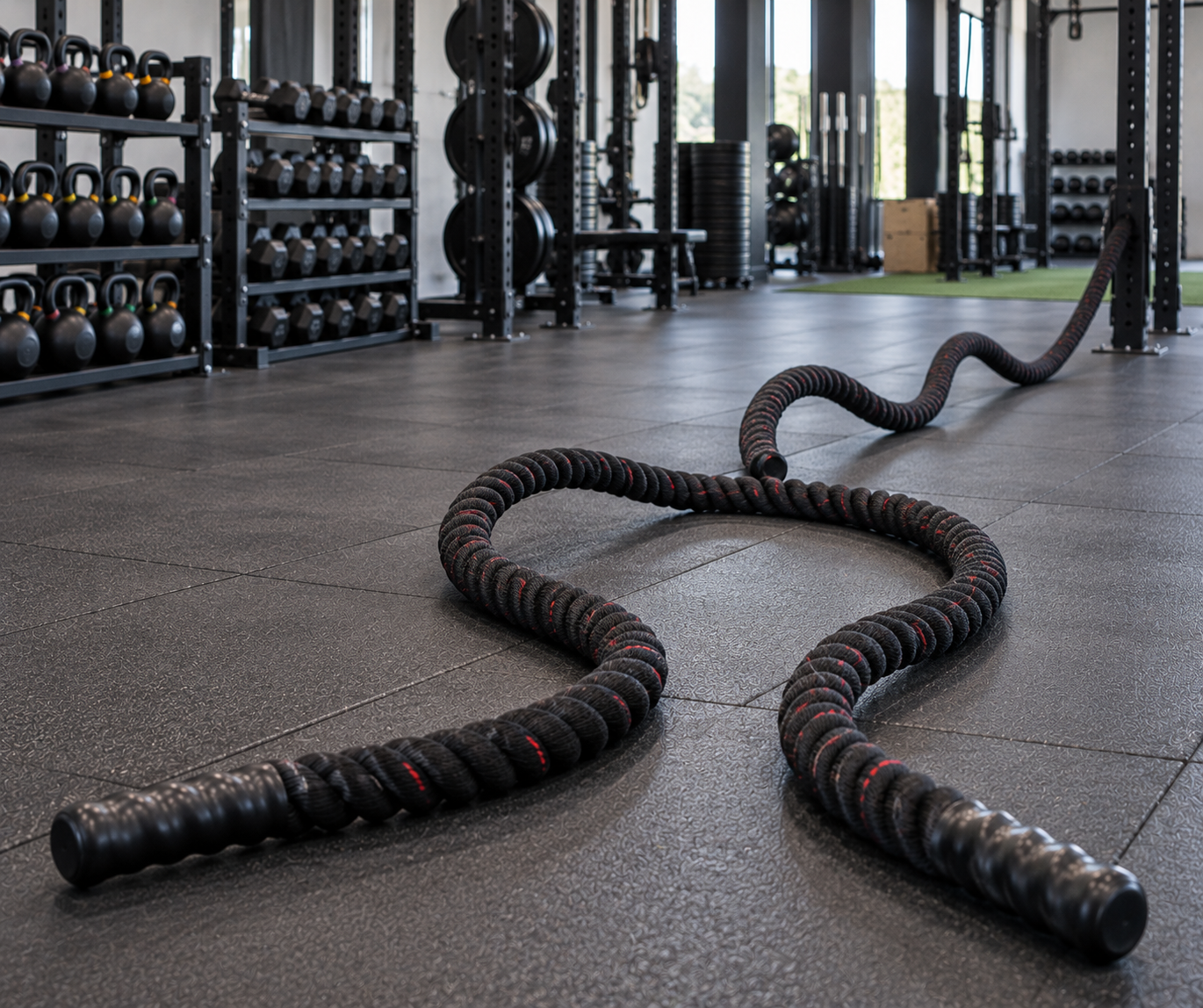
How to choose the length and diameter of the battle rope
The choice of the battle rope depends mainly on four factors: length, diameter, the user's experience level, and available space. A rope that is too long or too thick can make exercises excessively demanding, while a model that is too light might limit functional training progression.
For most users, a 9-meter battle rope represents the best compromise for individual workouts in home gyms and small studios. The 12-meter versions, on the other hand, are suitable when you want to increase the workload on the waves or when you have a larger dedicated space available.
Diameter also directly affects exercise intensity. Thinner ropes allow for faster and continuous movements, while larger diameter ones require a stronger grip and generate more demanding waves. Evaluating these aspects before purchase allows you to choose equipment that is truly suited to your goals.
- How to choose the length
- How to choose the diameter
- Comparison table
- How much space is needed
- Workout compatibility
- Mistakes to avoid
- FAQ
- How to evaluate the investment
How to choose the length of the battle rope
Length is the parameter that most affects the behavior of the rope during exercises. The greater the length, the greater the mass to be set in motion and the higher the effort required during wave generation.
The most common sizes are 9 and 12 meters. Both are designed to be anchored in the center, so each hand works on one half of the total length. This means that a 9-meter rope offers about 4.5 meters of work per side, while a 12-meter one reaches about 6 meters.
For those training individually, a length of 9 meters often represents the most balanced solution. The 12-meter versions find greater use in gyms, functional centers, and contexts where superior intensity is sought.
When to choose a 9-meter battle rope
A 9-meter battle rope is suitable for beginners, intermediate users, and facilities with limited space. It allows you to perform alternate waves, simultaneous waves, slams, and continuous movements while maintaining good technical quality.
When to choose a 12-meter battle rope
A 12-meter battle rope is indicated for experienced athletes and for those who wish to increase the load without changing the execution speed. The superior inertia makes every repetition more demanding and requires consolidated technique.
How to choose the diameter of the battle rope
Diameter influences the overall weight of the rope as well as the quality of the grip. A thicker rope requires greater strength in the forearms and hands throughout the duration of the exercise.
The most common diameters are about 38 mm and 50 mm. The first favors speed and control, while the second increases the muscular work of the grip and shoulders.
Before purchasing, it is useful to evaluate the level of the users and the training goals, avoiding choosing exclusively based on the declared weight.
Smaller diameters
Ropes with a smaller diameter are generally easier to grip and allow a high wave frequency. They are suitable for metabolic programs, circuits, and high-intensity workouts.
Larger diameters
Larger diameters increase the demand for grip strength and involve the upper limb muscles more. They are indicated for already trained users.
Comparison table
The following table summarizes the main selection criteria.
| Feature | 9 meters | 12 meters |
|---|---|---|
| Recommended level | Beginner and intermediate | Intermediate and expert |
| Required space | More compact | Larger |
| Wave intensity | Medium | High |
| Technical management | Simpler | More demanding |
| Typical use | Home gyms and studios | Gyms and functional training |
For diameter, it is possible to follow a similar logic: a smaller diameter favors speed and control, while a larger one increases the work required throughout the set.
How to interpret the comparison
The table does not identify an absolute best solution but helps to identify the rope most consistent with your technical level and the type of training planned.
Which criteria take priority
In case of doubt, it is preferable to consider in order the available space, the user's level, and only afterwards length and diameter.
How much space is needed to use a battle rope
Available space represents a criterion that is often underestimated. The rope must be able to stretch out completely without obstacles and allow safe execution of exercises.
In addition to the length of the rope, it is necessary to provide space for the anchor point and for the user's movements during the waves.
A stable surface also helps reduce rope wear during repeated use.
Importance of the surface
A gym flooring helps protect both the rope and the floor, improving equipment durability in areas dedicated to functional training.
Anchor point
The anchor point must be stable and designed to support the stresses generated by the exercises. It is important to periodically check the integrity of the fixing system.
Workout compatibility
The choice of the battle rope should be consistent with the planned training program. The needs of a metabolic circuit differ from those of work oriented toward strength endurance.
The rope can be included in programs that feature individual exercises, functional circuits, and high-intensity sessions.
It can also be combined with other tools such as slam balls and stations dedicated to conditioning work.
Functional circuits
In circuits, the speed of execution plays an important role. In these cases, a shorter rope or one with a smaller diameter can facilitate work continuity.
Strength endurance training
To increase muscular demand, long ropes with a larger diameter may be more suitable, provided they are compatible with the user's level.
Mistakes to avoid during purchase
One of the most common mistakes is choosing exclusively the heaviest model thinking it will automatically guarantee a better workout.
Another incorrect evaluation concerns the available space. Buying a rope that is too long without considering the usage area limits the quality of the workout.
Finally, it is important to check the coating of the ends, the quality of the finishes, and the compatibility with the intended anchoring system.
Evaluating only weight
Weight is only one of the elements to consider along with length, diameter, technique, and intended use.
Ignoring the technical level
A rope that is too demanding can compromise the quality of movement and make training progression less effective.
FAQ
Is a 9 or 12-meter battle rope better?
It depends on the user's level, the desired intensity, and the available space. In many contexts, a 9-meter rope represents the most versatile choice.
Does diameter affect difficulty?
Yes. A larger diameter generally requires a stronger grip and increases effort during exercises.
Is a lot of space needed?
The space must allow the rope to extend completely and allow the execution of waves without obstacles.
Is the battle rope suitable for beginners?
Yes, as long as a length and diameter consistent with the initial level are chosen and the wave technique is learned correctly.
How to evaluate the investment before purchase
The choice of the battle rope should be guided by verifiable criteria and not just price. User level, frequency of use, available space, and build quality allow you to identify the most suitable model without purchasing equipment that is oversized or limiting.
For gyms and professional studios, it can be useful to standardize a few configurations capable of satisfying different types of users, while for the home gym it is generally preferable to favor a versatile solution that allows progression over time without having to quickly replace the equipment.
Carefully evaluating length, diameter, anchor point, usage surface, and training goals allows you to make an informed choice and get the maximum return from the battle rope in the long run.
Comments (0)