
Trolley
You have no items in your shopping cart

 Budgets
 Dumbers
 Discs
Discs
 Benches
 Racks and Rigs
 Weights Holders
 Isotonic machines
 Calisthenics
 Cardio
 Kettlebells
 Flooring
 Gym Set
 Accessories
 Combat
 ARTI MARZIALI
 CONTAINER GYM
 Tug-Of-War
 Used Gym Equipment
 PILATES MACCHINARI
 GINNASTICA ARTISTICA
 CAMPI DA PADEL
 Prodotti in Pronta Consegna
 Informazioni
 IRONMAN
 Gift Card
- Donatif
- General information
- 0 I like it
- 521 Views
- 0 comments
- gym flooring, safety flooring, gym safety, shock-absorbing materials
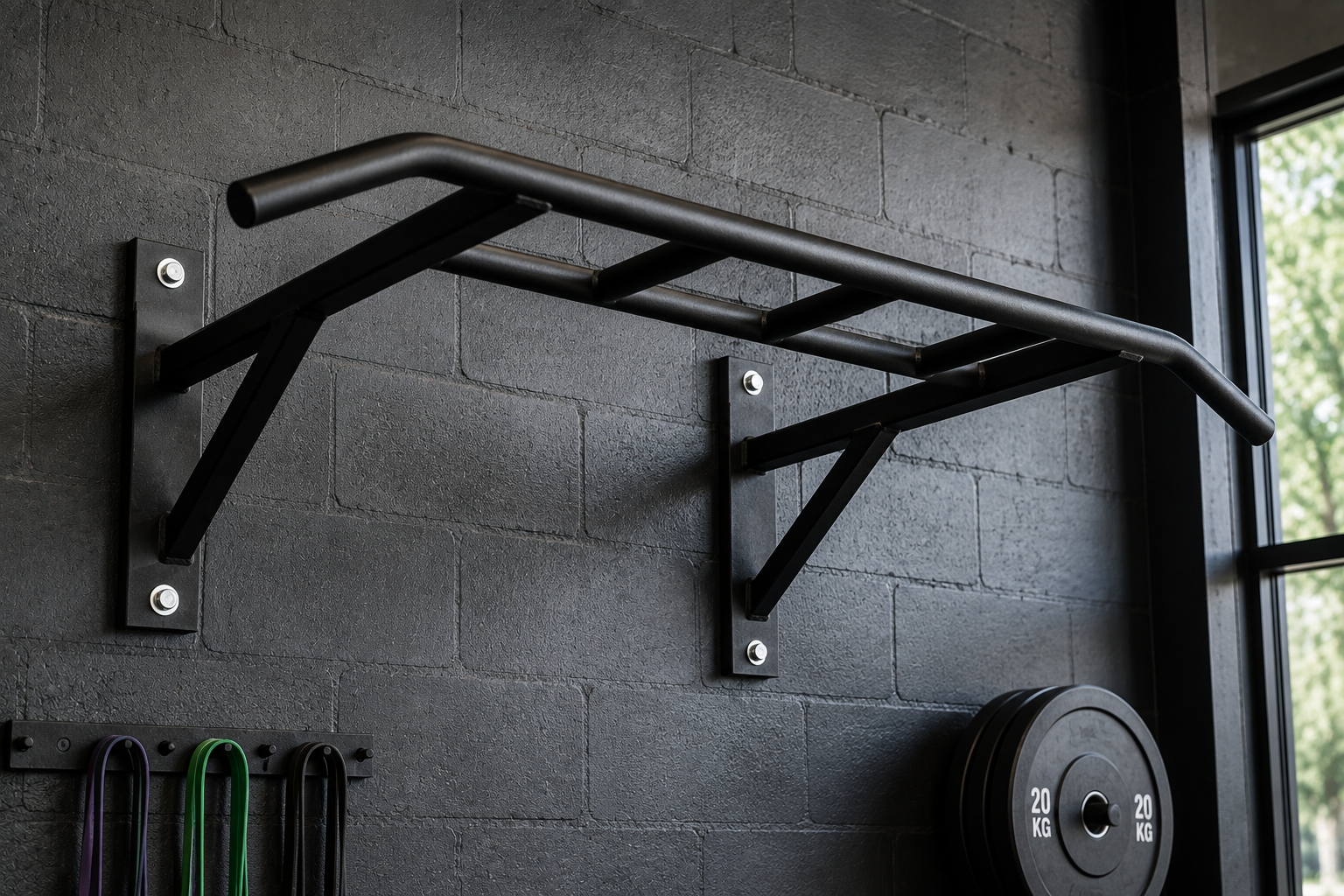
How to Install a Wall-Mounted Pull-Up Bar: Technical Guide for Zero Errors
Proper wall-mounted pull-up bar installation is the fundamental requirement for training safely and maximizing the potential of your equipment. Even the best professional bar can become unreliable if installed with inadequate fixings, on an unsuitable wall, or without following the manufacturer's technical instructions.
During a pull-up, the load applied to the structure does not simply correspond to body weight. Accelerations, explosive movements, oscillations, and changes in direction generate dynamic forces that can far exceed the user's static weight. For this reason, the quality of the installation is just as important as the quality of the bar itself.
In this guide, we analyze how to choose the most suitable wall, which fixings to use, how to determine the ideal height, and which errors to avoid to achieve a stable, safe installation designed to last over time.
- How to choose the correct wall
- Which anchors to use
- Ideal bar height
- Installation procedure
- Installation on different types of masonry
- Checks after assembly
- Errors to avoid
- Why proper installation is an investment
How to choose the correct wall
The first step consists of identifying a wall that is truly capable of supporting the loads generated during training. Not all masonry offers the same load-bearing capacity, and choosing the installation point without a preliminary check is one of the most frequent errors.
Reinforced concrete and solid brick walls generally constitute the most reliable solutions for installing a wall-mounted bar. They offer good mechanical resistance and allow you to make the most of the fixing systems provided by the manufacturer.
Hollow brick, stone, or other material masonry require a more careful evaluation and, in some cases, the use of specific anchoring systems designed to correctly distribute the loads.
Load-bearing and partition walls
Whenever possible, it is advisable to install the bar on a load-bearing wall, which is generally more resistant to the dynamic stresses generated during pull-ups, muscle-ups, and other intense exercises.
Evaluating available space
In addition to the wall's resistance, it is important to verify that there is sufficient space in front of the bar to perform all exercises safely without obstacles.
Which anchors to choose for a pull-up bar
Pull-up bar anchors represent one of the most important elements of the entire installation. Their function is to transfer loads from the structure to the masonry while keeping the connection stable even during intensive use.
The choice of fixing must be compatible with the wall material. Mechanical anchors, chemical anchors, and specific systems for hollow masonry offer different performance levels and must be selected based on the available support.
Using fixings that are not suitable for the type of masonry can significantly reduce the safety of the setup, even when the bar is built with high-quality materials.
When to use mechanical anchors
Expansion anchors are generally indicated for compact walls such as reinforced concrete and solid brick, where they can develop a high anchoring capacity.
When to prefer chemical anchors
In some applications, chemical systems allow for a more uniform distribution of the load and represent a particularly interesting solution for specific supports and professional installations.
What is the ideal height for a wall-mounted bar
The wall-mounted pull-up bar height directly affects the ease of use and the ability to correctly perform all the exercises provided in your training program.
A bar installed too low can limit the full extension of the body during the initial position of the pull-up, while an excessively high placement makes it difficult to reach the grip without additional supports.
The ideal height depends on the user's stature, the ceiling height, and the type of exercises you wish to perform. It is advisable to always provide sufficient space above the head and below the feet to allow for natural movement.
How to determine the correct position
Before drilling the wall, it is useful to simulate the position of the bar, verifying that the body can remain completely extended without touching the floor.
Installations for multiple users
When the bar is used by people of different heights, it is appropriate to find a compromise that guarantees comfort and safety for all users.
Step-by-step installation procedure
A correct pull-up bar installation requires precision, adequate tools, and compliance with the instructions provided by the structure's manufacturer.
After identifying the final position, it is necessary to accurately mark the drilling points, verifying the perfect leveling of the fixing plate. Imprecise drilling can compromise the alignment of the structure and make tightening the hardware more difficult.
Once the installation is complete, it is important to tighten all fixing elements according to the specified requirements, checking that the bar does not have any play or abnormal movements.
The necessary tools
A drill suitable for the type of masonry, correct drill bits, a level, tightening wrenches, and personal protective equipment allow you to work with greater precision and safety.
Tightening check
Uniform tightening of all fixing points helps to correctly distribute the stresses on the structure and the wall.
Installation on different types of masonry
Each material has different characteristics that require specific attention during assembly.
Solid brick walls generally offer excellent performance with correctly sized expansion anchors. Hollow brick masonry, on the other hand, requires systems designed to avoid breaking the internal chambers and to distribute the load over a wider surface.
Natural stone walls can have variable densities and require particular attention in choosing the fixing point and the anchoring depth.
Solid brick
It offers good load-bearing capacity and is among the most used supports for mounting professional bars when installed correctly.
Hollow brick and stone
They require specific fixings and an accurate evaluation of the masonry structure before final installation.
Checks after assembly
After completing the installation, it is fundamental to perform a series of checks before starting to train.
It is advisable to visually verify the correct tightening of all bolts, the absence of abnormal movements, and the perfect contact of the fixing plates against the wall.
Even during the normal life of the equipment, it is appropriate to perform periodic inspections to check the integrity of the hardware and the structure, especially after particularly intense workouts.
First load test
The first tests should be performed progressively, gradually increasing the load applied to the structure and verifying the absence of oscillations or abnormal noises.
Periodic checks
Regular inspection allows you to promptly identify any loosening or signs of wear, maintaining high safety standards.
The most common errors during assembly
One of the most frequent errors consists of underestimating the quality of the masonry, installing the bar on unsuitable supports without performing preliminary checks.
Another error concerns the use of anchors that are not compatible with the wall material or are smaller than those provided by the manufacturer.
Even incorrect positioning can compromise comfort during training, limiting the range of motion or making the use of the bar difficult.
Working without precise measurements
Accurate measurements and correct marking of the fixing points avoid errors that are difficult to correct once drilling is complete.
Saving on hardware
Using quality hardware and fixing systems is an essential component of the overall safety of the setup.
Why proper installation is an investment in safety
A professional bar expresses its full potential only when it is installed correctly. The choice of wall, fixings, and mounting position directly affects the stability of the structure and the quality of the training.
Devoting the necessary time to planning the installation allows you to reduce the risk of future problems, improve comfort during exercises, and increase the lifespan of the entire setup.
For those who wish to create a reliable station designed for years of intensive use, it is possible to consult the range of wall-mounted pull-up bar installations and related professional solutions available in the Donatif catalog, developed to offer construction quality, reliable components, and maximum safety in every home gym.
Comments (0)