
Trolley
You have no items in your shopping cart

 Budgets
 Dumbers
 Discs
Discs
 Benches
 Racks and Rigs
 Weights Holders
 Isotonic machines
 Calisthenics
 Cardio
 Kettlebells
 Flooring
 Gym Set
 Accessories
 Combat
 ARTI MARZIALI
 CONTAINER GYM
 Tug-Of-War
 Used Gym Equipment
 PILATES MACCHINARI
 GINNASTICA ARTISTICA
 CAMPI DA PADEL
 Prodotti in Pronta Consegna
 Informazioni
 IRONMAN
 Gift Card
- Donatif
- General information
- 0 I like it
- 469 Views
- 0 comments
- gym flooring, safety flooring, gym safety, shock-absorbing materials
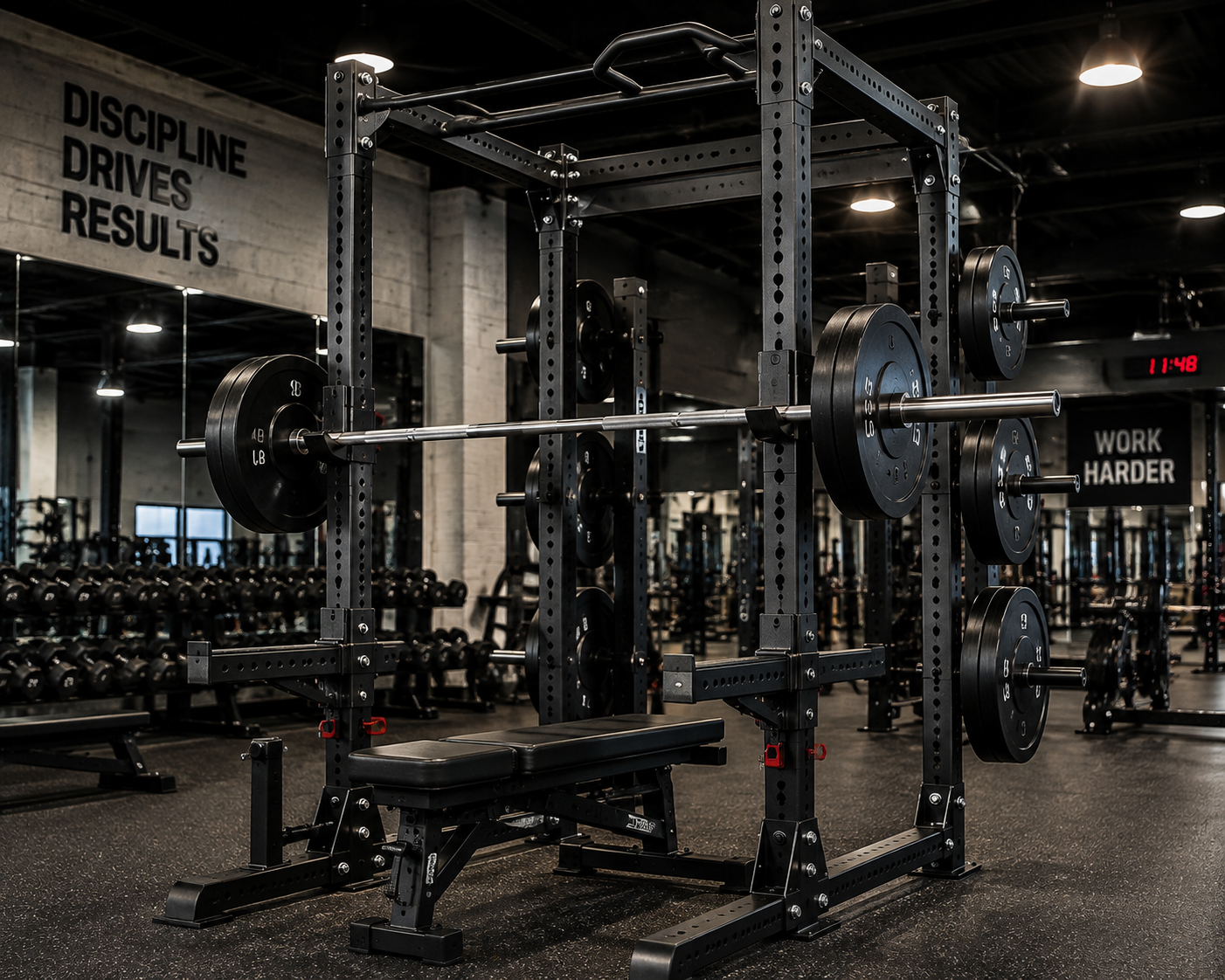
How to Maintain Your Rack: Cleaning, Tightening, and Weld Inspection
A rack represents one of the most important investments within a home gym or professional gym. It is the structure that supports the heaviest loads, accompanies thousands of repetitions over the years, and serves as the reference point for fundamental exercises like squats, bench press, military press, and pull-ups. For this very reason, dedicating a few minutes to periodic maintenance means preserving its safety, stability, and value over time.
Contrary to what many think, a powder-coated steel rack requires very little maintenance. Regular checks, proper cleaning, and verification of the most stressed points are enough to prevent wear, corrosion, and small problems that, if neglected, could compromise the reliability of the structure.
In this guide, we will analyze all the routine maintenance operations to be performed on gym racks, explaining how to properly clean painted steel, check tightenings and welds, prevent rust formation, and keep the rack efficient for many years of intense use.
- Why maintenance is important
- How to clean the rack correctly
- Checking bolts and tightenings
- Weld inspection
- How to prevent rust
- Scheduling periodic maintenance
- Errors to avoid
- Protecting your investment
Why maintenance is important
A rack is designed to withstand heavy loads and continuous use. During every workout, the structure is subjected to vibrations, impacts, twists, and stresses that, while within design specifications, can loosen some components over time or cause small surface marks.
Performing regular checks allows for the timely identification of any anomalies before they can turn into more serious problems. A slightly loose screw, for example, can be tightened in a few minutes, avoiding mechanical play that could increase as time passes.
Maintenance is not only for keeping the rack aesthetically pleasing, but it contributes above all to the user's safety, the durability of the structure, and the preservation of the equipment's value.
Safety comes first
Every periodic check reduces the risk of using a structure with loose or damaged components. Prevention is always the best choice when working with heavy loads.
Greater equipment durability
A correctly maintained rack retains its structural characteristics for longer, reducing the need for extraordinary interventions or premature replacements.
How to clean the rack correctly
Cleaning is the simplest intervention but also one of the most effective. Dust, sweat, chalk, and residue can accumulate over time, especially in areas of greatest contact like uprights, J-Cups, and safety systems.
For normal maintenance, it is sufficient to use a soft microfiber cloth slightly dampened with water or a non-aggressive neutral detergent. Afterward, it is important to dry the surface completely to avoid moisture stagnation.
Proper painted steel cleaning preserves the powder finish and keeps the rack aesthetically impeccable even after years of frequent use.
Which products to use
Neutral detergents are generally the best choice. Products containing aggressive solvents, ammonia, or abrasive substances can dull the paint and compromise the surface protection.
Clean the accessories too
J-Cups, spotter arms, pull-up bars, and plate storage supports must be included in the cleaning routine to ensure the correct functioning of all components.
Checking bolts and tightenings
Vibrations generated during training can, over time, cause a slight loosening of the hardware. For this reason, it is advisable to periodically verify the correct tightening of all mechanical connections.
The check must include uprights, crossbars, connection plates, and any element assembled using bolts. If abnormal play is found, it is appropriate to immediately restore the correct tightening by following the manufacturer's instructions.
This simple operation improves barbell rack safety, reduces unwanted vibrations, and helps keep the structure stable even during the most demanding workouts.
How often to check
In a home gym, a check every two or three months is generally sufficient, while in commercial gyms with intensive use, it is advisable to perform checks more frequently.
Use the correct tools
The use of appropriate wrenches avoids damaging nuts and bolts, ensuring uniform and secure tightening.
Weld inspection
Welds represent one of the most important structural elements of the rack. Although they are designed to last for many years, a simple periodic visual inspection allows you to verify that there are no anomalies.
It is sufficient to carefully observe the main joints looking for any cracks, deformations, or unusual surface alterations. Under normal conditions, these problems are extremely rare, but a preventive check only takes a few minutes.
If you notice suspicious signs or the structure has suffered exceptional impacts, it is advisable to temporarily stop using it and request a technical evaluation before continuing to train.
Visual inspection
Good lighting allows you to easily check the state of the welds without resorting to special tools.
When to ask for assistance
Any evident deformation or structural anomaly must be evaluated by qualified personnel before putting the rack back into service.
How to prevent rust
Modern powder coatings offer high protection against corrosion. However, constant humidity, poorly ventilated environments, or small deep scratches can promote the appearance of oxidation in the long term.
To avoid the formation of gym rack rust, it is important to keep the training room dry, quickly eliminate any water residue, and intervene promptly if you notice exposed spots on the surface.
Proper ventilation of the garage or gym also helps to limit environmental humidity and preserve the steel in optimal conditions.
Watch out for garages
Garages can be subject to strong temperature variations and condensation. Maintaining good ventilation significantly reduces the risk of corrosion.
Protect the paint
Small bumps are inevitable, but it is useful to periodically check for deep scratches to intervene before they can promote oxidation.
Scheduling periodic maintenance
Effective maintenance comes from regularity. Creating a simple checklist allows you to easily remember all essential checks without forgetting any details.
Operations can be divided into weekly, monthly, and quarterly checks, adapting the frequency to the number of workouts and the intensity of use of the structure.
Proper gym equipment maintenance does not require special technical skills, but only consistency and attention to detail.
Routine for home gyms
Cleaning after workouts, monthly visual checks, and checking tightenings every few months are generally sufficient for home use.
Routine for commercial gyms
In facilities with numerous users, it is advisable to increase the frequency of checks and maintain a log of the interventions performed.
Errors to avoid
One of the most common errors consists of using detergents that are too aggressive in an attempt to quickly remove dirt and chalk. These products can compromise the surface finish of the rack.
Another behavior to avoid is ignoring small mechanical play, thinking it is normal. Any variation from the original stability deserves an immediate check.
Finally, it is important not to modify the structure with drilling, additional welding, or incompatible components, as such interventions can alter the design characteristics and reduce the level of safety.
Avoid structural modifications
Any intervention not provided for by the manufacturer could compromise performance and invalidate any warranties.
Do not postpone checks
Small interventions performed promptly avoid more complex and expensive problems in the long term.
Protecting your investment
A quality rack is designed to accompany years of intense training. Dedicating a few minutes of periodic maintenance to it means preserving its performance, safety, and aesthetics without particular difficulty.
Proper cleaning, regular checks of bolts and welds, and a dry environment represent the best strategies to keep the structure efficient and reliable. These simple attentions contribute to reducing wear and ensuring an always safe training experience.
To learn more about the characteristics of professional structures and choose models designed to offer robustness and long life, you can consult the section dedicated to gym racks. Constant maintenance protects the value of the investment and allows you to continue training with maximum peace of mind for many years.
Comments (0)