
Trolley
You have no items in your shopping cart

 Budgets
 Dumbers
 Discs
Discs
 Benches
 Racks and Rigs
 Weights Holders
 Isotonic machines
 Calisthenics
 Cardio
 Kettlebells
 Flooring
 Gym Set
 Accessories
 Combat
 ARTI MARZIALI
 CONTAINER GYM
 Tug-Of-War
 Used Gym Equipment
 PILATES MACCHINARI
 GINNASTICA ARTISTICA
 CAMPI DA PADEL
 Prodotti in Pronta Consegna
 Informazioni
 IRONMAN
 Gift Card
- Donatif
- General information
- 0 I like it
- 428 Views
- 0 comments
- gym flooring, safety flooring, gym safety, shock-absorbing materials
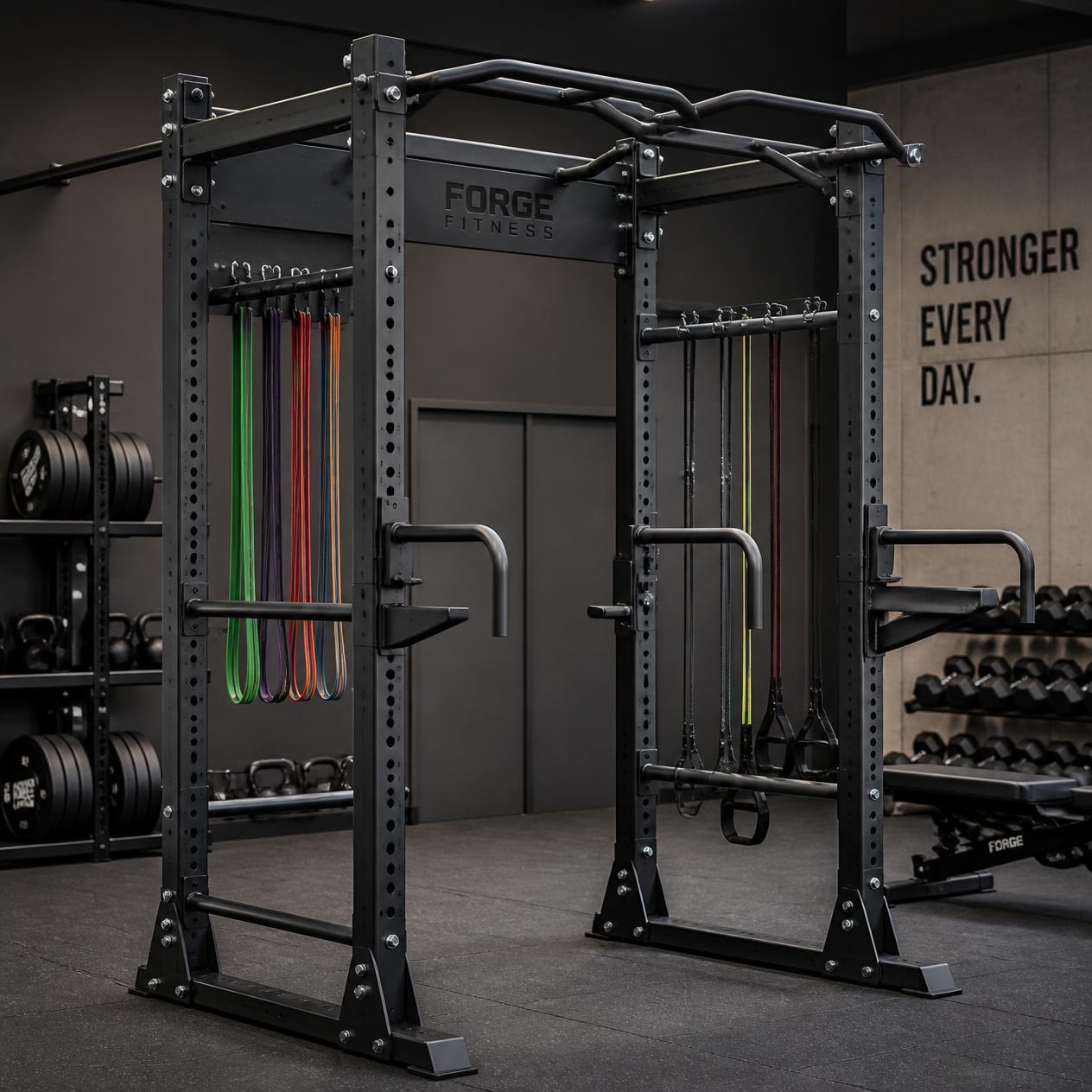
Configuring a Rack for Functional Training: Accessories and Layout
A modern power rack is no longer just a structure dedicated to squats, bench presses, and pull-ups. Thanks to the growing availability of functional training rack accessories, today it is possible to transform a traditional rack into the operational center of a complete gym, capable of supporting strength training, conditioning, mobility, and athletic preparation without having to purchase numerous separate machines.
For gym owners, functional boxes, personal training studios, and enthusiasts of advanced Home Gyms, modularity represents one of the most important criteria when choosing equipment. Investing in an expandable structure means being able to adapt your space to future needs, avoiding the need to completely replace the rack every time you want to introduce new types of training.
This guide explores how to configure a rack dedicated to functional training, which accessories to prioritize, how to design an efficient layout, and why upgrading an existing structure is often a smarter choice than purchasing new dedicated machines.
- Why choose a modular rack
- Essential accessories
- How to design the layout
- The importance of the landmine
- Dip station and pull-ups
- Organizing accessories
- Home Gym and gym applications
- Why it pays to upgrade your existing rack
Why choose a modular rack
The main advantage of a modular rack consists of the ability to adapt the structure to the user's needs without replacing the entire system. A well-designed configuration can evolve over time, moving from a simple station for squats and bench presses to a multifunctional system capable of supporting dozens of different exercises.
This approach allows you to distribute the investment in multiple phases, purchasing the accessories that are truly necessary and adding new components only when training goals change or the number of users increases.
From an economic point of view, modularity reduces waste and allows you to make the most of the rack you already have, avoiding taking up additional space with dedicated machines that perform only one function.
A structure that grows over time
Every added accessory expands training possibilities without modifying the main frame. This feature makes the rack an investment destined to maintain its value even in the years to come.
Optimizing the available budget
Gradually purchasing accessories allows you to better plan your spending, focusing initially on the elements that offer the best ratio between cost and the number of achievable exercises.
Essential accessories
The choice of accessories must be guided by the users' goals and the type of training proposed. However, some components represent an almost mandatory starting point for any configuration dedicated to functional training.
A modern rack can integrate systems for pull-ups, dips, barbell exercises, unilateral work, core training, and numerous functional variations without compromising the stability of the structure.
The important thing is to select accessories designed to be perfectly compatible with the frame, maintaining high safety standards even during dynamic exercises.
Pull-up bar
The pull-up bar is one of the fundamental elements. It allows you to perform pull-ups, preparatory muscle-ups, hanging leg raises, and numerous core control exercises.
Accessory storage supports
Storage for plates, barbell holders, and supports dedicated to kettlebells and resistance bands improve order, safety, and speed during training sessions.
How to design the layout
A good layout allows you to make the most of every square meter available without limiting freedom of movement. The position of the rack must ensure sufficient space for the use of the barbell, pulleys, kettlebells, and functional accessories.
It is necessary to provide areas dedicated to dynamic movements, paths free of obstacles, and a logical arrangement of equipment that reduces movement during circuits.
In compact Home Gyms, every centimeter is particularly important. Careful planning allows you to obtain an extremely complete gym even in relatively small environments.
The operational space
In addition to the footprint of the rack, it is necessary to consider the movement of the barbell, the use of the landmine, and the opening of the arms during exercises with resistance bands or rings.
Organizing training flows
In commercial gyms, an intelligent layout reduces downtime and facilitates the rotation of users between different workstations.
The role of the landmine
The landmine attachment is one of the most versatile accessories available for a modular rack. Through a simple pivot point, it allows you to perform presses, rows, squats, core rotations, lunges, and numerous variations used in athletic preparation.
Thanks to the guided but natural trajectory of the barbell, the landmine allows you to train strength, stability, and coordination with a very high level of safety, making it suitable for both beginners and advanced athletes.
Integrating the landmine significantly expands the number of available exercises without requiring significant additional space.
Practical applications
Unilateral presses, landmine rows, rotational presses, and split squats are just some of the possibilities offered by this accessory.
Why include it in the rack
Compared to numerous dedicated machines, the landmine offers an extraordinary variety of exercises with a contained investment and minimal footprint.
Dip station and pull-up bar
Among the most requested accessories is the dip station rack, essential for performing parallel bar dips, strength exercises for triceps and chest, and numerous bodyweight variations.
By combining a dip station and a pull-up bar, you get a complete station for developing relative strength, body control, and gymnastic skills without introducing additional structures.
The quality of the fixing system is fundamental so that the accessories maintain rigidity even during intensive use.
Bodyweight training
Dedicated stations allow you to easily integrate elements of calisthenics and functional training within the same structure.
Rigidity and stability
Precision-engineered accessories avoid unwanted oscillations, improving comfort and safety during every exercise.
Organizing accessories
A tidy gym improves not only the aesthetics but also the efficiency of the training. Properly storing plates, kettlebells, resistance bands, and small tools reduces exercise preparation time.
Dedicated supports allow you to keep the operational area around the rack free, reducing the risk of tripping and making it easier to clean the environment.
The presence of integrated storage systems also helps to preserve the equipment, limiting impacts and wear due to disorganized use.
Kettlebell supports
Placing kettlebells near the rack facilitates the creation of mixed circuits that combine barbell exercises and ballistic movements.
Plate management
Integrated plate holders improve ergonomics and speed during load changes, especially in superset sessions.
Applications for Home Gyms and gyms
The ideal configuration varies depending on the context. In an advanced Home Gym, the main goal is to maximize the variety of exercises while occupying as little space as possible.
For a commercial gym, on the other hand, modularity allows you to quickly adapt the rack to the different needs of users, offering strength training, functional training, and athletic preparation within the same area.
In both cases, gym rack customization represents one of the main advantages compared to completely fixed structures.
Domestic configuration
A targeted selection of accessories allows you to create a high-performance gym even in garages, basements, or dedicated rooms.
Professional configuration
In fitness centers, the ability to quickly modify the rack increases the profitability of the equipment and expands the services offered to customers.
Why it pays to upgrade your existing rack
Buying a new machine is not always the most cost-effective choice. In most cases, a modular rack you already have can be transformed into an extremely complete station simply by adding the accessories best suited to your needs.
This strategy allows you to make the most of the investment already made, reduce clutter, and build a gym destined to evolve over time without having to continuously replace equipment. To learn more about the possibilities offered by modular structures, you can consult functional training rack accessories, evaluating solutions designed to integrate new functions while maintaining high standards of quality and robustness.
The combination of modularity, intelligent design, and compatible accessories allows you to create an extremely versatile training environment, capable of satisfying both the needs of a professional Home Gym and those of a fitness center oriented toward functional training, without sacrificing safety, efficiency, and the possibility of future growth.
Comments (0)