
Trolley
You have no items in your shopping cart

 Budgets
 Dumbers
 Discs
Discs
 Benches
 Racks and Rigs
 Weights Holders
 Isotonic machines
 Calisthenics
 Cardio
 Kettlebells
 Flooring
 Gym Set
 Accessories
 Combat
 ARTI MARZIALI
 CONTAINER GYM
 Tug-Of-War
 Used Gym Equipment
 PILATES MACCHINARI
 GINNASTICA ARTISTICA
 CAMPI DA PADEL
 Prodotti in Pronta Consegna
 Informazioni
 IRONMAN
 Gift Card
- Donatif
- General information
- 0 I like it
- 11 Views
- 0 comments
- gym flooring, safety flooring, gym safety, shock-absorbing materials
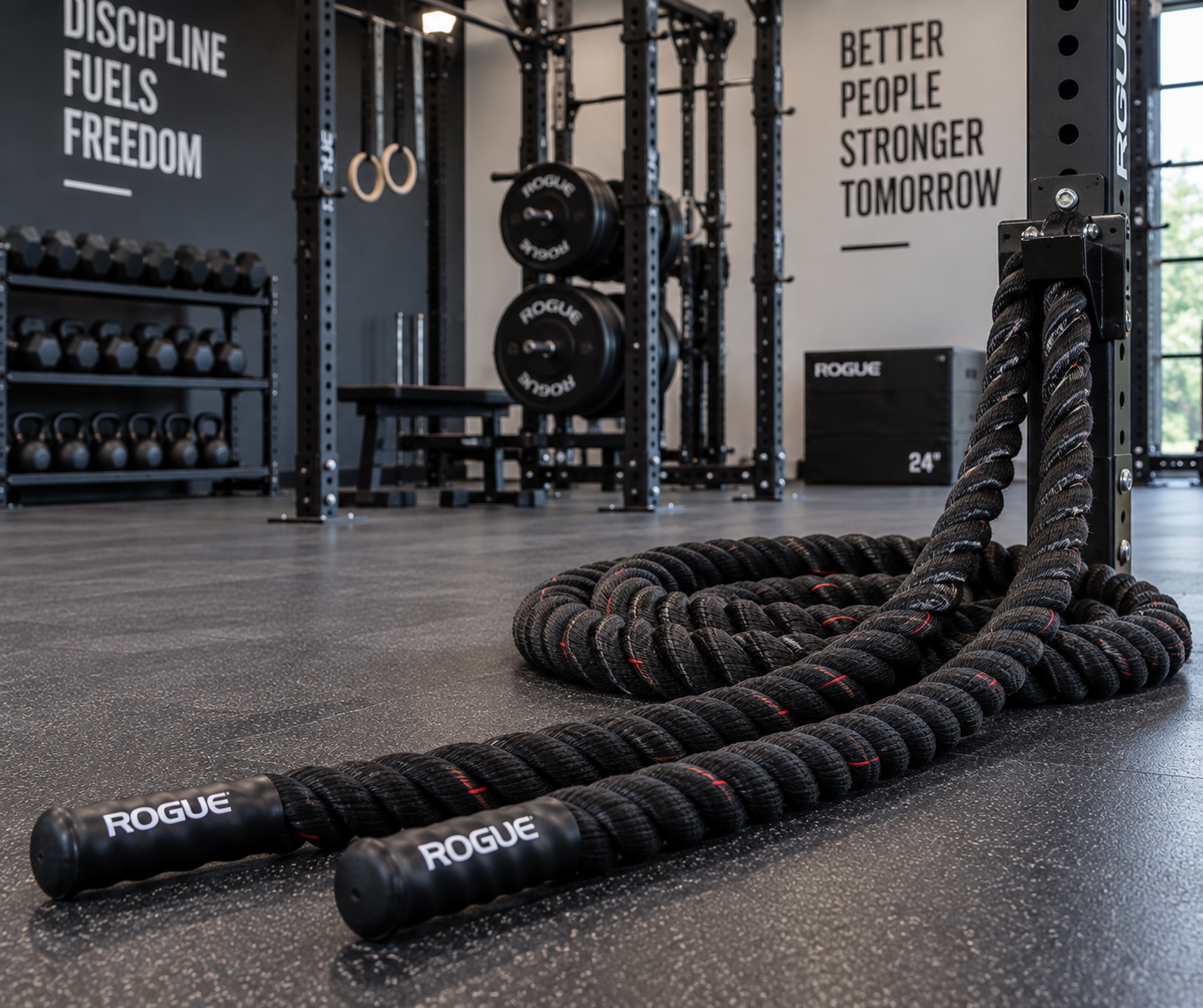
How much space is needed to use the battle rope
To correctly use a battle rope, you need a space proportional to the length of the rope, the anchoring system, and the type of exercises planned. A well-organized area allows you to perform waves safely, protects the rope from wear, and lets you integrate the station into a home gym or a professional gym without interference with other equipment.
The required space does not depend exclusively on the length of the battle rope. You must also consider the area occupied by the user during movements, the necessary margin to work without obstacles, and the presence of a stable anchor point. Proper planning prevents the rope from being dragged against walls, machinery, or other stations.
Before purchasing, it is therefore advisable to evaluate the available layout and verify that the area can accommodate both the rope and the user during all phases of the workout. This approach allows you to choose the most suitable model without compromising comfort and safety.
- Quick answer
- What the necessary space depends on
- How to organize the layout
- Comparison table
- Space in a home gym
- Space in a professional gym
- Mistakes to avoid
- FAQ
- How to plan space before buying
How much space is actually needed?
The necessary space must allow the rope to extend completely in front of the user and leave sufficient margins for executing waves. In addition to the length of the rope, it is important to consider the position of the anchor, freedom of movement, and the presence of other equipment nearby.
A correctly designed station improves workout quality and reduces the risk of accidental impacts with people or machinery.
When planning a new functional area, it is preferable to design the layout before choosing the final length of the rope.
Why space matters
An area that is too small limits the amplitude of the waves, makes technique more difficult, and accelerates rope wear due to continuous contact with surfaces and obstacles.
What elements to evaluate
The main criteria concern rope length, anchor point, free area, presence of other stations, and type of workout.
What does the necessary space depend on?
The length of the rope represents the first parameter to consider. A longer rope inevitably requires greater depth in the workout area.
The type of exercise also affects space organization. Some movements generate large waves, while others involve user displacement during the set.
Finally, you need to verify that the anchoring system is placed in a position that allows the rope to work in a straight line without deviations.
Influence of length
Longer ropes require a larger area to be used effectively and without movement limitations.
Influence of exercises
Individual exercises may require different configurations compared to circuits that integrate other workstations.
How to organize the station layout?
A station should be oriented so that the rope extends in a straight line relative to the anchor. This configuration facilitates wave control and reduces lateral friction.
It is advisable to keep passageways clear to avoid interference during multi-user sessions.
When multiple battle ropes are present, it is best to organize the stations regularly to simplify area management.
Anchor position
The fastening must be stable and easily accessible even during control and maintenance operations.
Path management
An orderly layout makes simultaneous use of stations simpler and improves overall safety.
Comparison table
This summary helps evaluate the main elements affecting space planning.
| Element | Impact on space | To verify |
|---|---|---|
| Rope length | Very high | Available area in front of the anchor |
| Diameter | Limited | Grip comfort |
| Configuration | High | Presence of other equipment |
| Workout | Variable | Planned movements |
| Flooring | Important | Protection against wear |
The table highlights how space availability depends on all design factors combined rather than a single parameter.
How to read the table
Elements with the greatest impact should be evaluated in the early stages of station design.
Order of priorities
It is advisable to first check the available layout and subsequently choose the length and diameter of the rope.
How much space is needed in a home gym?
In a home gym, it is often necessary to optimize every available meter. For this reason, it is best to plan an area dedicated exclusively to the battle rope.
The presence of walls, columns, or other equipment can limit freedom of movement and make the workout less effective.
A simple configuration also makes tidying up the equipment easier after each use.
Small spaces
In tighter environments, it is preferable to avoid configurations that force the rope to change direction during exercises.
Area organization
Keeping the work area clear improves comfort, safety, and workout continuity.
How much space is needed in a professional gym?
In gyms, sizing must account for the simultaneous presence of multiple users and the possibility of integrating the battle rope into functional circuits.
Effective planning facilitates instructors' work and improves flow management during peak hours.
Stations should be distributed avoiding overlaps between rope trajectories.
Integration with functional training
The battle rope can be paired with sled pushes, slam balls, and other stations as long as each exercise has its own operational area.
Importance of the surface
An anti-shock gym flooring helps protect both the floor and the rope during continuous use.
What mistakes are best avoided?
One of the most frequent mistakes is evaluating only the rope length without considering the user's movement.
Another critical issue concerns installing the station near passageways or equipment used simultaneously.
Choosing an unsuitable surface can also accelerate equipment wear.
Insufficient layout
A poorly organized space limits the quality of the waves and makes training more difficult.
Hard-to-reach anchor
An awkward position makes station inspection and maintenance operations more complex.
FAQ
Is a dedicated room needed?
No. An area that allows the rope to operate completely without obstacles is sufficient.
Does the space change based on rope length?
Yes. A longer rope requires a larger operational area.
Is it possible to use the battle rope outdoors?
Yes, as long as the anchor point is stable and the surface is suitable for the intended use.
Is flooring important?
Yes. An adequate surface helps limit wear on the rope and floor during workouts.
How to plan space before buying
Carefully evaluating available space allows you to choose a battle rope consistent with your training environment and planned goals. Preventive planning makes it easy to integrate the station into the existing layout and avoid subsequent modifications.
Both in home gyms and professional gyms, it is advisable to analyze rope length, station configuration, anchoring system, and surface characteristics together before proceeding with the purchase.
An approach based on verifiable criteria allows you to obtain a functional station, easily manageable and suitable for continuous use over time without compromising safety, comfort, and equipment durability.
Comments (0)