
Trolley
You have no items in your shopping cart

 Budgets
 Dumbers
 Discs
Discs
 Benches
 Racks and Rigs
 Weights Holders
 Isotonic machines
 Calisthenics
 Cardio
 Kettlebells
 Flooring
 Gym Set
 Accessories
 Combat
 ARTI MARZIALI
 CONTAINER GYM
 Tug-Of-War
 Used Gym Equipment
 PILATES MACCHINARI
 GINNASTICA ARTISTICA
 CAMPI DA PADEL
 Prodotti in Pronta Consegna
 Informazioni
 IRONMAN
 Gift Card
- Donatif
- General information
- 0 I like it
- 617 Views
- 0 comments
- gym flooring, safety flooring, gym safety, shock-absorbing materials
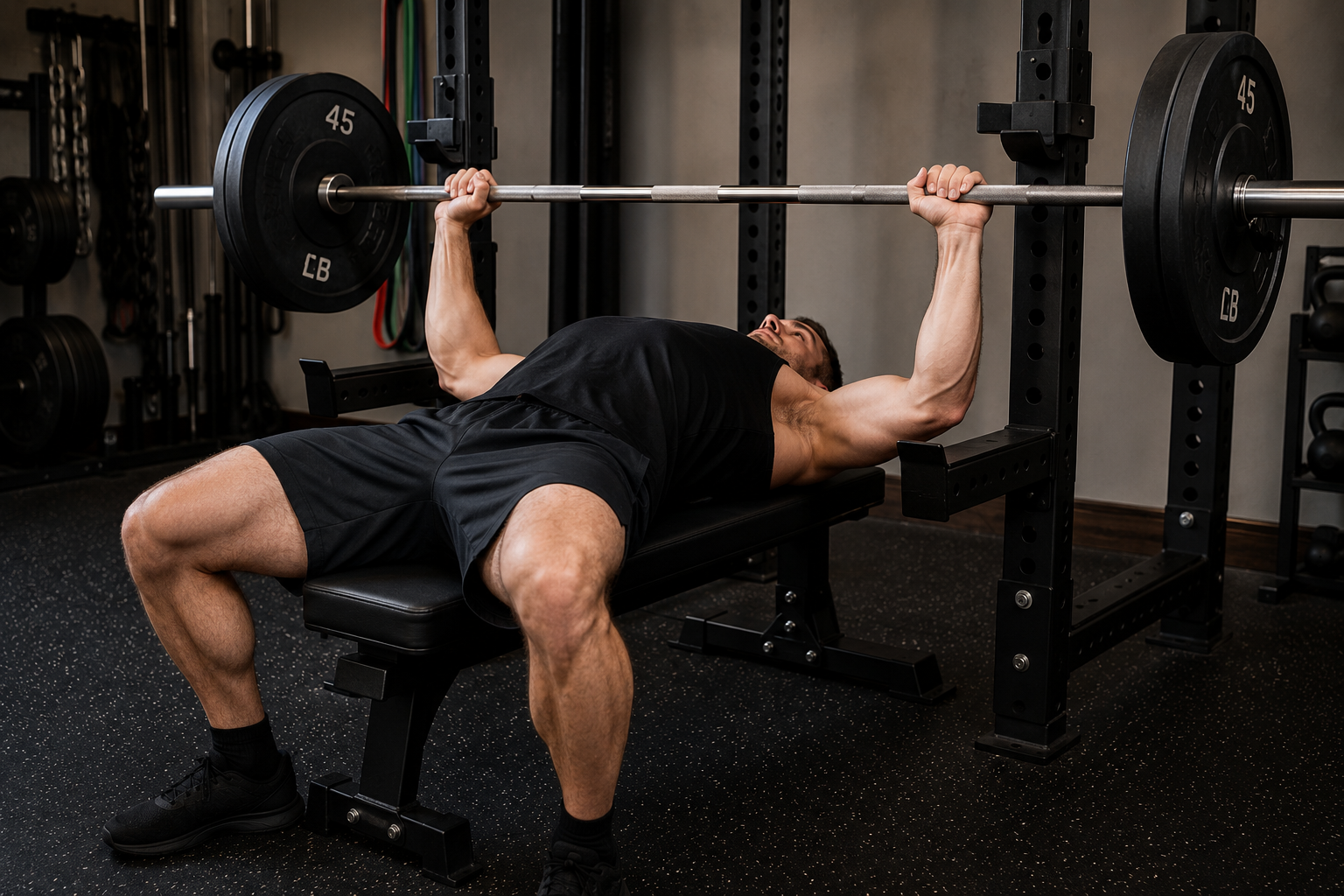
How much does a bench press barbell weigh? A guide to standard and Olympic models
When planning strength training, knowing the real weight of the barbell being used is essential for tracking progress correctly. In the bench press, in fact, the total load is not composed only of the plates loaded on the ends, but also of the weight of the barbell itself. Ignoring this value can lead to errors in recording results and evaluating improvements over time.
The bench press barbell weight can vary significantly based on the model chosen. A standard home gym barbell can weigh much less than a professional Olympic barbell used in gyms and strength competitions. Length, diameter, materials, and intended use also influence the final weight of the equipment.
Understanding the differences between 10 kg, 12 kg, 15 kg, and 20 kg barbells allows you to calculate the lifted load with precision and choose the equipment best suited to your needs. In this guide, we will analyze the main models, their empty weight, and how to account for them correctly during workouts.
- How much does a standard barbell weigh
- How much does an Olympic barbell weigh
- How length and diameter influence weight
- Why barbell weight matters in the bench press
- Differences between the main models
- How to correctly calculate the total load
- Common mistakes in counting weights
- Choosing the most suitable barbell
How much does a standard barbell weigh
Standard barbells are generally designed for home gyms, amateur training, and uses where extremely high loads are not required. Compared to Olympic models, they have smaller dimensions and a simpler structure, characteristics that directly influence the overall weight.
A standard barbell can have a variable weight based on length and construction. Shorter models can weigh about 10 kg, while longer and sturdier versions can reach around 12 or 15 kg.
For those training at home, it is therefore important to always check the product's technical data sheet instead of automatically assuming that every barbell has the same weight.
10 kg barbell
10 kg barbells are often associated with compact models intended for home workouts or for users starting a weight training journey.
The reduced weight makes the equipment easier to handle and allows you to focus on technique before progressively increasing the loads.
12 kg barbell
Models weighing about 12 kg represent a middle ground between lightweight and professional barbells.
They can be a good solution for those who want more stable equipment while maintaining dimensions suitable for home spaces.
How much does an Olympic barbell weigh
The Olympic barbell is the most widespread standard in professional gyms and strength disciplines. The most well-known model generally has a weight of 20 kg, a length of about 220 cm, and a sleeve diameter of 50 mm for the use of Olympic plates.
This type of barbell is designed to support high loads and withstand significant stress during exercises such as the bench press, squat, deadlift, and Olympic movements.
Its sturdier construction naturally entails a higher weight compared to standard models.
The 20 kg barbell
The 20 kg model is often considered the benchmark for strength training. Many training programs use this very weight as a base for calculating loads.
For example, a bench press with 100 kg of loaded plates corresponds to a total weight of about 120 kg if a 20 kg Olympic barbell is used.
Why the Olympic barbell is heavier
The greater mass comes from the quality of the materials, the greater length, the load capacity, and the components designed for intensive use.
The sturdier structure allows for better management of high loads.
How length and diameter influence weight
The weight of a barbell does not depend only on the material used, but also on its dimensions. A longer model requires a greater quantity of material and therefore tends to have a higher mass.
The diameter of the shaft and the sleeves also contributes to the weight difference between the various standards available on the market.
For this reason, two barbells with the same function can have very different characteristics.
The 150 cm barbell weight
150 cm barbells are generally more compact and are used in small spaces or for specific exercises. Their weight is often lower than complete Olympic models.
They are a practical solution when space is a significant limitation.
The 200 cm barbell weight
200 cm models represent an intermediate size very common in home gyms. They offer a good balance between maneuverability and load capacity.
The weight can vary depending on the construction and the standard used.
Why the barbell weight matters in the bench press
In the bench press, every detail of the load must be recorded correctly to monitor progress. Considering only the weight of the plates means underestimating the work actually performed.
This aspect becomes particularly important when following a structured program based on progressive load increases.
Precise recording allows you to compare workouts over time and evaluate improvements objectively.
Strength progression
Gradually increasing the weight lifted is one of the fundamental principles of strength training.
Knowing the actual weight of the barbell allows you to apply more precise progressions.
Training programming
Coaches and athletes often use precise values to set percentages of their one-rep max and plan sessions.
An error in counting can significantly change the intended intensity.
Differences between the main models
Not all barbells are designed for the same use. There are specific models for home gyms, powerlifting, Olympic weightlifting, and general training.
Each category has different characteristics in terms of weight, elasticity, load capacity, and rotation system.
Choosing the correct model means adapting the equipment to your training style.
Powerlifting barbells
Powerlifting barbells are generally designed to ensure rigidity and stability during exercises with very high loads.
The typical weight can be close to the 20 kg Olympic standard.
General fitness barbells
Models intended for general fitness can have lower weights to facilitate use by a wider range of users.
They are particularly common in home gyms.
How to correctly calculate the total load
Calculating the total weight on the bench is simple: you must add the weight of the barbell to the weight of the loaded plates. This rule applies regardless of the type of barbell used.
For example, with a 20 kg Olympic barbell and two 20 kg plates per side, the total weight will be 100 kg.
Knowing this formula avoids errors in recording workouts.
Calculating your one-rep max
When evaluating a one-rep max on the bench press, the weight of the barbell must always be included.
This allows for correct comparisons between different sessions and training programs.
Monitoring progress
Keeping track of the real load improves the quality of the programming and allows you to identify actual improvements.
Data precision is essential for every athlete.
Common mistakes in counting weights
One of the most frequent mistakes consists of considering only the loaded plates, completely forgetting the weight of the barbell.
Another mistake is assuming that all barbells have the same weight.
These inaccuracies can make workout monitoring less reliable.
Confusing standards
A lightweight standard barbell and a 20 kg Olympic barbell can significantly change the final result.
Always checking the model used is a good habit.
Not checking the specifications
The manufacturer's information represents the main reference for knowing the weight and characteristics of the equipment.
Careful reading avoids surprises during use.
Choosing the most suitable barbell
The choice of the ideal barbell depends on personal goals, available space, and training level. A beginner who trains occasionally may have different needs compared to an athlete who aims to constantly improve their strength.
Evaluating weight, length, standard, and build quality allows you to make a more informed investment.
To compare solutions suitable for different levels of use, you can consult the range of Donatif professional barbells, designed to offer reliability both in home gyms and fitness facilities.
Knowing the real weight of your barbell means training with greater precision, recording progress correctly, and building a strength journey based on reliable data.
Comments (0)