
Trolley
You have no items in your shopping cart

 Budgets
 Dumbers
 Discs
Discs
 Benches
 Racks and Rigs
 Weights Holders
 Isotonic machines
 Calisthenics
 Cardio
 Kettlebells
 Flooring
 Gym Set
 Accessories
 Combat
 ARTI MARZIALI
 CONTAINER GYM
 Tug-Of-War
 Used Gym Equipment
 PILATES MACCHINARI
 GINNASTICA ARTISTICA
 CAMPI DA PADEL
 Prodotti in Pronta Consegna
 Informazioni
 IRONMAN
 Gift Card
- Donatif
- General information
- 0 I like it
- 25 Views
- 0 comments
- gym flooring, safety flooring, gym safety, shock-absorbing materials
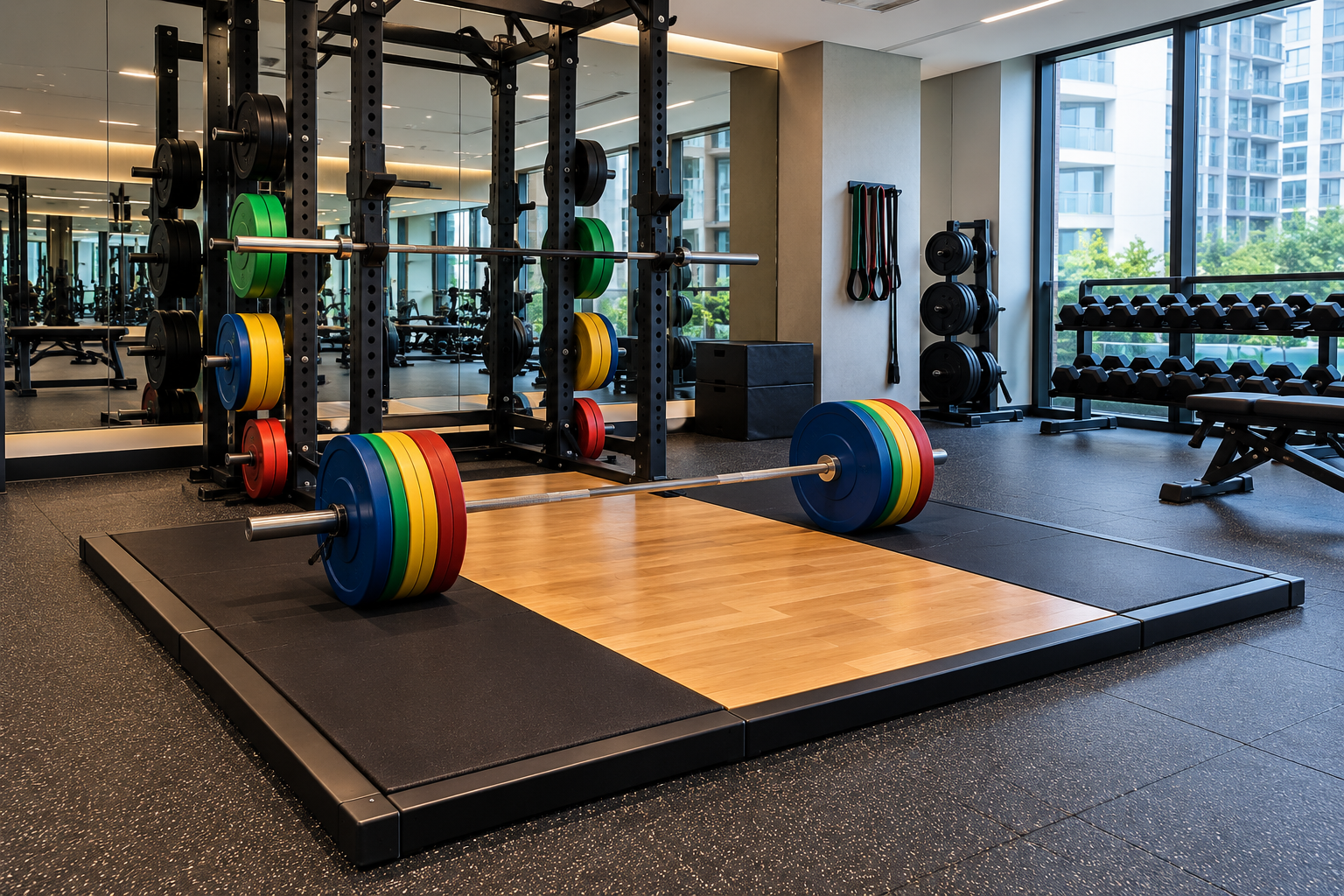
Weightlifting Platform Dimensions: How to Choose the Right Size
The dimensions of a lifting platform represent one of the most important aspects in designing a workstation dedicated to weightlifting. A platform that is too small can limit the execution of Olympic movements, while an oversized solution risks occupying precious space without offering real operational advantages.
The choice should not be based solely on the platform's measurements, but should also consider the surrounding free space, the weight room configuration, the presence of other equipment, and the type of training planned. Proper design improves the safety, comfort, and organization of the environment.
This guide illustrates the main technical criteria that help choose the most suitable dimensions for a weightlifting platform, avoiding design errors and correctly evaluating compatibility with the context of use.
- Quick answer
- Which dimensions really matter
- How to choose the correct size
- Compatibility with available space
- Materials and configuration
- Installation and positioning
- Purchase mistakes to avoid
- FAQ
- Evaluating the investment
What dimensions should a weightlifting platform have?
The dimensions of a lifting platform must be chosen considering the movements to be performed, the available space, the arrangement of other equipment, and the protection of the flooring. Rather than seeking a universal measurement, it is essential to design a workstation that guarantees freedom of movement, safety, and functionality.
Each installation should be evaluated in the specific context of the gym or home gym.
When applicable, it is advisable to consult the manufacturer's technical documentation and the guidelines of sports federations or standards used for training surfaces.
The discipline influences the choice
The needs of those who practice Olympic weightlifting differ from those who use the platform primarily for general strength exercises.
The surrounding space is part of the platform
The design must also include the free area necessary to load the barbell, move safely, and manage accessories.
Which characteristics matter more than just dimensions?
The platform measurements represent only one of the parameters to consider. Materials, structure, load-distribution capacity, and integration with the flooring directly affect overall performance.
The platform's construction system, the quality of the support surfaces, and compatibility with the subfloor also influence stability and durability over time.
For this reason, it is advisable to evaluate the entire project and not exclusively the length or width of the platform.
The platform structure
A balanced design helps maintain stability during exercises and correctly distribute loads on the flooring.
The work surface
The finish must guarantee adequate grip, wear resistance, and continuity during daily use.
How to choose the most suitable size?
The choice should start with the type of exercises performed most frequently, the number of users who will use the workstation, and the overall configuration of the weight room.
A professional gym with multiple stations requires a different organization compared to a home gym, where optimizing available space often represents the primary design criterion.
To find out about the main available solutions, you can consult the section dedicated to lifting platforms, which is useful for comparing different configurations intended for barbell training.
Planned movements
Exercises such as snatch, clean and jerk, or deadlift require a design consistent with the mechanics of the technical movement.
Number of users
In facilities with high traffic, it is advisable to organize the spaces so that each athlete can train without interfering with neighboring stations.
How to verify compatibility with available space?
The platform should not be evaluated in isolation, but together with the environment that will host it. Walkways, columns, racks, and other equipment influence the final configuration.
Proper design provides sufficient space for loading the barbell, for the athlete's movements, and for staff access during maintenance operations.
The height of the room can also be an element to verify in environments dedicated to Olympic movements.
Circulation paths
Passageways intended for users should remain separate from the operational area of the platform.
Layout integration
The arrangement of the stations should promote order, safety, and ease of supervision.
Which materials and configurations should be evaluated?
The materials used influence wear resistance, impact behavior, and the ease of maintenance of the platform.
The assembly system, the quality of the surfaces, and compatibility with the surrounding flooring also affect overall performance.
A well-designed configuration allows the platform to be integrated with the rest of the room while maintaining functional and aesthetic continuity.
Choice of materials
Materials should be selected based on the intensity of use and the characteristics of the environment.
Continuity with the flooring
The integration between the platform and the floor contributes to safety and practicality during workouts.
How to install the platform correctly?
Installation should be carried out on a stable, even subfloor compliant with the manufacturer's instructions.
The position of the platform must allow complete movements, access to accessories, and sufficient space for handling the barbell during all phases of training.
When high loads are expected, it is also advisable to verify compatibility with the building structure and the existing flooring system.
Subfloor preparation
An even foundation represents the basis for maintaining the stability and durability of the entire workstation.
Choice of positioning
The platform should be placed in an area that promotes safety, accessibility, and correct organization of the room.
Which purchase mistakes are best avoided?
One of the most common mistakes consists in choosing the platform exclusively based on its measurements without evaluating the context of use.
Another critical issue concerns the failure to analyze the available operational space and the weight room configuration.
It is also advisable to avoid neglecting materials, installation methods, and the characteristics of the existing flooring during the design phase.
Evaluating only the dimensions
Measurements must be interpreted together with the intended use, platform structure, and room organization.
Neglecting surrounding space
The functionality of the workstation also depends on the free area available for the athlete and for moving equipment.
Frequently asked questions
Is there a standard size valid for all platforms?
No. Dimensions should be defined based on the type of training, the gym configuration, and the manufacturer's instructions.
Do dimensions change between home gyms and professional gyms?
Yes. The available space and the number of users influence the workstation design and the choice of the platform.
Do accessories affect the design?
Yes. Plate racks, barbell supports, and other elements should be considered when planning the area to avoid clutter and facilitate the use of the platform.
Why evaluating dimensions correctly represents an investment?
A platform designed with dimensions consistent with the environment improves safety, facilitates room organization, and contributes to operational continuity during workouts.
Comparing technical documentation, construction characteristics, materials, and installation methods allows for a more conscious choice than simply evaluating price.
A complete design allows for the creation of an efficient workstation that is easily manageable and ready to adapt to the future evolution of the gym or home gym.
Comments (0)