
Trolley
You have no items in your shopping cart

 Budgets
 Dumbers
 Discs
 Benches
 Racks and Rigs
 Weights Holders
 Isotonic machines
 Calisthenics
 Cardio
 Kettlebells
 Flooring
 Gym Set
 Accessories
 Combat
 ARTI MARZIALI
 CONTAINER GYM
 Tug-Of-War
 Used Gym Equipment
 PILATES MACCHINARI
 GINNASTICA ARTISTICA
 CAMPI DA PADEL
 Prodotti in Pronta Consegna
 Informazioni
 IRONMAN
 Gift Card
- Donatif
- General information
- 0 I like it
- 50 Views
- 0 comments
- gym flooring, safety flooring, gym safety, shock-absorbing materials
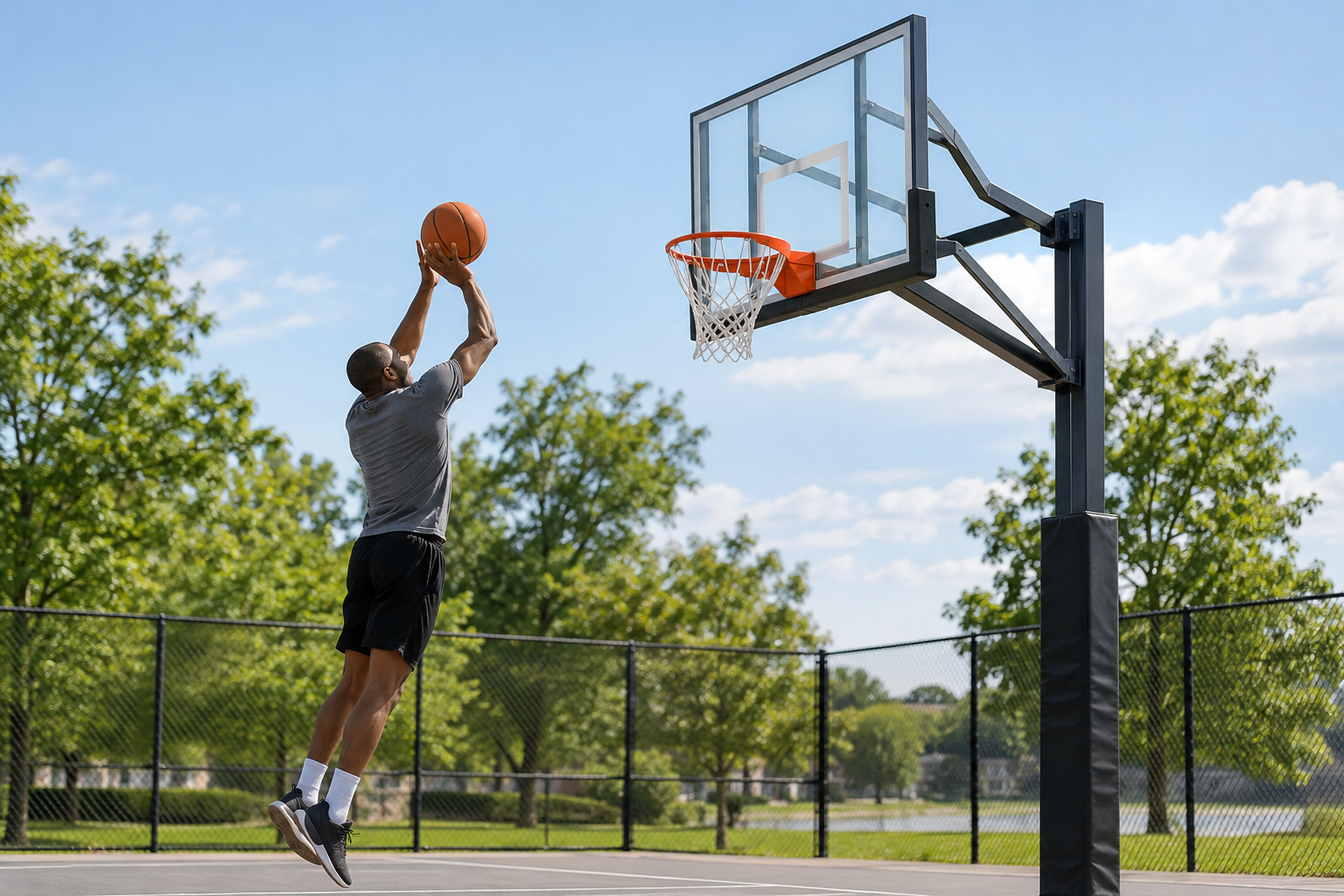
Regulatory dimensions of a basketball hoop: a practical guide for sports facilities
Knowing the regulatory dimensions of a basketball hoop is fundamental for designing a sports area that is functional, safe, and consistent with the needs of its users. For a gym manager, a purchasing officer, or a sports facility designer, the correct installation of the hoop requires attention not only to the height of the rim, but also to the backboard dimensions, the distance from the baseline, the structure's footprint, and the intended conditions of use.
Official measurements represent an essential technical reference, especially when the facility must host organized training, school activities, competitions, or athletic preparation programs. However, meeting the main dimensions does not automatically mean having an installation that complies with every federal requirement. One must also consider the equipment's construction features, protective padding, the stability of the supports, and safety clearances.
This guide analyzes the main dimensional specifications of the basketball hoop according to FIBA international standards, distinguishing official measurements from practical design criteria. The goal is to provide indications that can be used during technical evaluation, when requesting quotes, and when planning interventions, without being limited to a simple selection of products.
- Official measurements of the basketball hoop
- Regulatory backboard dimensions
- Positioning the hoop relative to the court
- Support structures and installation systems
- Safety and technical requirements of the facility
- Adapting measurements to users
- Dimensional checks and maintenance
- Investment criteria for a sports facility
Official measurements of the basketball hoop
The reference dimensions for international basketball are defined by FIBA through the official rules and equipment specifications. The best-known measurement is the height of the hoop, set at 3.05 meters from the playing floor to the top edge of the ring. This value constitutes the reference for standard competitions and allows for uniform playing conditions across different facilities.
The hoop, however, consists of more than just the ring. The system includes the rim, the net, the backboard, and a support structure that must keep these elements in the intended position even during use. The precision of the installation therefore depends on the correct geometric relationship between these components and the mechanical behavior of the entire system.
For a professional gym, it is advisable to distinguish the nominal measurements reported in commercial datasheets from the measurements effectively detectable after assembly. A product declared as regulatory must be installed on a properly leveled surface, with adequate supports, and following the manufacturer's instructions. Final compliance also depends on the context in which it is used.
Regulatory height of the rim
The official height of the top edge of the ring is 3,050 millimeters relative to the playing floor. The measurement must be taken vertically, taking the finished surface of the court as a reference and not any subflooring or levels prior to the installation of the flooring. This distinction is important in renovations, where adding a new coating can change the actual height.
In adjustable systems, the mechanism must allow for reaching and maintaining the expected position without unwanted movements. The mere presence of a numerical indicator does not replace instrumental verification of the height.
Diameter and characteristics of the ring
The regulatory internal diameter of the ring is between 450 and 459 millimeters according to FIBA specifications. The ring must be horizontal and fixed in such a way as to maintain the intended geometry. The choice of component also requires attention to the material cross-section, rigidity, and the possible presence of a breakaway mechanism under load.
The net must be compatible with the ring and allow the ball to pass through without abnormal obstructions. In professional contexts, wear-resistant materials and mounting systems designed for frequent use help to reduce replacement interventions.
Regulatory backboard dimensions
The backboard is an essential element of the game system, as it influences rebounds, close-range shots, and the visual perception of the hoop. In FIBA specifications, standard dimensions are 1,800 millimeters wide and 1,050 millimeters high. These dimensions constitute the reference for backboards intended for regulatory facilities.
The choice of backboard must also consider the construction material. In competitive contexts, transparent solutions conforming to applicable specifications are used, while for recreational or multipurpose environments, different materials may be adopted, provided they are appropriate for the use and requirements of the facility. Not all backboards marketed as professional necessarily possess the certifications required for every category of competition.
In addition to external dimensions, it is important to verify the correct positioning of the ring relative to the backboard surface. Any assembly errors can alter the distance of the rim from the vertical plane and change the behavior of the ball during shots.
Reference rectangle on the backboard
The rectangle drawn behind the ring provides a useful visual reference during the shot. According to FIBA specifications, it measures 590 millimeters in width and 450 millimeters in height, with lines of the width provided by the technical regulations. Its position must be consistent with that of the ring and with the overall geometry of the backboard.
During purchase, it is useful to verify that the markings are made with durable materials and maintain adequate contrast relative to the surface. The legibility of the lines becomes particularly important in environments with intense artificial lighting.
Materials, rigidity, and rebound behavior
The backboard material influences the ball's response, maintenance, and impact resistance. Transparent solutions for competitive use must meet specific requirements for mechanical behavior and safety. Panels intended for recreational activities may have different characteristics and should not be considered automatically equivalent.
A purchasing officer should request information on thickness, material type, mounting system, and permitted conditions of use. The presence of a sturdy frame and correctly designed connections helps preserve the alignment of the backboard over time.
Positioning the hoop relative to the court
Correct positioning of the hoop requires considering the court geometry and not just the height of the ring. A FIBA regulatory court measures 28 meters in length and 15 meters in width, measured according to the references provided by official rules. The placement of the backboards must be consistent with these dimensions and the markings on the playing surface.
The front face of the backboard is located 1.20 meters from the inner edge of the baseline, toward the center of the court. The central point of the ring is located approximately 1.575 meters from the inner edge of the same line, considering the expected distance between the backboard plane and the center of the rim. These figures allow one to understand the relationship between the hoop, the baseline, and the playing area.
During design, it is also necessary to consider obstacle-free zones, access spaces, and any support structures located beyond the court perimeter. The availability of a sufficiently large surface does not, by itself, guarantee that all safety distances are respected.
Distance from the baseline
The distance between the backboard and the baseline must be verified using the correct geometric reference. Measuring from the outer edge of the line, rather than the internal one provided, can introduce differences that compromise the installation's precision. For this reason, it is advisable to prepare a dimensioned drawing before assembly.
In existing facilities, verification must also include the position of the markings already present. If the court has been redesigned or resized, the hoop may no longer be correctly aligned.
Perimeter spaces and safety areas
FIBA rules provide for an obstacle-free space around the playing area, with requirements that must be verified in relation to the type of facility and the hosted competition. The general reference includes a strip of at least 2 meters beyond the boundary lines, without prejudice to the application of further relevant technical requirements.
A manager should evaluate the presence of walls, columns, seating, mobile storage, and other elements that may interfere with the athletes' trajectories. In multipurpose projects, it is important to verify that equipment used for other disciplines does not reduce the spaces necessary during basketball activities.
Support structures and installation systems
The support system determines the stability of the hoop and conditions the organization of the spaces. The main configurations include freestanding mobile structures, wall-mounted installations, and systems suspended or anchored to structural elements of the building. Each solution presents different requirements in terms of footprint, load distribution, accessibility, and maintenance.
The choice should not depend exclusively on initial economic availability. A compact structure may be suitable for a school gym, while a facility intended for high-level competitions may require systems specifically compliant with federal requirements. The characteristics of the building and the usage program are therefore the first elements to evaluate.
It is important to verify that the manufacturer provides adequate technical documentation, installation instructions, and indications on permissible loads. Structural checks and the dimensioning of anchors must be entrusted to competent professionals, especially when the system transfers loads to walls, floors, or other building elements.
Fixed wall-mounted or suspended hoops
Fixed structures can help keep part of the playing surface free but require an accurate assessment of the anchor points. The support must guarantee the regulatory position of the backboard without excessive deformation during normal use.
In existing buildings, it is necessary to know the nature of the wall or the load-bearing structure. It is not enough to choose anchors or brackets based on the static weight of the equipment, because dynamic stresses and the expected operating conditions must also be considered.
Mobile hoops and freestanding systems
Mobile systems allow the environment to be reconfigured when the court is used for different disciplines. Mobility represents an operational advantage only if accompanied by reliable stabilization, locking, and movement devices.
For professional structures, it is appropriate to check the position of the bases, available protections, and minimum distances between support components and the court. Movement must take place according to the manufacturer's procedures, avoiding improvised adaptations that could compromise safety.
Safety and technical requirements of the facility
The safety of a basketball hoop depends on the interaction between dimensions, mechanical characteristics, and the installation environment. A structure with correct dimensions can still present critical issues if it lacks adequate protections, if the anchors are unsuitable, or if the system is used beyond the conditions provided by the manufacturer.
For sports facilities, it is advisable to check the applicable technical standards, including the UNI EN 1270 series regarding basketball equipment, in addition to FIBA specifications when requested. Product standards and sports regulations meet different needs and must be considered in a complementary way, according to the facility's purpose.
Technical documentation should allow the identification of the model, configuration, installation conditions, and maintenance procedures. For a purchasing officer, the availability of verifiable information is a more reliable criterion than generic commercial declarations about the professional quality of the product.
Protections and padding
Backboard protections and support structure padding help reduce the consequences of accidental impacts. Dimensions, position, and material characteristics must comply with the requirements applicable to the facility's category. Not all generic padding necessarily offers equivalent performance.
It is important to periodically check that coatings are intact, correctly fixed, and free of protruding parts. Deteriorated protections can lose effectiveness and require replacement even when the metal structure remains perfectly usable.
Stability, loads, and intensive use
During sports activity, the hoop can be subjected to repeated stress. In contexts where dunks are expected, it is particularly important to adopt components designed for such use, including any rings with breakaway mechanisms compliant with the required specifications.
Resistance and stability tests must be evaluated through the manufacturer's documentation and relevant regulatory references. It is not correct to deduce the load capacity from the mass of the structure alone or from the apparent sturdiness of the rim.
Adapting measurements to users
Official dimensions represent the reference for standard basketball, but not every activity carried out in the gym necessarily requires the same configuration. Programs aimed at children, introductory activities, and some athletic preparation paths can benefit from different heights, provided they are consistent with the rules of the discipline and educational objectives.
For minibasket, the heights and characteristics of the equipment must be verified in relation to the regulations of the competent federation, age categories, and updated provisions. There is no single reduced height that is universally valid for every youth activity. The choice therefore requires an evaluation of the sports program actually being proposed.
A fitness center that integrates basketball into its services should also consider the frequency of reconfigurations. If the hoop is used by different groups during the day, an adjustable system can offer organizational advantages, provided the mechanism is reliable and every position is checked.
Youth basketball and training activities
In youth programs, the height of the hoop influences shooting technique and the athletes' ability to execute correct movements. Equipment that is disproportionate to the physical characteristics of the users can favor ineffective technical compensations.
For this reason, it is advisable to define user categories before purchase. Operational heights must be chosen based on relevant sports provisions and not simply based on the adjustments available on the product.
Use in multipurpose gyms
Multipurpose gyms require careful planning of footprints. The presence of professional fitness equipment, functional training systems, and other sports devices can affect the availability of safety zones and environment reconfiguration procedures.
When basketball coexists with athletic preparation activities, it is useful to organize the areas to avoid interference between mobile equipment and the playing space. To integrate complementary strength and coordination exercises, the choice of gym accessories should take into account available spaces and storage methods, without compromising the usability of the court.
Dimensional checks and maintenance
Checking measurements should not be limited to the installation phase. Over time, impacts, vibrations, flooring interventions, and movement operations can modify the alignment of some components. A periodic verification program allows for identifying any anomalies before they affect the quality of play or the safety of users.
The frequency of checks must be defined by considering the manufacturer's instructions, intensity of use, and the characteristics of the structure. A facility intended for daily training and competitions requires a different maintenance organization than a hoop used occasionally in a recreational environment.
It is useful to prepare an internal technical datasheet reporting the initial dimensions, the installed model, available documentation, and the dates of interventions. This procedure facilitates the transfer of information between maintenance workers, facility managers, and personnel in charge of inspections.
Check of dimensions and alignment
Verification should include at least the height of the upper edge of the ring, the horizontality of the rim, the position of the backboard, and the distance relative to court references. The instruments used must offer precision adequate to the tolerances provided by the applicable specifications.
In the presence of adjustable systems, it is appropriate to check the positions actually used and verify that the locking devices maintain the selected configuration. Any deviations must be corrected according to the manufacturer's instructions.
Preventive maintenance of components
Maintenance includes visual inspection of accessible welds, connections, fasteners, protections, and moving mechanisms. Operations requiring specialist skills must be performed by qualified personnel, avoiding unauthorized modifications to the structure.
A log of interventions allows for recognizing recurring problems and scheduling replacements. The availability of compatible spare parts represents an important element in the evaluation of the supplier, especially for facilities used intensively.
Investment criteria for a sports facility
Choosing a professional hoop should start from a technical specifications guide built on the real needs of the facility. Before requesting a quote, it is appropriate to define the expected level of activity, available dimensions, type of installation, and any federal requirements. These elements allow for comparing solutions that are effectively compatible with the project.
The main practical criteria include dimensional compliance, structural quality, availability of protections, accessibility for maintenance, and completeness of documentation. It is also important to distinguish the cost of the product from the expenses necessary for transport, assembly, structural checks, and subsequent management activities.
A technically complete quote should specify the dimensions of the backboard, the characteristics of the ring, the type of support, overall dimensions, and installation conditions. For mobile systems, it is also necessary to evaluate storage spaces and handling methods. For fixed ones, however, the characteristics of the anchors and checks of the existing structure assume particular importance.
The total cost of use depends on the durability of the components, the frequency of maintenance, and the ease of finding spare parts. Initially inexpensive equipment can entail higher expenses over time if it requires frequent interventions or if it does not allow for the replacement of individual damaged elements.
For a gym manager, the value of the investment is also measured in operational continuity. A correctly dimensioned, installed, and maintained structure allows for scheduling activities with greater reliability, reducing the risk of interruptions due to technical problems. The choice must therefore favor consistency between sports requirements, building conditions, and intended use.
Before final approval of the purchase, it is advisable to request a dimensioned drawing of the proposed configuration, verify relevant declarations of conformity, and plan the measurement check after assembly. When the facility is intended for official competitions, one must also compare the solution with the updated requirements of the competent sports body. This approach allows for transforming regulatory dimensions from simple catalog data into concrete parameters for a conscious technical and economic decision.
Comments (0)