
Trolley
You have no items in your shopping cart

 Budgets
 Dumbers
 Discs
Discs
 Benches
 Racks and Rigs
 Weights Holders
 Isotonic machines
 Calisthenics
 Cardio
 Kettlebells
 Flooring
 Gym Set
 Accessories
 Combat
 ARTI MARZIALI
 CONTAINER GYM
 Tug-Of-War
 Used Gym Equipment
 PILATES MACCHINARI
 GINNASTICA ARTISTICA
 CAMPI DA PADEL
 Prodotti in Pronta Consegna
 Informazioni
 IRONMAN
 Gift Card
- Donatif
- General information
- 0 I like it
- 566 Views
- 0 comments
- gym flooring, safety flooring, gym safety, shock-absorbing materials
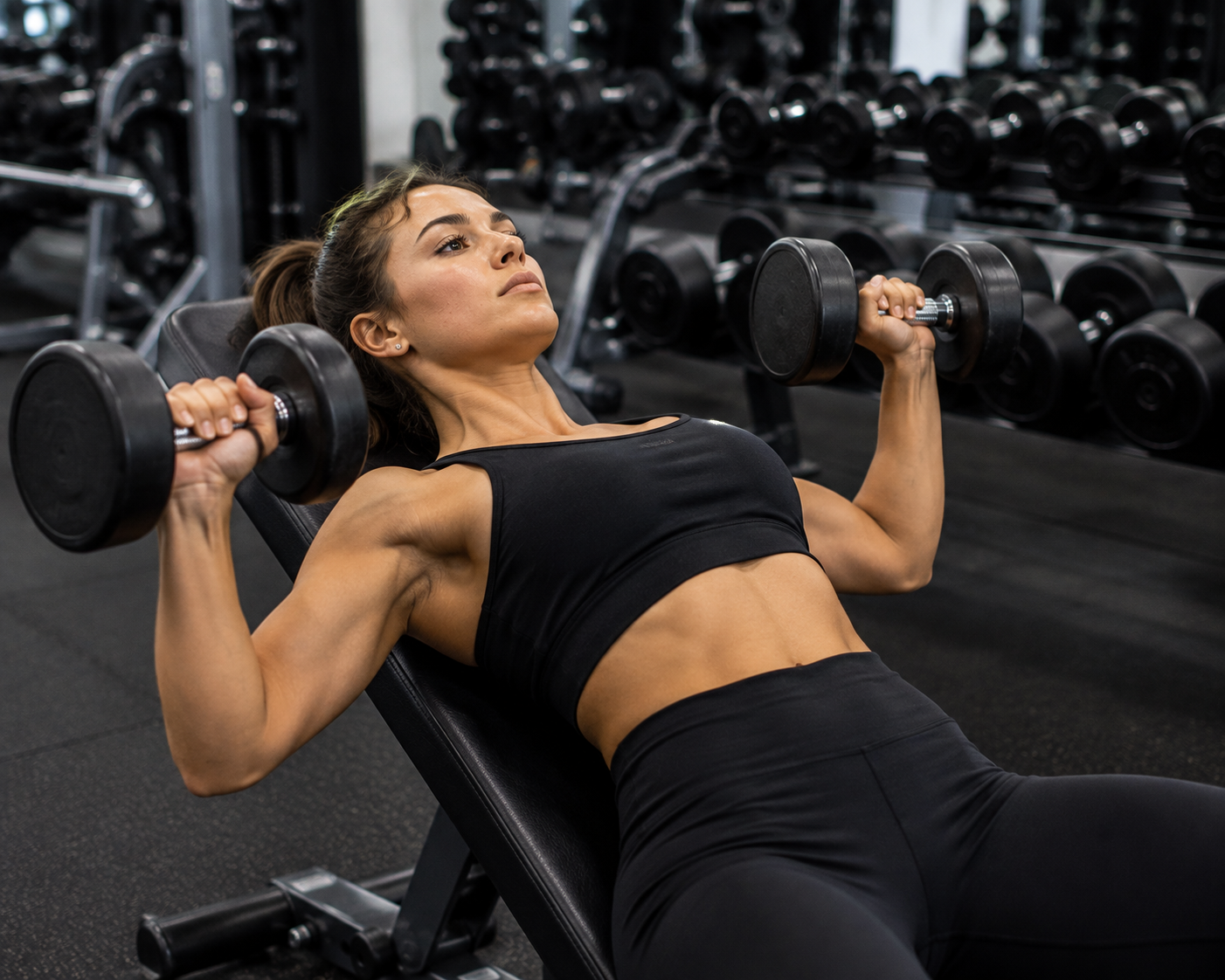
Dumbbell chest exercises: build a chest of steel without a barbell
Training your chest completely does not necessarily mean depending on a barbell or the classic flat bench. Dumbbells are in fact one of the most effective tools for developing the chest because they allow for greater freedom of movement, superior control of the trajectory, and more balanced work between the two sides of the body. Dumbbell chest exercises allow you to focus on the quality of muscle contraction and to exploit characteristics that are often limited by barbell exercises.
The main advantage of dumbbells concerns the range of motion, that is, the amplitude of the movement performed during the exercise. Thanks to the possibility of going deeper and independently managing the position of the arms, it is possible to increase the stimulus on the pectorals and work on aspects such as stretching, contraction, and joint stability.
For those who train in a home gym or want to build a developed chest without using a barbell, a program based on presses, flyes, and dumbbell variations allows you to achieve significant results. The difference is not determined only by the weight lifted, but by the ability to control the movement and create effective muscle tension.
- Why train your chest with dumbbells
- Advantages of the dumbbell range of motion
- Anatomy of the chest and function of the pectorals
- Best dumbbell exercises for the chest
- Incline dumbbell presses for the upper chest
- Dumbbell flyes for isolation and stretching
- Home chest workout with only dumbbells
- Building a complete chest with dumbbells
Why train your chest with dumbbells
Dumbbells offer a series of specific advantages when the goal is to develop the chest. Unlike the barbell, where the hands are bound to the same bar, each arm must manage its own load independently. This requires greater control and allows you to identify any strength differences between the right and left sides.
This characteristic makes dumbbell exercises particularly useful for improving muscle symmetry. When using a barbell, in fact, the dominant side can contribute more during the press, while with dumbbells each part of the body must work independently.
Furthermore, the greater joint freedom allows you to adapt the movement to your own physical structure. Limb length, shoulder mobility, and individual characteristics can be managed better compared to a completely constrained movement.
Greater movement control
During a dumbbell press, the athlete must control both the descent and ascent phases. This increases the involvement of stabilizer muscles and requires greater technical concentration.
A controlled movement allows you to maintain tension on the pectorals while avoiding excessive compensation by the shoulders and triceps.
Developing symmetry between the two sides
Working with two separate tools allows you to correct any imbalances. Each side must in fact produce its own force without being able to count on the help of the other.
In the long run, this approach can help build more harmonious muscle development.
Advantages of the dumbbell range of motion
One of the most important aspects of chest training concerns the amplitude of the movement. The range of motion determines how much the muscle is stretched and contracted during a repetition, influencing the quality of the stimulus received.
Dumbbells often allow for a more natural movement than the barbell because there is no bar that limits the final position of the hands. This allows you to increase the joint excursion and better perceive the muscle's work.
A greater ROM does not simply mean going as low as possible, but using an amplitude compatible with mobility, control, and safety.
Muscle stretching and tension
The stretching phase under load represents an important element in the hypertrophic stimulus. With dumbbells, it is possible to emphasize this phase while maintaining control of the position.
The goal must be to create continuous tension without losing joint stability.
Shoulder stability in dumbbell exercises
The freedom of movement requires a greater ability to stabilize the shoulder joint. For this reason, technique and control become fundamental elements.
Correct execution allows you to exploit the advantages of free movement while maintaining high levels of safety.
Anatomy of the chest and function of the pectorals
The pectorals are mainly composed of the pectoralis major, a muscle that participates in the adduction and pushing movements of the arm. To develop it completely, it is necessary to use exercises capable of involving different angles.
The chest does not work in isolation: during presses, the triceps, anterior deltoids, and shoulder stabilizer muscles also participate.
A complete program must therefore consider the role of all groups involved.
Upper chest and lower chest
Changing the inclination of the bench allows you to change the distribution of the stimulus on the different bundles of the pectoral. Incline variants are often used to emphasize the upper part of the chest.
The combination of different angles allows for more balanced development.
Role of muscle contraction
It is not enough to move the weight: it is important to perceive the muscle during the movement. A good mind-muscle connection allows you to focus the work more on the target group.
This aspect becomes particularly important in isolation exercises.
Best dumbbell exercises for the chest
An effective chest routine with dumbbells should include pushing and isolation movements. Presses allow you to use heavier loads and develop strength, while opening exercises increase control and specific work on the muscle.
The correct combination allows you to obtain a complete stimulus without the need to use numerous pieces of equipment.
Each exercise must be chosen based on the athlete's goals and characteristics.
Dumbbell chest press
The dumbbell chest press is one of the fundamental exercises for developing the chest. It allows you to use significant loads while maintaining a freer trajectory than the barbell.
The controlled negative phase and an explosive but stable push improve the quality of the work.
Dumbbell presses on a flat bench
Flat bench dumbbell presses mainly involve the central part of the pectoral. The use of dumbbells allows for a wider descent and greater freedom in the position of the hands.
This makes the exercise an important base for any program dedicated to the chest.
Incline dumbbell presses for the upper chest
Incline dumbbell presses are a fundamental exercise to stimulate the upper portion of the pectoral more. The inclination of the bench changes the pushing angle and allows you to distribute the muscle work differently.
They are particularly useful for those who want to build a more complete and proportionate chest.
Like any exercise, they must be performed while maintaining control and stability.
Choosing the inclination
A moderate inclination generally allows you to maintain a good balance between chest involvement and shoulder participation.
Excessive angles can shift the work too much towards the anterior deltoids.
Progression of incline presses
Gradually increasing the load or improving movement control allows you to continue creating new stimuli.
Progression must always be accompanied by solid technique.
Dumbbell flyes for isolation and stretching
Dumbbell flyes are one of the best-known exercises for increasing isolation work on the chest. Unlike presses, the movement focuses more on the opening and closing of the arms.
This allows you to better perceive the stretching of the muscle and improve the mind-muscle connection.
The load used must be managed carefully because the main goal is not to lift the maximum weight, but to control the movement.
Control of the eccentric phase
The slow descent in flyes increases the time under tension and allows you to maintain greater control.
A well-executed eccentric phase improves the overall quality of the exercise.
Integrating flyes into the program
Flyes can be inserted after pushing exercises to complete the work on the pectorals.
Their main function is to increase the specific stimulus and not to completely replace fundamental movements.
Home chest workout with only dumbbells
Creating an effective home chest workout is possible even without a complete gym. A pair of dumbbells and an adjustable bench can be enough to develop a complete program dedicated to the pectorals.
The key is to correctly organize exercises, volume, and load progression.
A well-designed home gym allows you to achieve important results even with essential equipment.
Creating a complete routine
An effective session can combine a heavy pushing exercise, an incline variant, and an isolation movement.
This structure allows you to work on strength, hypertrophy, and muscle control.
Optimizing space and equipment
Dumbbells are an ideal solution for those with little space because they allow for numerous variants with a reduced number of tools.
Versatility therefore becomes one of the main advantages of the home gym.
Building a complete chest with dumbbells
Dumbbell chest exercises demonstrate that it is not necessary to use only the barbell to obtain effective muscle development. The greater freedom of movement, load control, and the possibility of working on a wider range of motion represent important advantages for those who want to improve their training.
A complete program must combine presses, incline variants, and isolation movements, always maintaining attention to technique and the quality of the contraction. The result does not depend only on the weight used, but on the ability to create a precise and progressive stimulus.
Choosing reliable tools like adjustable dumbbells allows you to build a versatile home gym ready to support every phase of the muscle growth journey.
Comments (0)