
Trolley
You have no items in your shopping cart

 Budgets
 Dumbers
 Discs
 Benches
 Racks and Rigs
 Weights Holders
 Isotonic machines
 Calisthenics
 Cardio
 Kettlebells
 Flooring
 Gym Set
 Accessories
 Combat
 ARTI MARZIALI
 CONTAINER GYM
 Tug-Of-War
 Used Gym Equipment
 PILATES MACCHINARI
 GINNASTICA ARTISTICA
 CAMPI DA PADEL
 Prodotti in Pronta Consegna
 Informazioni
 IRONMAN
 Gift Card
- Donatif
- General information
- 0 I like it
- 71 Views
- 0 comments
- gym flooring, safety flooring, gym safety, shock-absorbing materials
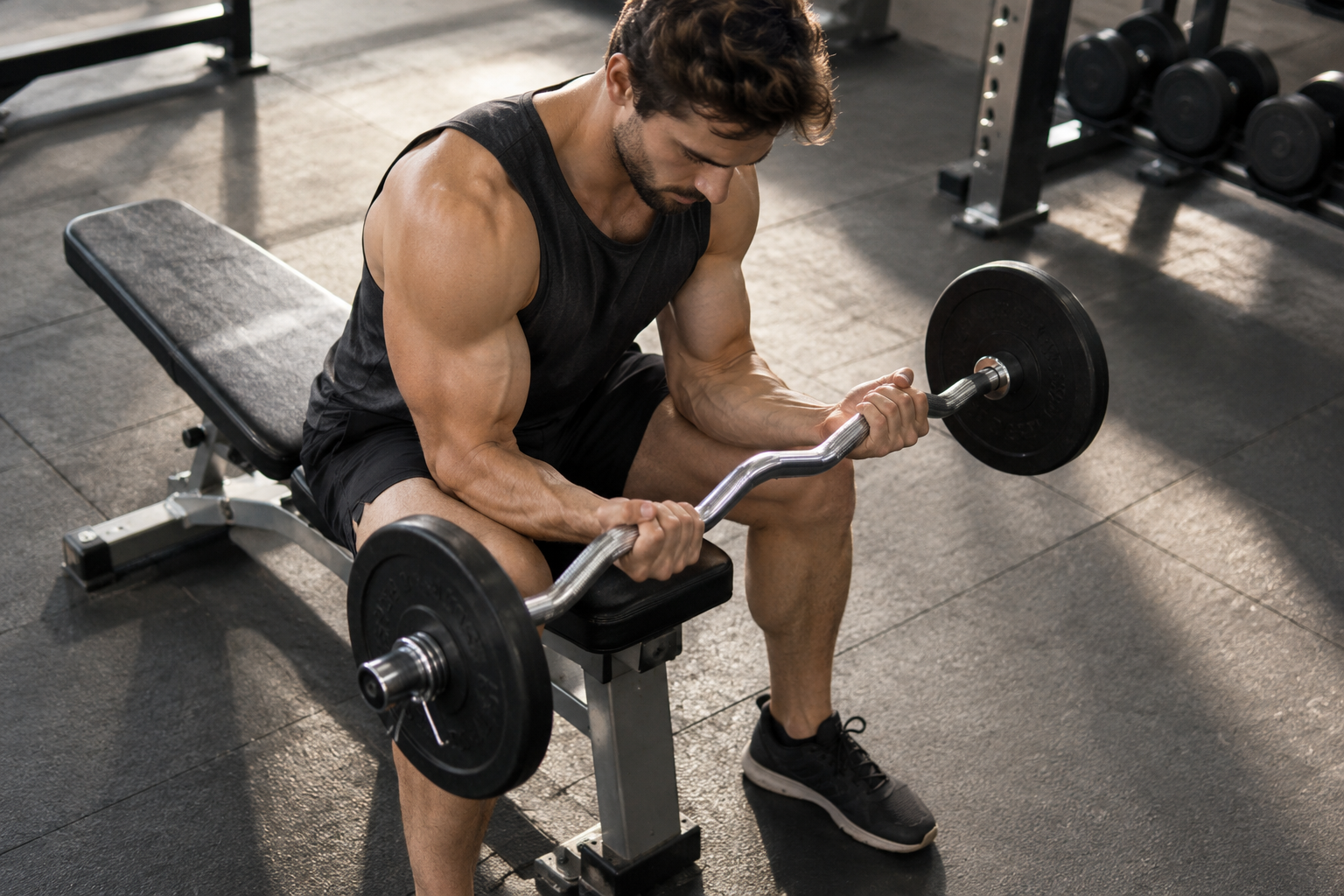
Effective exercises with the EZ curl bar: a practical guide for professional gyms
Integrating effective exercises with the EZ curl bar into the programming of a professional gym expands upper body training possibilities, offering users a versatile tool for working on the biceps, triceps, and accessory musculature. The specific shape of the grips is the distinctive element of this bar, designed to allow different hand orientations compared to a straight barbell.
For gym managers and purchasing officers, evaluating the EZ curl bar should not be limited to the price or the presence of the tool in the supplier's catalog. It is necessary to understand which exercises it allows to perform, how to integrate it into the various areas of the facility, and which construction characteristics affect the quality of the experience. A correctly selected bar can be used in individual training programs, supervised sessions, and muscle strengthening pathways.
This guide delves into the technical and operational aspects of using the EZ curl bar, with particular attention to the correct execution of movements, the choice of loads, safety, and equipment management. The objective is to provide practical criteria for organizing an effective training offer, avoiding viewing the bar exclusively as an accessory dedicated to bicep curls.
- Characteristics of the EZ curl bar and operational advantages
- Bicep curls with the EZ curl bar: technique and variants
- Triceps training with the EZ curl bar
- Complementary exercises and practical applications
- Execution technique, load selection, and progression
- Safety, ergonomics, and error prevention
- How to choose an EZ curl bar for a professional gym
- Equipment organization and maintenance
- Evaluating the investment based on the facility
Characteristics of the EZ curl bar and operational advantages
The EZ curl bar is a short barbell characterized by a contoured central section, with angled grips that allow the hands to be positioned in intermediate orientations between a fully supinated and a neutral grip. This geometry can be more comfortable for some users during certain exercises, especially when gripping a straight bar causes feelings of tension at the wrists.
The ergonomic advantage, however, should not be interpreted as a universal guarantee of greater joint safety. Individual response depends on mobility, anatomical conformation, technique, and the load used. In a professional gym, it is therefore advisable to offer different grip possibilities, allowing instructors to identify the most suitable solution for the user's characteristics.
From a managerial standpoint, the EZ curl bar represents a relatively compact piece of equipment that can be used at various stations. Its versatility allows for expanding the variety of exercises without necessarily requiring a dedicated machine for every movement. For this reason, it can constitute a useful element within a well-organized free weight area.
Grip geometry and wrist position
The angles of the bar influence the orientation of the forearm during the grip. An intermediate position can reduce the need to maintain full supination, but actual comfort must be verified during execution. It is important to check that the width of the grips is compatible with the user's build and that the hands can maintain a stable grip for the entire duration of the set.
Differences compared to the straight barbell
The straight barbell and the EZ curl bar are not necessarily interchangeable in every exercise. The straight bar allows uniform grips along its entire length, while the contouring of the EZ offers predefined positions. The choice depends on the movement, the muscular objective, and individual preferences. A complete gym should evaluate both solutions as complementary tools, not as universally superior alternatives.
Bicep curls with the EZ curl bar: technique and variants
The curl represents one of the most common exercises performed with the EZ curl bar. The movement primarily consists of elbow flexion against resistance and involves the biceps brachii along with the brachialis and brachioradialis, with varying contributions depending on the forearm's orientation. The angled grip can make the movement comfortable for users who prefer to avoid full supination.
To perform the standing curl, the user grasps the bar with both hands, maintains a stable position, and progressively brings the load toward the upper body through elbow flexion. During the descent phase, it is important to control the movement, avoiding letting the weight drop or using trunk momentum to complete the repetitions.
For a gym manager, it is useful to consider that the quality of the exercise depends above all on technique and load selection. The availability of an ergonomic bar does not compensate for incorrect execution. Instructors should therefore verify body stability, elbow position, and the user's ability to maintain control during both phases of the movement.
Standing curl with angled grip
In the standing curl, it is advisable to keep the feet at a comfortable distance and the torso stable, avoiding accentuating lumbar extension during the lift. The elbows generally remain close to the torso, while still allowing the small adaptations necessary for natural movement. The load must allow the repetitions to be completed without systematically resorting to hip or shoulder momentum.
Preacher curl with the EZ curl bar
The preacher curl bench allows the curl to be performed with the upper arms supported by an inclined pad. This configuration limits certain torso compensations and modifies the mechanical demands of the exercise. It is important to correctly adjust seat height, avoid forcing elbow extension under load, and verify that the bar can be safely lifted and replaced.
Triceps training with the EZ curl bar
The EZ curl bar can also be used for exercises dedicated to the triceps, particularly in elbow extensions. These movements allow the triceps brachii muscle to be trained through different configurations, modifying shoulder position and effort distribution during execution. The choice of variant should consider joint mobility, experience, and control capacity.
One of the most used exercises is the lying triceps extension, often performed on a flat bench. The user holds the bar above the body and progressively flexes the elbows to lower the load before returning it to the starting position through extension. The trajectory must be controlled and consistent with individual mobility, avoiding turning the movement into an uncontrolled descent toward the face.
Overhead extensions represent an additional possibility, but require adequate shoulder mobility and careful load management. For beginners, it may be preferable to start with simpler variants, possibly using dumbbells or machines that allow greater control. The EZ curl bar should be introduced into the programming when it offers a practical advantage over available alternatives.
Lying triceps extensions
During execution on a bench, the user must maintain a stable position and use a firm grip. The elbows flex progressively while the load follows a controlled trajectory, chosen based on mobility and the exercise objective. For initial executions or with demanding loads, the supervision of an instructor can be useful, especially during the phases of grasping and repositioning the bar.
Overhead extensions
Overhead extensions require keeping the arms in an elevated position while the elbows flex and extend. This configuration can increase the stretch of the long head of the triceps, but is not necessarily suitable for everyone. It is appropriate to verify that the user can maintain a stable position without excessive spinal compensation or shoulder discomfort.
Complementary exercises and practical applications
In addition to traditional movements for biceps and triceps, the EZ curl bar can be used in certain complementary training variants. Its shape allows for experimenting with different grip orientations, but it does not automatically make every exercise more effective. Application must be evaluated in relation to movement biomechanics and the possibility of maintaining adequate control.
Among the most interesting variants are reverse-grip curls, which modify the relative contribution of the muscles involved in elbow flexion. They can be used within programs dedicated to upper limb development, provided the load is adapted to the lower lifting capacity that some users experience compared to supinated-grip curls.
Another application concerns the use of the bar in strength circuits with selected exercises. In this context, it is important to avoid overly rapid movement changes that compromise technique. For a professional gym, the tool's versatility gains value when it allows for organizing orderly sessions, with coherent progressions and manageable transition times.
Reverse-grip curl
In the reverse-grip curl, the hands grasp the bar with the palms oriented predominantly downward, according to the available geometry. The movement involves the elbow flexors, with a significant contribution from the brachioradialis. It is generally appropriate to use lower loads than those employed in more favorable variants, avoiding wrist compensations and trunk swaying.
Using the EZ curl bar in strength circuits
In circuits dedicated to the upper limbs, the EZ curl bar can be inserted into sequences that alternate bicep and triceps movements. However, programming must consider local fatigue, station availability, and the time required to change loads. Effective organization prevents users from simultaneously occupying multiple pieces of equipment without using them, improving shared space management.
Execution technique, load selection, and progression
Load selection is one of the main factors determining the quality of exercises with the EZ curl bar. Excessive weight can encourage compensations, reduce movement control, and make it difficult to maintain a consistent trajectory. Conversely, an appropriate load allows for progressively developing strength and work capacity while maintaining sufficiently stable technique.
For instructors, it is useful to evaluate not only the number of completed repetitions, but also the quality of the final repetitions in the set. When the user noticeably alters posture, uncontrollably accelerates the descent phase, or uses accessory movements to lift the weight, it may be necessary to reduce the load or stop the set.
Progression should be gradual and based on observable parameters. Increasing weight is not the only way to make an exercise more demanding. It is possible to intervene on the number of repetitions, sets, controlled range of motion, and rest management. These elements must be coordinated according to the objective and preparation level.
How to identify the initial load
The initial load should allow for correctly learning the movement and completing the planned repetitions while maintaining a margin of control. For a beginner, it can be useful to start with just the bar, pre-verifying its actual weight, which varies among models. Subsequently, weight plates can be added in small increments while observing the user's technical response.
Progression and repetition management
A practical strategy consists of defining a repetition range and increasing the load only when the user manages to complete it with stable technique and effort consistent with the program. Progression must not be identical for everyone: experience, recovery, training frequency, and individual goals influence the speed at which difficulty should be increased.
Safety, ergonomics, and error prevention
Using the EZ curl bar requires attention to safety even when relatively light loads are employed. The presence of contoured grips can improve comfort under certain conditions, but it does not eliminate stress on the elbows, wrists, and shoulders. Appropriate technique and a progression compatible with the user's capabilities remain fundamental.
The most common errors include excessive use of momentum, loss of control in the eccentric phase, and choosing a range of motion incompatible with individual mobility. In triceps extensions, it is also important to consider the position of the load relative to the body, especially when the exercise is performed lying down.
For the gym manager, prevention also involves environmental organization. Bars must be stored on appropriate racks, plates must be secured with compatible systems, and training spaces must allow movements without interference. Simple and shared procedures help reduce improper behaviors during daily use.
Technical errors to recognize
In curls, excessive torso sway may indicate that the load exceeds the user's control capacity. In triceps extensions, too rapid a descent or an unstable shoulder position can increase execution difficulties. Instructors should intervene through simple cues, modifying the load or variant when necessary, without imposing rigid trajectories incompatible with individual characteristics.
Managing joint discomfort
The presence of discomfort during an exercise requires careful evaluation. It may be appropriate to modify the grip, reduce the load, temporarily limit the range of motion, or choose an alternative tool. Persistent or significant pain should not be ignored or automatically interpreted as a normal effect of training. In these cases, consultation with a qualified healthcare professional is indicated.
How to choose an EZ curl bar for a professional gym
Choosing an EZ curl bar intended for professional use must consider dimensional characteristics, build quality, plate compatibility, and frequency of use. Not all bars on the market are designed to sustain the same operating conditions. It is therefore important to verify the specifications declared by the manufacturer, distinguishing solutions intended for home use from those indicated for commercial environments.
Aspects to evaluate include overall length, grip diameter, bar weight, angle geometry, and declared load capacity. Knurling can also influence grip quality: too aggressive a finish may be uncomfortable, while an excessively smooth surface can make the grip less stable under certain conditions.
To compare different configurations, it is useful to consult the characteristics of professional gym barbells, verifying which models meet the facility's needs. Selection should prioritize compatibility, robustness, and ease of management over simple aesthetic finishes or unnecessary features.
Materials, finishes, and build quality
The quality of the steel, the grip manufacturing, and the surface treatment affect wear resistance and maintenance. Finishes can offer different levels of corrosion protection, but still require proper cleaning. It is advisable to verify the regularity of welds, where present, the absence of visible defects, and the overall assembly quality.
Compatibility with plates and locking systems
EZ curl bars can feature sleeves with different diameters. Before purchasing, it is necessary to verify compatibility with the plates already present in the gym and their relative locking systems. Mere aesthetic similarity between two bars does not guarantee they use the same standard. The loadable length of the sleeves must also be considered based on the plates and expected loads.
Equipment organization and maintenance
An EZ curl bar may be used frequently throughout the day, especially in gyms with a dedicated strength training area. To avoid clutter and excessive waiting times, it is useful to establish a precise location, easily accessible and consistent with the stations where exercises are performed. The presence of dedicated racks helps keep the environment tidy.
Routine maintenance should include cleaning the grips, checking surfaces, and verifying the condition of the sleeves. In models equipped with rotating components, it is advisable to follow the manufacturer's instructions for any maintenance interventions. Using products incompatible with the finishes can damage surface treatments and reduce equipment quality over time.
For facility managers, introducing periodic control procedures is useful. A visual check can allow the identification of deformations, corrosion, loose components, or anomalies requiring technical investigation. Damaged equipment must be excluded from use until its suitability is verified.
Storage and layout in the weight area
Bars should be stored on stable racks, avoiding leaving them on the floor or in walkways. Placement must allow users to retrieve them without interfering with other stations. When multiple bars are available, it can be useful to organize them by type or weight, facilitating identification and reducing the time needed to prepare for training.
Cleaning and periodic checks
Cleaning frequency depends on intensity of use and environmental conditions. Sweat, humidity, and residue can accumulate in the knurling and on metal surfaces. It is advisable to use products and tools compatible with the manufacturer's instructions, avoiding unforeseen abrasive interventions. A regular inspection program helps keep the equipment functional and presentable.
Evaluating the investment based on the facility
Integrating the EZ curl bar into a gym's inventory should start with an analysis of the activities actually performed. A facility dedicated primarily to free weight training may have different needs compared to a corporate fitness room or a center that mainly uses selectorized machines. The number of bars needed depends on usage frequency, station availability, and user demographics.
A primary criterion consists of observing peak hours and checking how often users request the same equipment. If the EZ curl bar is simultaneously used for curls, triceps extensions, and other variants, it may be appropriate to provide multiple units. The decision should nevertheless derive from concrete usage data, avoiding redundant purchases that occupy space without improving service.
Economic evaluation must consider initial cost alongside expected lifespan, build quality, and maintenance needs. Equipment intended for intensive use should offer characteristics appropriate to usage frequency and user variety. Compatibility with already available plates can also influence total cost, as it avoids the need to purchase unforeseen additional accessories.
Another aspect concerns integrating the EZ curl bar with benches, racks, and other professional fitness equipment. Coherent outfitting allows for organizing different exercises without creating makeshift stations. It is appropriate to verify that supports are suited to the bar's dimensions and that the area layout allows users to perform movements with sufficient space.
For a gym offering personalized training programs, the availability of the EZ curl bar can expand options available to instructors. However, the tool's value depends on the ability to select appropriate exercises and correctly teach their execution. Staff training and defining operational procedures thus contribute to enhancing the investment just as much as product selection.
The final decision should be based on a combination of technical and managerial criteria: bar quality, compatibility with existing equipment, usage frequency, safety, and the ability to organize effective exercises with the EZ curl bar for users with different levels. A correctly sized purchase enhances weight area functionality, maintains an orderly environment, and offers reliable tools for long-term training programming.
Comments (0)