
Trolley
You have no items in your shopping cart

 Budgets
 Dumbers
 Discs
Discs
 Benches
 Racks and Rigs
 Weights Holders
 Isotonic machines
 Calisthenics
 Cardio
 Kettlebells
 Flooring
 Gym Set
 Accessories
 Combat
 ARTI MARZIALI
 CONTAINER GYM
 Tug-Of-War
 Used Gym Equipment
 PILATES MACCHINARI
 GINNASTICA ARTISTICA
 CAMPI DA PADEL
 Prodotti in Pronta Consegna
 Informazioni
 IRONMAN
 Gift Card
- Donatif
- General information
- 0 I like it
- 456 Views
- 0 comments
- gym flooring, safety flooring, gym safety, shock-absorbing materials
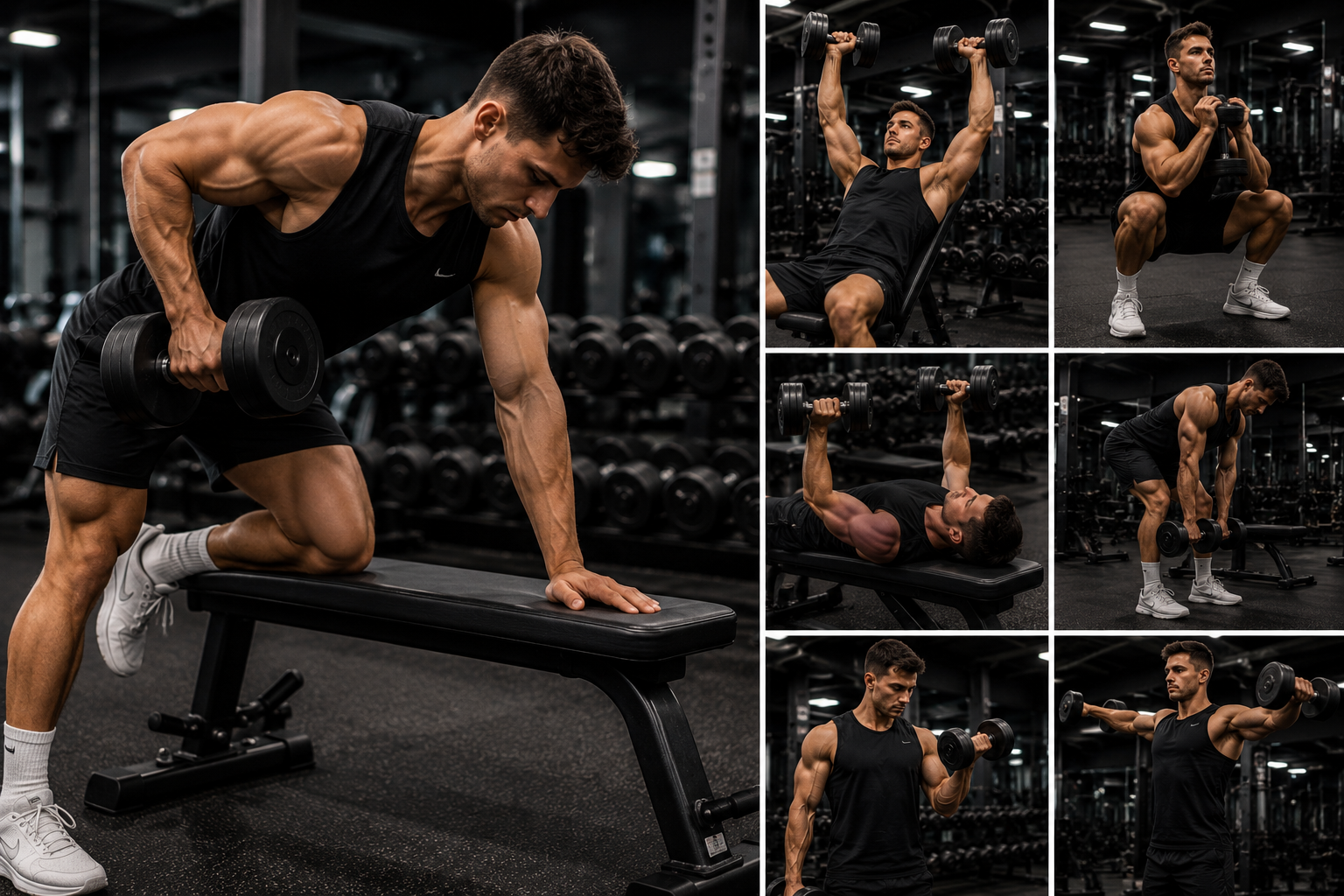
Full body dumbbell workout: 30 minutes for real results
Lack of time is one of the main obstacles that prevent many people from training consistently. Between work, personal commitments, and increasingly intense daily rhythms, finding a free hour to go to the gym can become complicated. For this reason, efficient workouts, capable of offering great results in a short time, are becoming an increasingly interesting solution. The full body dumbbell workout allows you to engage the entire body using just one pair of weights and intelligent programming.
A complete workout does not necessarily have to be long to be effective. Through multi-joint exercises, organized circuits, and proper management of breaks, it is possible to create an intense session in about 30 minutes. The fundamental principle is to maximize the ratio between time invested and stimulus obtained.
For those training at home, during a break from work, or in small spaces, dumbbells represent one of the most versatile tools available. They allow you to develop strength, muscular endurance, and coordination without the need for complex machinery or large dedicated surfaces.
- Why choose a full body dumbbell workout
- Principles of the Minimalist method for maximum efficiency
- Structure of a 30-minute workout
- Total body dumbbell weight exercises
- Home dumbbell circuit for training in small spaces
- How to increase intensity and progression
- Errors to avoid in full body workouts
- Building a sustainable routine over time
Why choose a full body dumbbell workout
Full body training is based on a simple concept: stimulating all major muscle groups within the same session. This approach is particularly useful for those with little time because it allows you to obtain a complete workout without having to dedicate separate days to each body part.
Dumbbells adapt perfectly to this philosophy because they allow you to perform movements for legs, shoulders, chest, back, and core using only one piece of equipment. Their versatility allows you to create balanced programs even in an essential home gym.
For those seeking efficiency, the main value is not training longer, but choosing exercises that produce the maximum stimulus in the shortest possible time.
Advantages over split workouts
Traditional workouts often involve splitting sessions by specific muscle groups. This method can be effective, but it requires more time availability and training frequency.
A full body program instead allows you to maintain a high frequency and stimulate every muscle group multiple times during the week.
Ideal for those with little time
For a professional with demanding days, a parent, or a person with many commitments, a 30-minute session can represent the most realistic solution.
Training consistency becomes easier when the time required is compatible with daily life.
Principles of the Minimalist method for maximum efficiency
The Minimalist method stems from the idea of getting the maximum return on time investment. It does not mean doing less randomly, but eliminating what is superfluous by focusing on the elements that produce the greatest benefit.
A short and effective workout must be based on high-yield exercises, controlled breaks, and planned progression. Every minute of the session must have a precise purpose.
This approach is particularly suitable for using dumbbells because it allows you to create dynamic sequences without constantly changing equipment.
Choosing multi-joint exercises
Exercises that involve multiple joints allow you to train different muscle groups simultaneously. Squats, presses, rows, and overhead movements are examples of exercises capable of generating a high stimulus.
Using these movements allows you to reduce the total number of exercises while maintaining the effectiveness of the session.
Managing time under tension
When available time is limited, increasing the quality of repetitions becomes fundamental. A controlled movement keeps the muscle under tension longer and improves the overall stimulus.
The execution speed must therefore be chosen based on the training goal.
Structure of a 30-minute workout
A complete 30-minute workout must be organized precisely to avoid downtime. An effective structure can include an initial warm-up phase, a high-intensity central block, and a short final phase dedicated to recovery.
The simplicity of the programming allows you to keep concentration high and make the most of the available time.
The result is a compact session capable of stimulating the whole body.
Warm-up phase
The warm-up prepares muscles and joints for the subsequent work. It must be short but sufficient to increase body temperature and mobility.
Dynamic movements and light activations represent good preparation before the main loads.
Central workout phase
The main part of the workout must focus on the most important exercises. Organizing movements in a circuit allows you to reduce breaks and keep intensity high.
The choice of exercises must ensure a balanced engagement of the whole body.
Total body dumbbell weight exercises
Total body weight exercises with dumbbells allow you to build complete sessions without using many tools. The combination of pushing, pulling, and lower limb work creates a balanced stimulus.
Proper exercise selection allows you to train strength and conditioning simultaneously.
The goal is to create a continuous flow of work while always maintaining correct technique.
Dumbbell squats
The dumbbell squat mainly involves legs and glutes, but also requires core stability. It is one of the most effective exercises for increasing the total work of the session.
The ability to change the position of the dumbbells allows you to adapt the movement to your capabilities.
Dumbbell presses and rows
Presses train the upper body through pushing movements, while rows develop back musculature through pulling.
Alternating these patterns allows you to create balance between the main muscle groups.
Home dumbbell circuit for training in small spaces
A home dumbbell circuit represents a practical solution for those who want to train without a full gym. The principle of the circuit consists of performing multiple consecutive exercises with reduced breaks, creating intense and dynamic work.
This method is particularly suitable for those with little time because it allows you to combine strength and cardiovascular components within the same session.
The simplicity of the circuit should not be confused with ease: quality depends on the choice of exercises and intensity management.
Example of a circuit structure
An effective circuit can alternate a leg exercise, an upper body exercise, and a core exercise. This organization allows you to distribute fatigue and maintain a constant pace.
The variety of movements makes the session more complete.
Adapting the circuit to your level
The load, number of repetitions, and recovery time must be modified based on the user's experience. A beginner and an advanced athlete can use the same structure with different intensities.
Personalization allows you to keep the program effective over time.
How to increase intensity and progression
A short workout must still follow a principle of progression. Without a gradual increase in stimulus, the body tends to adapt and improvements can slow down.
Progression can occur by increasing weight, number of repetitions, technical quality, or slightly reducing recovery times.
The important thing is to apply controlled and measurable changes.
Increasing load intelligently
Increasing dumbbell weight is one of the simplest methods to create new stimuli. However, the load must always be compatible with the ability to maintain good technique.
Excessive weight can reduce the quality of movement.
Monitoring progress
Recording loads, repetitions, and sensations during training helps evaluate evolution over time.
An organized approach allows you to make better decisions about progression.
Errors to avoid in full body workouts
Full body workouts are extremely efficient, but they require good organization. One of the most common errors is including too many exercises without considering the necessary recovery.
An effective program must be sustainable and adapted to the individual's capabilities.
Simplicity often represents an advantage when applied with judgment.
Training at maximum intensity always
Intensity is important, but not every session must be pushed to the limit. An intelligent approach alternates periods of greater effort and moments of recovery.
This allows you to maintain consistency and quality in the long term.
Neglecting technique
The speed of the circuit must not compromise execution. Poorly controlled movements reduce effectiveness and increase the risk of errors.
Technique always remains the basis of a productive workout.
Building a sustainable routine over time
Full body dumbbell training proves that concrete results can be obtained even with limited time. The key is not the duration of the session, but the ability to use effective exercises and maintain constant progression.
A 30-minute routine can become a sustainable habit for professionals, busy people, and anyone who wants to integrate fitness into their day without complications.
Choosing versatile tools like adjustable dumbbells allows you to create a compact and complete training solution, capable of adapting to the athlete's goals and offering maximum value over time.
Comments (0)