
Trolley
You have no items in your shopping cart

 Budgets
 Dumbers
 Discs
Discs
 Benches
 Racks and Rigs
 Weights Holders
 Isotonic machines
 Calisthenics
 Cardio
 Kettlebells
 Flooring
 Gym Set
 Accessories
 Combat
 ARTI MARZIALI
 CONTAINER GYM
 Tug-Of-War
 Used Gym Equipment
 PILATES MACCHINARI
 GINNASTICA ARTISTICA
 CAMPI DA PADEL
 Prodotti in Pronta Consegna
 Informazioni
 IRONMAN
 Gift Card
- Donatif
- General information
- 0 I like it
- 423 Views
- 0 comments
- gym flooring, safety flooring, gym safety, shock-absorbing materials
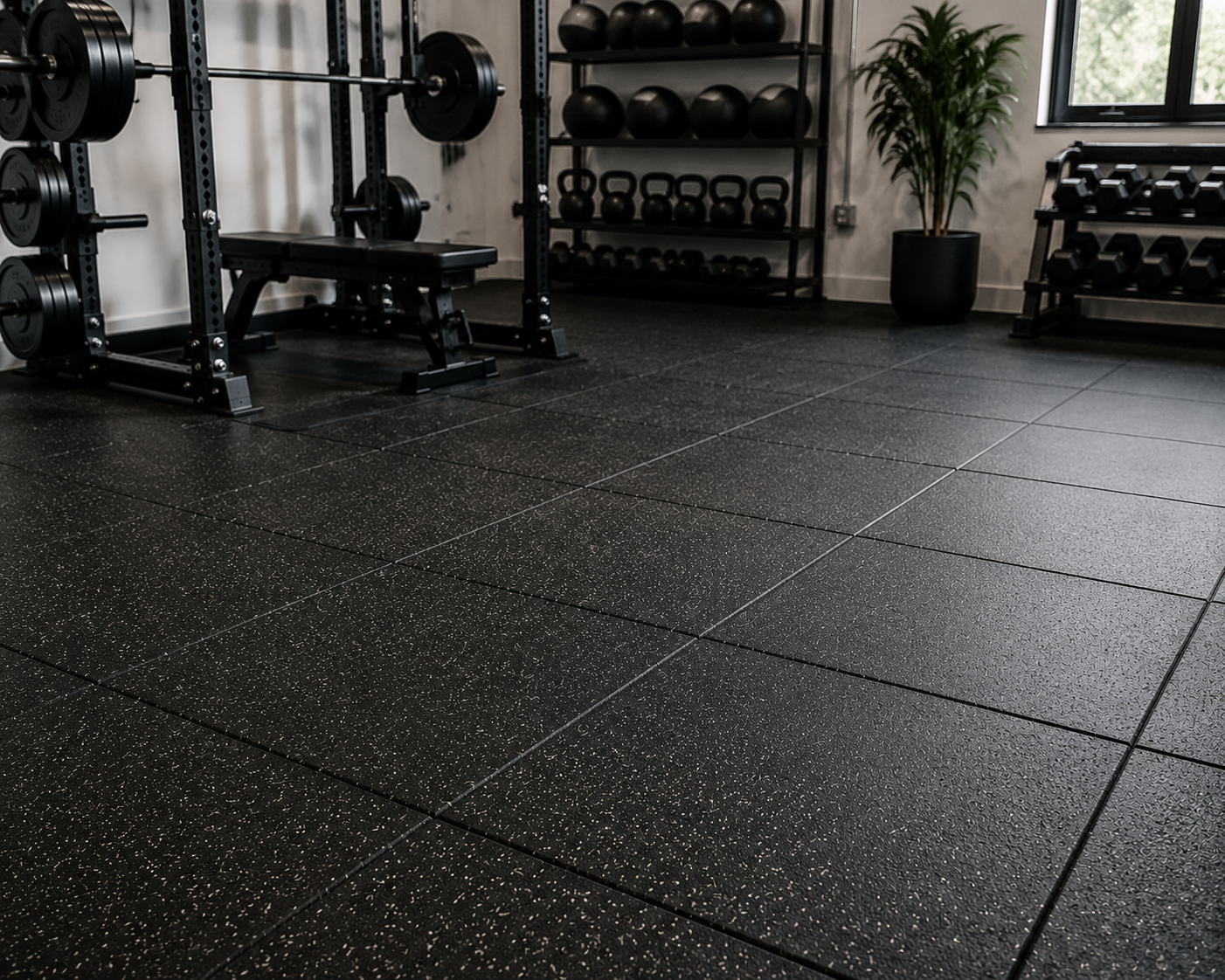
Racks and Flooring: How to Protect the Floor Slab and Reduce Vibrations
Installing a power rack or a half rack inside a home gym is one of the best investments for training safely with barbells and heavy loads. However, many enthusiasts focus all their attention on choosing the structure and overlook an equally important element: the flooring. A rack installed directly on the home floor can transmit high static loads, vibrations, and impact noise that, over time, can compromise usage comfort, increase the risk of surface damage, and create problems with neighbors.
The correct combination of rack and technical flooring is not just about the aesthetics of the home gym. The underlying surface influences weight distribution, equipment stability, protection of the floor slab, and the ability to limit the propagation of vibrations generated during squats, deadlifts, military presses, and other barbell exercises. A properly designed solution also improves training safety and extends the lifespan of both the flooring and the equipment.
In this guide, we analyze everything you need to know to choose the best rubber flooring for racks, evaluating materials, thicknesses, density, shock absorption capacity, and installation techniques, with particular attention to protecting the floor slab and reducing vibrations in apartments.
- Why the rack needs technical flooring
- Static and dynamic loads
- Why choose SBR rubber
- Flooring thickness and density
- Reducing noise and vibrations
- Protecting the floor slab
- Correct installation
- How to choose the best solution
Why the rack needs technical flooring
A professional power rack can weigh from a few tens to over a hundred kilograms. To this value, you must add the weight of the plates, the barbell, and the athlete. During exercises, the floor is subjected not only to a static load but also to continuous dynamic stresses that generate vibrations and concentrated force peaks.
Traditional flooring, such as parquet, stoneware, or laminate, is not designed to absorb this type of stress. Over time, signs of compression, scratches, deformations, or small surface failures may appear, especially in the most frequently used areas.
Technical flooring, on the other hand, distributes the load over a wider surface, reduces pressure points, and improves the overall stability of the rack during every workout.
Greater structure stability
A uniform base limits oscillations and micro-movements of the structure, offering a more secure support during heavy exercises and improving the feeling of solidity of the entire station.
Protection of existing flooring
Technical rubber creates a barrier between the rack and the home floor, reducing the risk of permanent damage due to constant pressure or accidental impacts.
Understanding static and dynamic loads
Many users evaluate only the weight of the rack, forgetting that much higher forces come into play during training. When a barbell is placed on the supports or during a deadlift, the energy produced by the impact is quickly transferred to the floor.
These dynamic stresses generate vibrations that can propagate through the floor slab and reach the rooms below. The higher the load and the greater the frequency of training, the more important it becomes to adopt flooring designed to dissipate energy.
Evaluating only the static weight is therefore not sufficient to choose the most suitable solution for your home gym.
The weight of the structure
Racks, accessories, and plates represent a constant load distributed on the floor that must be properly supported to avoid pressure concentrations.
Impact energy
Placing the barbell on the supports or performing high-intensity exercises produces impulsive forces much higher than the simple weight of the equipment.
Why SBR rubber is the ideal solution
SBR rubber is one of the most used materials in professional gyms thanks to the balance between elasticity, resistance, and durability. Its characteristics allow it to absorb part of the energy produced by impacts without compromising the stability of the rack.
A modern rack base mat made of high-density rubber helps to better distribute weight and limits the transmission of vibrations to the building structure. It also protects the floor from impacts, abrasions, and compressions caused by daily use.
The quality of the mixture and the density of the material directly affect performance: professional products maintain elasticity and absorption capacity longer than cheap solutions.
Elasticity and resistance
Technical rubber retains its characteristics even after years of intensive use, making it ideal for home gyms and small professional studios.
A choice designed to last
Quality materials reduce wear, simplify maintenance, and ensure a reliable surface even with frequent training.
Thickness and density: how they affect performance
Flooring thickness is one of the most important parameters in designing a home gym. The greater the thickness, the greater the surface's ability to absorb part of the vibrations generated by exercises will generally be.
Density also plays a fundamental role. A material that is too soft could deform excessively under the weight of the rack, while rubber that is too rigid would reduce the ability to dissipate impacts.
The ideal choice depends on the type of training, the maximum weight used, and the frequency of sessions.
How to choose the correct thickness
Workouts with heavy barbells generally require thicker surfaces than a gym dedicated mainly to exercises with light dumbbells.
Why density matters
The correct balance between rigidity and elasticity simultaneously improves stability, comfort, and the durability of the flooring.
How to limit noise and vibrations
One of the main objectives of technical flooring is to reduce the propagation of vibrations through the floor slab. This aspect is particularly important in apartments and condominiums where structural noise is one of the main causes of discomfort.
Proper home gym soundproofing does not depend solely on the flooring, but the latter constitutes the first line of defense against impacts generated by weight training.
The combination of a stable rack, technical rubber, and correct load distribution allows for a significant reduction in the noise perceived in the rooms below.
Reducing barbell vibrations
Placing the barbell in a controlled manner and using an elastic surface limits the amount of energy transmitted to the building structure.
Training without disturbing
Careful planning helps maintain peaceful relationships with neighbors and makes the home gym more pleasant to use at any permitted time.
Protecting the floor slab and preserving the structure
A home's floor slab is designed to support normal operating loads, but frequent training with heavy weights can generate concentrated stresses that deserve special attention.
Proper weight floor slab protection helps to better distribute the load, reducing the risk of damage to finishes and limiting vibrations that pass through the structure.
This does not mean that the floor slab automatically becomes unsuitable for training, but it highlights the importance of using flooring specifically designed for this type of use.
Distributing weight evenly
A continuous surface avoids excessive pressure concentrations under the rack uprights and improves the behavior of the entire system.
Reducing wear over time
Protecting the floor means preserving the value of the property and limiting potential restoration costs after years of training.
The importance of correct installation
Even the best material loses effectiveness if installed incorrectly. The surface must be perfectly level, stable, and free of unevenness that could compromise the stability of the rack.
The joints must be made with precision, avoiding gaps or height differences that could affect the behavior of the flooring during use.
Careful installation improves safety, facilitates maintenance, and contributes to the overall durability of the investment.
Subfloor preparation
A clean, dry, and regular base ensures better performance and extends the useful life of the flooring.
Periodic checks
Periodically inspecting the surface allows for the timely identification of any signs of wear or deformation.
How to choose the best solution for your home gym
The choice of flooring must take into account the weight of the rack, the type of training, the available space, and the living environment. A solution designed solely based on price may not offer the necessary performance in terms of safety, comfort, and durability.
To achieve the best result, it is advisable to look for professional products, correctly sized and designed to work together with the equipment. You can learn more about the different solutions dedicated to technical flooring by consulting rubber flooring for racks available for home gyms and professional gyms.
A correct balance between rack, flooring, and load distribution allows you to improve the training experience, limit barbell rack vibrations, protect the floor slab, and preserve both the property and the equipment over time, ensuring a safer and more comfortable environment for every session.
Comments (0)