
Trolley
You have no items in your shopping cart

 Budgets
 Dumbers
 Discs
Discs
 Benches
 Racks and Rigs
 Weights Holders
 Isotonic machines
 Calisthenics
 Cardio
 Kettlebells
 Flooring
 Gym Set
 Accessories
 Combat
 ARTI MARZIALI
 CONTAINER GYM
 Tug-Of-War
 Used Gym Equipment
 PILATES MACCHINARI
 GINNASTICA ARTISTICA
 CAMPI DA PADEL
 Prodotti in Pronta Consegna
 Informazioni
 IRONMAN
 Gift Card
- Donatif
- General information
- 0 I like it
- 13 Views
- 0 comments
- gym flooring, safety flooring, gym safety, shock-absorbing materials
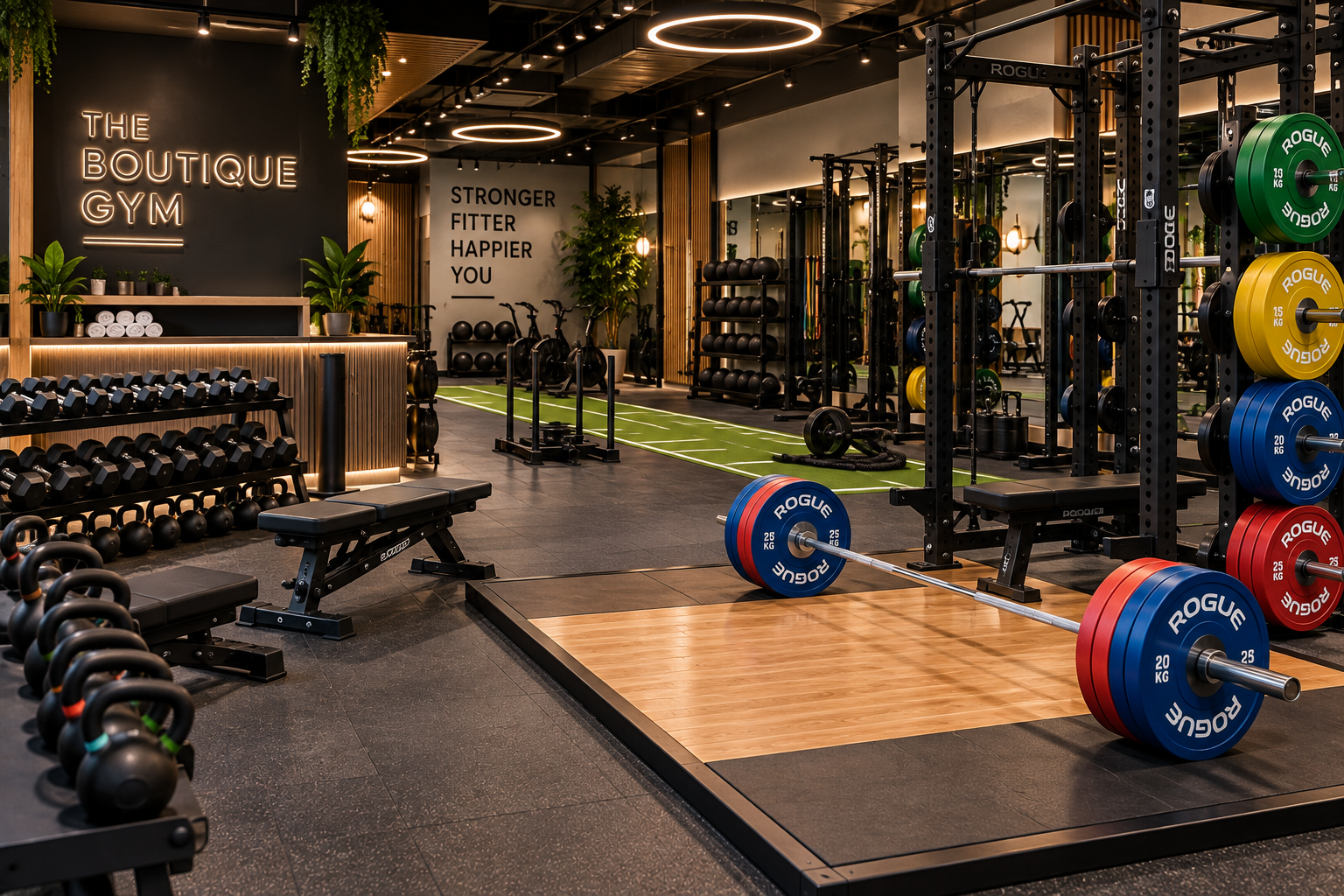
Boutique gym: what it is, how it works, and how to design a specialized facility
A boutique gym is a fitness center designed to offer a highly specialized training experience, focused on one or a few disciplines and characterized by small group sizes, high customer attention, and functionally organized spaces. Unlike a traditional gym, the design does not revolve around the quantity of available equipment, but rather on the quality of the experience, the coherence of the layout, and operational efficiency.
This model is adopted by numerous establishments dedicated to functional training, strength training, personal training, indoor cycling, Pilates, and other disciplines that require easily reconfigurable spaces and precise organization of stations. The goal is to create an environment in which every element contributes to the proper execution of training sessions.
To design a boutique gym, it is necessary to evaluate available surface area, types of services, maximum number of concurrent users, equipment organization, and potential for future expansion. Careful planning allows you to optimize investments and develop a facility that is easy to manage over time.
- What is a boutique gym?
- How does a boutique gym work?
- How to design spaces
- What equipment is needed
- Table of essential elements
- Operational management and maintenance
- Mistakes to avoid
- How to plan the investment
What is a boutique gym?
A boutique gym is a specialized fitness facility that focuses its activity on a limited number of disciplines or training methodologies. The design is developed around the service offered, favoring the quality of the experience, space organization, and operational continuity.
Dimensions are generally smaller than those of a multi-service gym, but environments are designed to make the most of every available square meter. Each area has a precise function and contributes to the execution of the planned activities.
Defining the format represents the first design step because it determines the layout, equipment, workflows, and class organization.
Why define the target audience?
Identifying the target audience allows you to select services, equipment, and space organization that truly match customer needs.
Why focus on specialization?
Concentrating the offering on well-defined activities makes it easier to design functional environments and optimize investments.
How does a boutique gym work?
The operation of a boutique gym is based on structured programs, organized sessions, and efficient use of space. Workouts can be individual or carried out in small groups, maintaining a strong focus on the quality of the experience and the organization of activities.
Equipment is selected based on the adopted training method and distributed according to a layout that favors fluid movements, supervision by instructors, and rapid room reconfiguration.
Daily management includes class planning, equipment inspection, space tidying, and scheduled maintenance of the entire facility.
How are sessions organized?
Activities are normally scheduled according to pre-established times and programs consistent with the facility's format.
Why is the customer experience central?
An experience-oriented design improves the usability of environments and facilitates the organization of daily activities.
How to design a boutique gym?
Design should begin with the analysis of the available space and the services that will be offered. The layout must allow users to move without interference and instructors to easily supervise sessions.
It is advisable to provide a main training area, areas dedicated to equipment storage, well-defined connecting pathways, and spaces intended for reception. Each environment should be easily accessible and organized according to the facility's operational flow.
The possibility of modifying the room's configuration over time also represents an important criterion, especially for activities that evolve progressively or introduce new services.
Why is the layout decisive?
A rational distribution of spaces improves operational efficiency and makes class management easier.
Why design flexible spaces?
A modular configuration allows you to quickly adapt the facility to different training programs.
What equipment is needed?
The choice of equipment depends on the boutique gym's format. It is generally preferable to select multi-function tools that allow for numerous usage modalities, reducing overall bulk and increasing the room's versatility.
Before purchasing, it is appropriate to check dimensions, installation methods, maintenance requirements, and compatibility among different components. Storage systems also play an important role in keeping environments tidy.
The professional dumbbell set represents a frequently adopted solution in boutique gyms thanks to its versatility and the possibility of using it in numerous types of training.
Why choose multi-function equipment?
They allow you to perform numerous exercises while keeping the operational space free and facilitating room reconfiguration.
Why check compatibility?
Equipment designed to work together facilitates maintenance, expansion, and organization of the entire facility.
Table of essential elements
The following table summarizes the main elements to consider in the design.
| Element | Function | Evaluation criterion |
|---|---|---|
| Training area | Main activities | Free space and flexibility |
| Equipment | Exercise execution | Versatility and compatibility |
| Storage | Organization | Accessibility and order |
| Reception | Customer welcoming | Functionality of pathways |
| flooring | Support for activities | Compatibility with the format |
| Lighting | Operational comfort | Uniformity of environments |
The actual configuration should always be adapted to the facility's dimensions and the activities actually planned.
Manufacturer technical sheets constitute the primary reference for verifying characteristics, installation methods, and equipment maintenance.
Why consult technical documentation?
Manufacturer manuals contain the information necessary for the installation, use, and maintenance of equipment.
Why plan for growth?
A modular design allows you to integrate new services while maintaining consistency among environments.
How to manage the boutique gym over time?
Effective management includes scheduled equipment maintenance, environment cleaning, periodic surface checks, and constant organization of operational areas.
Verifications should be carried out following the instructions provided in manufacturer manuals and documented when required by the facility's internal procedures.
Keeping the room tidy facilitates both daily activities and routine maintenance operations.
What checks to perform?
It is advisable to regularly check equipment, surfaces, storage systems, and transit pathways.
Why schedule maintenance?
Constant planning helps preserve the functionality and organization of the facility over time.
What mistakes to avoid?
One of the most common mistakes consists of purchasing numerous pieces of equipment without having precisely defined the boutique gym format. This approach reduces the flexibility of environments and makes organizing activities more difficult.
It is also advisable to avoid layouts with unclear pathways, insufficient storage areas, and spaces lacking the possibility of being reconfigured.
Neglecting scheduled maintenance can also compromise the quality of the experience offered to users and the operational management of the facility.
Do more pieces of equipment always improve the project?
No. A selection consistent with the format is generally more effective than a wide but poorly organized equipment supply.
Why design before purchasing?
Initial planning allows you to optimize investments, layout, and the future development of the boutique gym.
How to plan the investment?
An effective boutique gym stems from a design that integrates the business model, space organization, and equipment choice. Analyzing operational needs, expansion possibilities, and scheduled maintenance right from the start allows you to develop an efficient and easily manageable facility.
Carefully evaluating micro gym layouts, multi-function equipment, space organization, and component compatibility allows you to build a project consistent with the activity's goals and the experience you wish to offer clients.
Comments (0)