
Trolley
You have no items in your shopping cart

 Budgets
 Dumbers
 Discs
 Benches
 Racks and Rigs
 Weights Holders
 Isotonic machines
 Calisthenics
 Cardio
 Kettlebells
 Flooring
 Gym Set
 Accessories
 Combat
 ARTI MARZIALI
 CONTAINER GYM
 Tug-Of-War
 Used Gym Equipment
 PILATES MACCHINARI
 GINNASTICA ARTISTICA
 CAMPI DA PADEL
 Prodotti in Pronta Consegna
 Informazioni
 IRONMAN
 Gift Card
- Donatif
- General information
- 0 I like it
- 146 Views
- 0 comments
- gym flooring, safety flooring, gym safety, shock-absorbing materials
Abdominal Bench Alternatives: Exercises and Core Training Choices
Training the core without an abdominal bench is possible through exercises involving trunk control, support management and movement production or resistance. The core is not only the visible front abdominal muscle. The task changes when you flex the trunk, hold position or control a sideways force.
A bench is one option, not a requirement for every programme. Some alternatives need only floor support; others use cables or resistance. None is automatically best everywhere. Compare your objective and ability to perform it consistently rather than the number of accessories in the room.
This guide distinguishes exercise families and selection criteria. Examples are general rather than an individual routine. Specific needs or persistent difficulties require adaptation by someone familiar with the person. An exercise is useful when its task remains understandable and controllable.
- Which trunk function do you want to train?
- Which floor exercises can replace the bench?
- How should front and side planks be chosen?
- How can quadruped exercises be used?
- What do cables and bands offer?
- When should loaded variations and carries be used?
- How should sets and progression be organised?
- How do you choose between a bench and alternatives?
Which trunk function do you want to train?
Clarify the goal first. Moving the trunk against resistance differs from holding it while limbs move. Resisting rotation also differs from managing a lateral load. These tasks can coexist but should not be confused because all create abdominal sensations. Consider existing activity and identified needs. If other training already demands considerable loaded control, account for it before adding sets. A long list does not alone establish complete preparation.
Compare tasks rather than names
Exercises sharing a name can differ greatly through support, leverage and resistance, while different names may describe similar tasks. Specify what moves, what stays controlled and what ends a set. Select suitable variations without a universal ranking. Do not claim an exercise removes fat from one area or guarantees freedom from problems. Its role belongs within the programme and the person's response, not promises based on equipment appearance.
Which floor exercises can replace the bench?
The floor supports trunk-flexion variations and limb movements with controlled positioning. A floor crunch has a different range from some bench configurations and need not copy them forcibly. Choose comfortable contact and avoid pulling the head or neck with the hands. The intended action should replace neither a swing nor pursuit of an arbitrary endpoint. A manageable bodyweight variation can support learning, but its simple appearance does not remove the need to adjust workload.
Dead bugs and limb control
A dead bug involves moving limbs while controlling the selected trunk configuration. Range and lever length change difficulty. Extending every limb simultaneously is not needed immediately. Reduce movement when control is lost or breath is held continuously to complete it. Describe starting position, moving limb and return clearly. Progress is not only how far a hand or foot travels if the setup changes markedly to achieve it.
How should front and side planks be chosen?
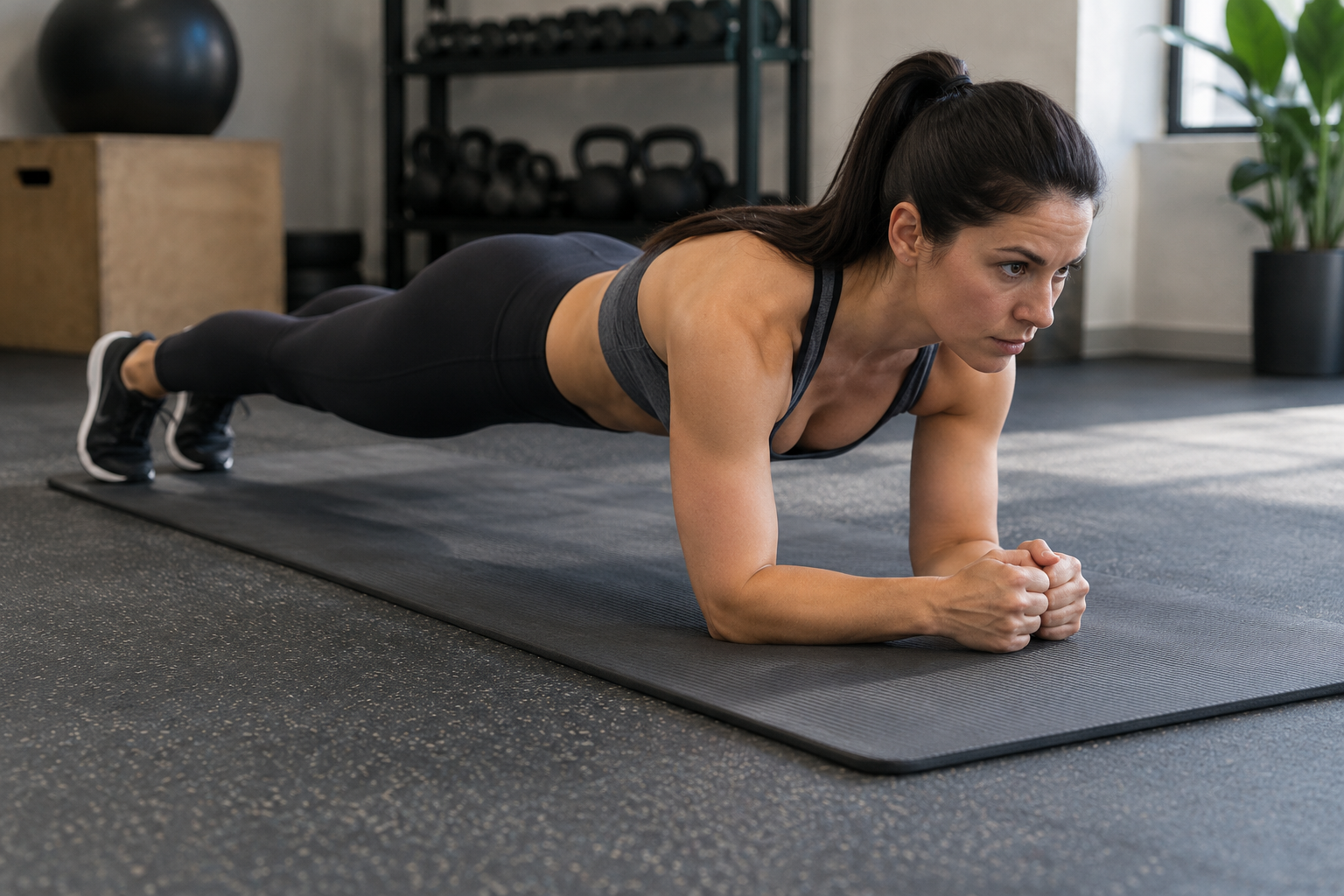
In a front plank, support points carry the body while the trunk maintains position. Their distance and variation affect demand. Begin with a duration allowing recognisable position and breathing rather than a long hold with gradual deterioration. Elevated support or a simplified setup can adapt difficulty. Time alone does not judge the set. Once the task changes, extra seconds no longer describe the same performance. Define the ending criterion beforehand for useful comparisons.
The role of the side plank
A side plank changes force direction and support distribution. It is not simply a more advanced front plank. Adjust leverage and position to support the body without collapse or unexpected contacts. The shoulder and other contact points need to tolerate the variation. If getting into position consumes all effort or causes discomfort, consider another option. Compare times under similar conditions. Altering support, leverage and duration together does not explain which capacity improved.
How can quadruped exercises be used?
An all-fours position allows support changes and observation when a limb lifts. In a bird dog, the task is not merely lifting hand and foot as high as possible. The path should remain compatible with the chosen trunk position. Start with controllable movement without uncontrolled rotation or shifting. Opposite-arm-and-leg extension is one possibility, not compulsory for everybody. Reduce range or change how many supports move together when adaptation is needed.
Observe the return
Returning to the start is part of the repetition. A good initial action followed by a hurried return reduces consistency. Consider hand and knee contact, space and surface. If a body part cannot comfortably support the position, change the setup rather than adding speed. The exercise should permit attention to movement instead of becoming a floor-pressure tolerance test. A mat can improve comfort without automatically solving technique or a personal requirement for specific adaptation.
What do cables and bands offer?
Cables and bands apply forces in different directions. In anti-rotation variations, the task is control while resistance tends to change position. In moving variations, the trunk participates in the intended path. These are not equivalent categories. Choose manageable application and resistance without constantly repositioning to compensate. Any fixing must be suitable and used according to instructions. An available handle does not establish that every anchor suits the movement.
Resistance and operating space
A band changes behaviour as it stretches; a cable machine depends on its transmission. Do not directly compare colours, labels or numbers across systems. Record configuration and distance where needed for repeatability. Keep paths clear of people and objects and check components before use. Learning benefits from demand that leaves the task recognisable. Increasing tension until the whole body leans does not necessarily improve the intended control.
When should loaded variations and carries be used?
Carrying resistance combines trunk control with grip and locomotion. A one-sided load differs from symmetrical distribution. Select weight that permits walking and controlled placement without marked compensation. The route must remain visible and clear. Do not choose a carry simply because it looks more functional. Define its capacity target and whether grip limits it before the trunk. The task includes pickup, route and deposit, not just steps between markers. Organise every phase before the set.
Equipment compatibility
Dumbbells and other loads offer different configurations. Barbells may also appear in a programme involving trunk work, but are not required initially and do not replace every alternative. Check supports, plates, collars and space for the activity. Choice follows movement and experience rather than an obligation to use a particular object. Load application changes demand. More weight does not make exercises with different leverage, paths and support directly comparable.
How should sets and progression be organised?
Choose a few variations with clear purposes rather than every possibility in one session. Repetitions and times should preserve the task, with suitable recovery. Constant exhaustion is unnecessary for useful work. Progress can involve control, range, leverage or resistance, but changing everything obscures interpretation. Keep references stable enough for comparison. Account for squats, pulls and other programme work because the trunk may already be challenged. Added work should fit the full weekly demand.
An understandable choice
An illustrative combination could include a holding task and controlled limb movement. The actual selection depends on the person, not a compulsory pair. Assess regularity and repeatability after practice. Change one variable when too easy; review dose or variation when quality repeatedly declines. Longer time is not the only advance. Longer leverage or a more consistent path changes the task and should be recorded. Adaptation should leave the programme understandable.
How do you choose between a bench and alternatives?
Compare purpose, access, adjustment and space. A bench may provide useful support for certain variations, while floor work or other tools simplify management elsewhere. No absolute winner is necessary. A gym also needs user understanding and peak-time availability. An apparently compact alternative may still need considerable operating room. Assess complete activity and transitions rather than equipment footprint in storage or at rest.
Monitor and adapt
Record variation, supports, repetitions or duration and perceived difficulty. Strong abdominal sensation does not establish quality or suitability by itself. Observe movement and later recovery. If pain or persistent difficulties alter the action, stop or adapt and seek appropriate assessment. The aim is programme-relevant capacity rather than completing a list at any cost. Distinct goals and clear progression turn bench-free core work into an organised choice based on the task and the person's actual possibilities.
Comments (0)