
Trolley
You have no items in your shopping cart

 Budgets
 Dumbers
 Discs
 Benches
 Racks and Rigs
 Weights Holders
 Isotonic machines
 Calisthenics
 Cardio
 Kettlebells
 Flooring
 Gym Set
 Accessories
 Combat
 ARTI MARZIALI
 CONTAINER GYM
 Tug-Of-War
 Used Gym Equipment
 PILATES MACCHINARI
 GINNASTICA ARTISTICA
 CAMPI DA PADEL
 Prodotti in Pronta Consegna
 Informazioni
 IRONMAN
 Gift Card
- Donatif
- General information
- 0 I like it
- 196 Views
- 0 comments
- gym flooring, safety flooring, gym safety, shock-absorbing materials
How to choose a cardio machine: a practical guide for gyms and fitness rooms
Understanding how to choose a cardio machine is one of the most important decisions for anyone who manages a gym, designs a fitness room, or needs to upgrade equipment dedicated to cardiovascular training. The choice is not just about the type of machine, but involves technical characteristics, intensity of use, available space, management costs, and user expectations. Seemingly affordable equipment can prove poorly suited when placed in a professional context with operational needs different from those anticipated.
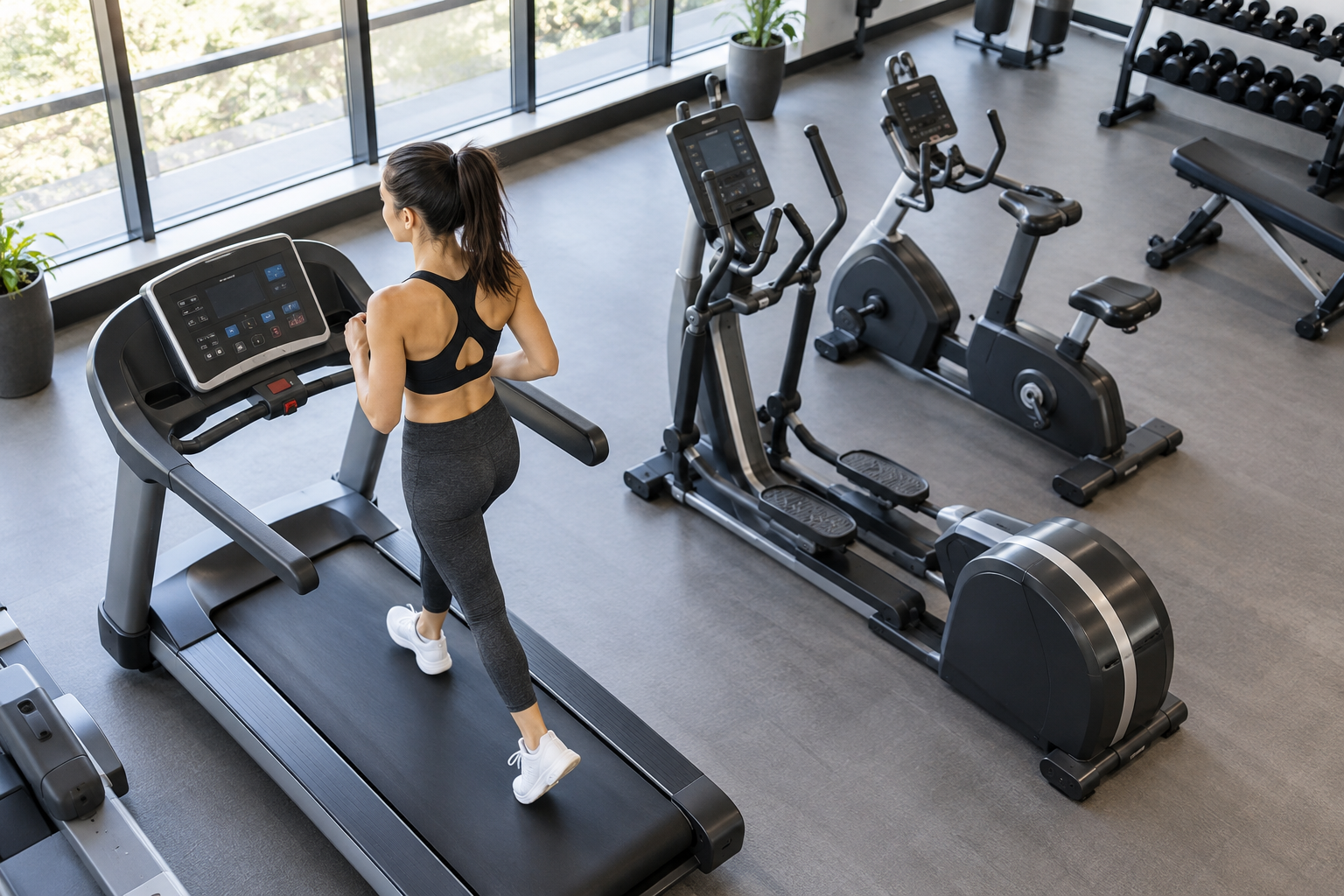
The cardio fitness market includes treadmills, exercise bikes, indoor bikes, ellipticals, rowers, and other solutions designed for different training modalities. Each category has advantages and limitations that must be evaluated in relation to the intended use. For a commercial gym, for example, operational continuity and ease of maintenance may carry more weight than the presence of numerous digital features. In a corporate fitness room, however, simplicity of use, footprint, and accessibility can become priority criteria.
This guide proposes a practical method to compare alternatives without confusing technical performance, purchase price, and commercial value. The objective is to help managers, designers, and purchasing managers define verifiable requirements, recognize compromises, and select equipment consistent with their project, reducing the risk of poorly functional investments.
- Define requirements before choosing
- Compare the main types of cardio machines
- Evaluate the truly important technical specifications
- Verify space, installation, and safety
- Consider intensity of use and reliability
- Analyze purchase and management costs
- Compare offers and suppliers with objective criteria
- Apply criteria to different fitness contexts
- Transform technical evaluation into an informed investment
Define requirements before choosing
The first phase of a correct selection consists in clarifying what function the equipment will have to perform within the structure. Buying a cardio machine without having defined the service objectives means starting from the product characteristics rather than operational needs. This approach can lead to choosing oversized, insufficient, or underutilized models.
A generalist gym must generally satisfy different needs: warm-up, continuous aerobic training, interval work, and moderate-intensity cardiovascular activity. A facility dedicated to athletic preparation might instead require equipment capable of supporting particularly intense and frequent sessions. The distinction directly influences the characteristics to look for.
Before examining catalogs, it is useful to gather information on the number of users, the average duration of sessions, peak attendance times, and the skills of the people who will use the machines. This data makes it possible to build a selection guide based on concrete needs rather than generic preferences.
Identify the profile of users
Age, motor experience, objectives, and physical characteristics of users influence the suitability of a machine. A fitness room frequented by people with very different levels of preparation should prioritize intuitive adjustments, accessibility, and the ability to progressively adapt intensity. In a specialized center, however, more advanced parameters and greater precision in load management can be important.
It is also advisable to consider the variety of body types. Seat adjustments, control positions, dimensions of support surfaces, and declared maximum load capacity can determine how usable a machine really is for the intended clientele.
Establish operational priorities
Not all requirements have the same importance. For some facilities, the priority is to increase the number of available stations, while for others it is to offer complementary training modalities. Separating indispensable requirements, desirable features, and optional functions allows narrowing down alternatives and makes it simpler to justify the final choice.
An effective method consists in assigning a weight to each criterion before evaluating the products. In this way, an interesting digital feature does not risk improperly compensating for a limitation regarding robustness, footprint, or compatibility with the intended use.
Compare the main types of cardio machines
The various cardio machines are not automatically interchangeable. While sharing the general objective of supporting cardiovascular training, they offer different movements, adjustment modalities, and biomechanical demands. Selection should therefore start from the type of experience the facility intends to offer.
Treadmills allow walking and running with speed adjustment and, in designed models, inclination. Bikes allow predominantly seated training, while ellipticals offer a guided movement that involves, depending on the configuration, the upper limbs as well. Rowers instead require specific coordination and involve multiple muscle groups during the gesture.
The best choice does not necessarily coincide with the most versatile machine on paper. It is preferable to evaluate the frequency with which each function will actually be used and the equipment's ability to integrate with the other stations present.
Treadmills and ellipticals
The treadmill represents a particularly recognizable and accessible solution for many users. In professional selection, it is necessary to consider the running surface, motor characteristics, speed range, available inclination, and cushioning system. These elements must be interpreted together with the conditions of use declared by the manufacturer, avoiding attributing an absolute meaning to a single numerical value.
The elliptical can be useful for diversifying the cardiovascular offering through a guided movement. Stride length, transmission fluidity, movement geometry, and the possibility of adjusting resistance affect the experience. Perceived comfort must be checked directly, because machines with similar specifications may turn out differently during exercise.
Bikes and rowers
Upright, recumbent, and indoor cycling bikes meet different needs. The former can be used for general cardiovascular activity, recumbents offer a seated position with back support, and indoor bikes are often oriented toward structured sessions and group workouts. Ergonomic adjustments and resistance characteristics must be compatible with intended users.
Rowers represent an interesting alternative when you want to integrate cardiovascular work with a gesture that involves legs, trunk, and upper limbs. It is important to check the resistance system, smoothness, dimensions, and need for technical supervision. To compare the different families of professional cardio machines, it is best to start from the required training modalities and subsequently delve into the characteristics of individual models.
Evaluate the truly important technical specifications
Product datasheets contain numerous data, but not all have the same decision-making value. A specification becomes useful only when it can be connected to an operational requirement. Power, resistance, load capacity, dimensions, and electronic functions must be interpreted in relation to the intended use, not compared as isolated numbers.
For example, high motor power alone does not guarantee greater reliability. It is necessary to distinguish between nominal power and peak values, verify measurement conditions, and consider thermal management and declared destination of use. Similarly, a high number of preset programs does not necessarily imply a better user experience.
A correct technical comparison requires homogeneous data. When two producers use different definitions, it is appropriate to ask for clarification before attributing an advantage to one of the products. The quality of available information is itself a useful element in evaluation.
Mechanical performance and adjustments
In treadmills, it is useful to examine the characteristics of the belt, deck, and transmission system. In bikes, stability, position adjustments, and resistance progressivity take on greater importance. For ellipticals and rowers, it is necessary to check movement fluidity, ergonomics, and braking system response.
The maximum user weight capacity must be compared with the intended public and the manufacturer's indications. It is also important to verify that adjustments are easily accessible and maintain position during use. A technically advanced machine that is difficult to adapt can generate problems in daily management.
Console, monitoring, and connectivity
Displays, programs, heart rate detection, and connectivity can improve the experience, but their value depends on the service offered. A gym offering structured training paths might benefit from monitoring functions and digital integration, while a small fitness room might prioritize immediate commands and simple interfaces.
Before considering an electronic function indispensable, it is appropriate to verify compatibility, any subscriptions, availability of updates, and continuity of software support. The displayed measurements must also be interpreted according to the manufacturer's indications, without assuming that every parameter has clinical precision.
Verify space, installation, and safety
The declared dimensions of a machine represent only a part of the necessary space. To properly design a cardio area, one must consider accesses, circulation paths, operating distances, maintenance interventions, and manufacturer safety indications. A layout that is too compact can compromise accessibility and comfort.
The evaluation must also include flooring, floor load capacity, availability of electrical power supplies, and environmental conditions. The heaviest machines or those subject to dynamic stresses require particular attention to compatibility with the room. In complex projects, it is appropriate to involve competent professionals for structural and plant engineering checks.
An effective layout does not consist of placing as many tools as possible in a limited surface. The objective is to achieve a balance between service capacity, usability, and management. Adequate spaces also favor cleaning, supervision, and technical interventions.
Dimensions and user paths
Before purchasing, it is useful to represent each piece of equipment on a floor plan, including the free areas required by the manual. It is necessary to check door openings, the passage of any wheelchairs, the accessibility of controls, and the possibility of reaching the machines without crossing dangerous operating zones.
Safety distances should not be defined through generic values applied indiscriminately to all machines. They must be verified against the instructions of the selected model and the provisions applicable to the installation context.
Electrical power supply, noise, and ventilation
Some equipment requires continuous electrical power, while others use autonomous systems or batteries for certain functions. It is necessary to check voltage, absorption, plug type, and indications relating to system protection. Installation must respect manufacturer prescriptions and relevant standards.
Noise and vibrations deserve attention especially in hotels, offices, apartment buildings, and structures with sensitive adjacent rooms. Ventilation and temperature can also affect user comfort and the operating conditions of the equipment. Preventive verification reduces the likelihood of costly modifications after delivery.
Consider intensity of use and reliability
One of the most important differences between a machine destined for a domestic environment and one designed for professional contexts concerns the expected usage profile. A commercial gym can subject equipment to consecutive sessions, frequent adjustments, and users with different physical characteristics. Therefore, it is not sufficient to evaluate the external appearance or the presence of similar functions.
The commercial classification of the product must be accompanied by verifiable indications on the destination of use. It is useful to request information regarding permitted conditions, any limitations of use, maintenance procedures, and warranty coverage in a professional environment.
Reliability depends on several factors: mechanical design, component quality, correct installation, maintenance, and compliance with operating limits. It is not possible to deduce the actual duration of a machine from price alone or from the weight of the structure.
Frequency of use and workloads
To size the cardio fleet, it is useful to estimate how many people will use the equipment simultaneously and for how long. A machine used for short and occasional sessions presents different needs compared to a station engaged for a large part of the day. The opening hours of the gym alone do not describe the actual load.
A practical example consists in recording attendance in peak bands and comparing them with the average duration of workouts. If demand is concentrated on a few stations, it might be more useful to increase the number of machines requested by users rather than purchasing a particularly sophisticated but underutilized model.
Preventive maintenance and spare parts availability
Maintenance must be considered right from the selection phase. Cleaning, periodic checks, adjustments, and replacement of components subject to wear vary according to the technology used. It is appropriate to request the maintenance manual and check which interventions can be performed by internal staff and which require qualified assistance.
The availability of spare parts and intervention times are particularly relevant when a machine breakdown reduces service capacity. An initial lower price can lose part of its convenience if repairs require long periods of inactivity or hard-to-find components.
Analyze purchase and management costs
The purchase price is only one component of the investment. To correctly compare two pieces of equipment, one must consider delivery, installation, any room adjustments, consumption, maintenance, and predictable repair costs. This approach makes it possible to distinguish immediate savings from convenience over the period of use.
The total cost of ownership makes it possible to organize this information into a single economic framework. It does not provide a certain forecast, because some costs depend on failures and future operating conditions, but it helps make assumptions explicit and compare offers on coherent bases.
For a gym, it is also useful to consider the economic impact of station unavailability. An out-of-service machine can cause waiting times, limit workout planning, and reduce the quality perceived by members. The value of this consequence depends on the organization of the structure and should not be estimated through arbitrary percentages.
Distinguish initial price and ancillary costs
A quote should specify whether it includes transport, floor handling, assembly, testing, initial training, and packaging disposal. Conditions can vary significantly among suppliers and make a comparison based exclusively on the price indicated in the catalog unmeaningful.
It is also necessary to verify whether accessories, dedicated electrical connections, or paid digital services are necessary. Separating these items allows identifying the cost required to make the machine actually usable, avoiding surprises during installation.
Energy consumption and economic life
To estimate energy consumption, it is not enough to consider the declared maximum power. Real consumption depends on the machine's operation, session intensity, usage time, and any standby states. When available, data measured under representative conditions offer a more useful basis for comparison.
An example of economic evaluation can use a five-year horizon, summing purchase, installation, estimated energy, and planned maintenance. The chosen duration is only an analysis hypothesis and does not represent a guarantee on the useful life of the product. Comparing different scenarios allows understanding how much the result depends on operating conditions.
Compare offers and suppliers with objective criteria
Once requirements are defined, commercial selection should become simpler. Instead of requesting generic quotes for apparently equivalent machines, it is best to communicate the installation context, expected number of users, training modalities, and economic constraints to suppliers. This allows obtaining more comparable proposals.
The evaluation of cardio equipment can be organized through a matrix that distinguishes mandatory requirements and preference criteria. Safety, compatibility with professional use, and dimensional limits can be considered conditions of admissibility. Ergonomics, ease of maintenance, digital functions, and overall cost can instead contribute to the comparative score.
It is important to prevent the evaluation from turning into a sum of irrelevant characteristics. A product with numerous accessory functions should not automatically surpass a simpler solution that better satisfies operational needs. Criteria must be defined before examining offers, limiting the risk of modifying priorities based on commercial presentation.
Request verifiable technical documentation
A well-structured request for quotation should include a complete technical data sheet, user manual, installation indications, warranty conditions, and assistance information. It is useful to verify documentation relating to compliance with applicable requirements and technical standards pertinent to the specific category of equipment.
Commercial claims such as high resistance, intensive use, or professional technology must be accompanied by concrete information. When a parameter is not available, it is preferable to record the data as unverified rather than attributing a presumed performance to the product.
Evaluate assistance, warranty, and support
Warranty conditions must be read carefully, distinguishing duration, covered components, exclusions, and intervention procedures. It is particularly important to verify that coverage is valid for the intended destination of use, especially when machines will be installed in facilities open to the public.
After-sales support also includes spare parts availability, technical assistance, and clarity in managing reports. A supplier that communicates procedures and conditions transparently allows the purchasing manager to better evaluate the operational risk associated with the investment.
Apply criteria to different fitness contexts
There is no universally correct cardio configuration. The choice changes according to the size of the structure, the service model, and the type of clientele. Applying the same criteria to different contexts helps understand which characteristics are truly decisive and which can be considered secondary.
A commercial gym with high attendance might prioritize operational continuity, ease of use, and the availability of multiple stations. A corporate fitness room with distributed access throughout the day could focus on footprint, simplicity of controls, and autonomous management. A center dedicated to athletic preparation might instead require specific adjustments and monitoring tools compatible with training programs.
These examples do not constitute mandatory configurations. They serve to show how the context modifies the weight of criteria and why a choice technically valid for one facility can be disadvantageous for another.
Commercial gym with frequent use
Imagine a gym that needs to renovate a cardio area frequented mostly in the evening hours. Before replacing existing machines, the manager can analyze which stations are used most, how long sessions last, and where any queues form. This information makes it possible to establish whether it is necessary to increase the number of treadmills, diversify the types, or improve the reliability of the machines present.
In this scenario, the choice should attribute particular importance to maintenance, spare parts, ease of cleaning, and resistance to repeated use. The addition of advanced features can be useful, but should be justified by actual customer needs or service programming.
Corporate fitness room or accommodation facility
A compact fitness room must often offer a versatile service with few stations. In this case, it is appropriate to choose equipment that is easily understood even without continuous assistance, verifying instructions, accessibility, and safety devices. The variety of training modalities can be more important than the presence of many machines belonging to the same category.
A possible project can provide for a combination of treadmills and bikes, evaluating an elliptical or a rower according to space and public. The final configuration must in any case derive from the analysis of needs and technical checks of the room, not from a standard composition.
Athletic preparation center and specialized training
In a structure oriented toward athletic preparation, selection may require greater attention to resistance response, adjustability repeatability, and the possibility of executing specific protocols. The choice between bikes, rowers, and treadmills depends on the required gesture and the relationship with other activities carried out in the center.
It is useful to involve technicians responsible for programming and provide practical tests with users. The compatibility between machine, training methodology, and staff skills constitutes a more reliable criterion than the mere presence of advanced functions in the catalog.
Transform technical evaluation into an informed investment
The final decision should be built through a verifiable sequence: definition of needs, identification of mandatory requirements, comparison of types, verification of specifications, and economic analysis. This process makes it possible to reduce the number of alternatives without sacrificing the elements that truly affect service quality.
Before approving the purchase, the facility manager should be able to answer some fundamental questions: what need does the machine solve, how many users will use it, what operating conditions must it sustain, how much space does it require, and what costs does it entail in the considered period. The answers should be documented through internal data, technical data sheets, and verifiable commercial conditions.
A well-motivated cardio machine choice does not necessarily require the most expensive product or the one with the highest number of functions. Instead, it requires coherence between performance, intended use, and available resources. When two alternatives satisfy essential requirements, it is reasonable to favor the one that offers the best balance between overall cost, managerial simplicity, and assistance.
Build a simple decision matrix
To make the comparison more transparent, indicative weights can be assigned to the main criteria. For example, a commercial gym could assign 30% to reliability and fitness for use, 25% to ergonomics and performance, 20% to total cost, 15% to assistance, and 10% to additional functions. These percentages represent only an example and must be adapted to the actual priorities of the structure.
Each product can receive a score for each criterion, provided the evaluation is supported by verifiable information. Mandatory requirements must be checked separately: a machine unsuited for installation or intended use should not be recovered through a high score in optional functions.
Perform checks before ordering
Before confirmation, it is useful to check definitive dimensions, delivery accesses, electrical requirements, warranty conditions, available documentation, and services included in the quote. When possible, a practical test helps evaluate ergonomics, noise, fluidity, and ease of adjustment, aspects that do not always emerge from technical data sheets.
For more significant investments, it is appropriate to keep a summary of the examined alternatives and the reasons for the choice. This documentation facilitates comparison with suppliers and consultants, makes spending approval clearer, and constitutes a useful basis for subsequent expansions or replacements of the machine fleet.
Investment protection also depends on the ability to anticipate the evolution of the structure. A modular configuration, composed of equipment compatible with current needs and integrable over time, can offer greater flexibility compared to a purchase concentrated exclusively on the features available today. Evaluating the project as a whole allows allocating the budget to truly necessary performance while keeping technical, economic, and operational risks under control.
Comments (0)