
Trolley
You have no items in your shopping cart

 Budgets
 Dumbers
 Discs
 Benches
 Racks and Rigs
 Weights Holders
 Isotonic machines
 Calisthenics
 Cardio
 Kettlebells
 Flooring
 Gym Set
 Accessories
 Combat
 ARTI MARZIALI
 CONTAINER GYM
 Tug-Of-War
 Used Gym Equipment
 PILATES MACCHINARI
 GINNASTICA ARTISTICA
 CAMPI DA PADEL
 Prodotti in Pronta Consegna
 Informazioni
 IRONMAN
 Gift Card
- Donatif
- General information
- 0 I like it
- 176 Views
- 0 comments
- gym flooring, safety flooring, gym safety, shock-absorbing materials
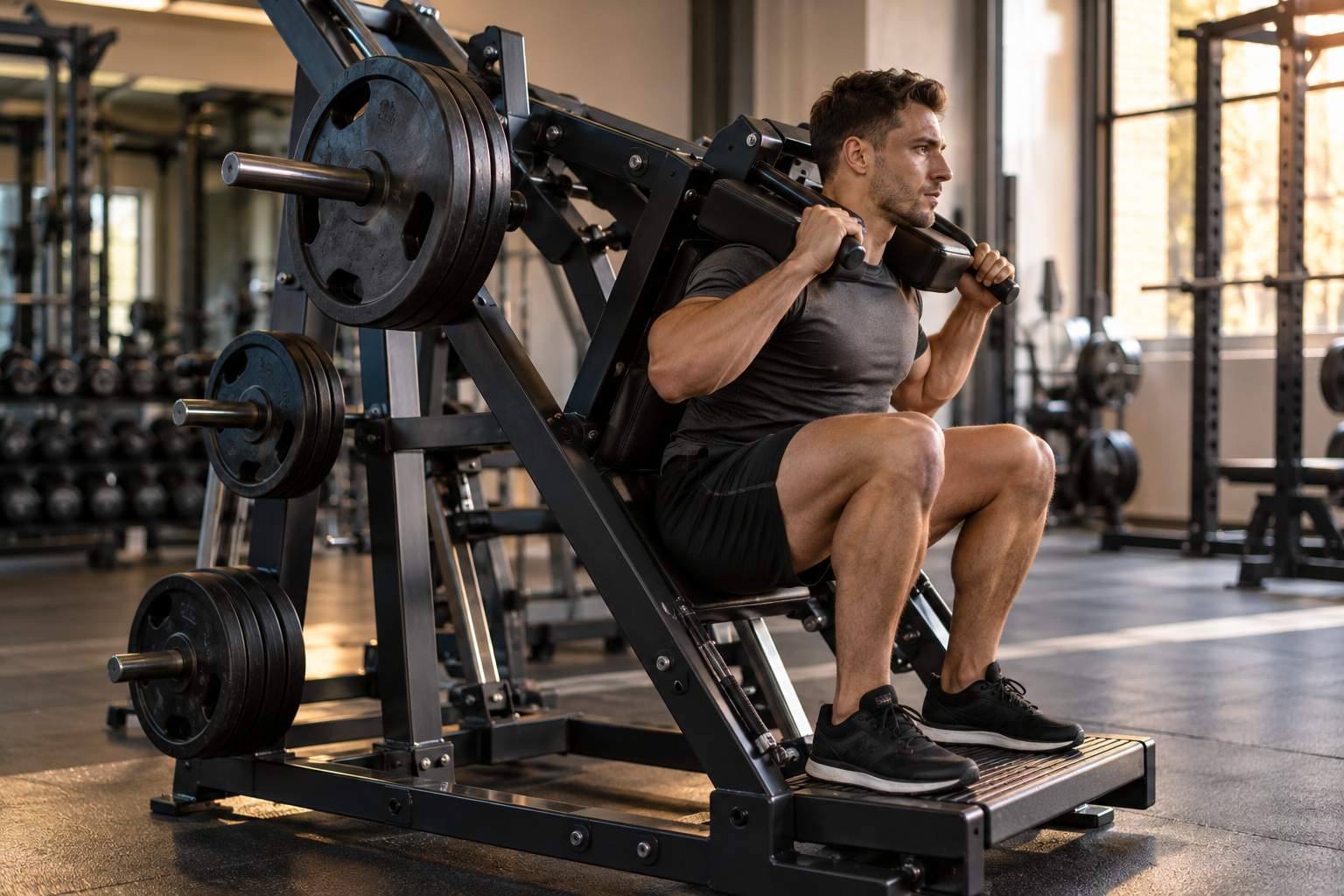
Muscles involved in the power squat machine: workout guide
Knowing the muscles involved in the power squat machine helps to better understand the role of this equipment in lower body preparation. The power squat machine is a squat exercise machine that, depending on its structural configuration, guides or conditions the trajectory of movement through a mechanical structure. It is used in weight rooms primarily to train the quadriceps and glutes, with the contribution of other muscle groups involved in stabilization and joint control.
For gym managers, athletic trainers, and strength area supervisors, knowing how the machine works means being able to evaluate its contribution to the training offer. Not all power squat machines have the same geometry: footplate position, movement inclination, load distribution, and the presence of body supports can significantly alter execution. For this reason, technical indications must always be interpreted considering the model actually available.
This guide analyzes the main muscles involved, the differences compared to free-weight squats, the variables that influence muscle work, and the criteria for including the machine in a professional weight room. The objective is to provide useful information both for exercise programming and equipment evaluation, distinguishing potential benefits from characteristics that must be verified before purchase.
- How the power squat machine works
- Main muscles involved in the movement
- Secondary muscles and stabilization
- Execution technique and body position
- Differences between the power squat machine and free-weight squat
- How to include the machine in training
- Common errors and safety criteria
- Technical evaluation and investment for the weight room
How the power squat machine works
The power squat machine is designed to allow a squat movement through a structure that conditions the load trajectory. Depending on the model, the user may be in an upright, inclined position, or supported by specific rests. The movement mainly involves flexion and extension of the hip and knee joints, with ankle participation varying according to geometry and foot position.
Compared to a free barbell squat, the machine introduces mechanical constraints that modify balance and coordination demands. This does not mean that all models eliminate the need for stabilization or that they reproduce the exact same motor pattern. The structure configuration determines which movements are allowed and how forces are transferred to the body during the exercise.
For a technical manager, it is important to distinguish the general characteristics of the category from the specifics of the individual product. A lever-operated machine may behave differently from a guided carriage structure. The relationship between applied load and actually perceived resistance can also change along the trajectory, making it uninformative to compare loaded kilograms alone.
Guided trajectory and load distribution
The movement trajectory is determined by the mechanical structure of the machine. In lever models, the fulcrum position and arm length influence resistance behavior. In guided systems, however, the movement follows the path allowed by the structural elements.
These differences can modify the relationship between joint movement and muscle demand. Before choosing a machine, it is therefore useful to observe how it behaves throughout the entire range of motion, verifying that it allows intended users to assume positions compatible with their anthropometric characteristics.
Differences between power squat, hack squat, and other machines
Commercial names for squat machines are not always used uniformly. Power squats, hack squats, and other configurations may share functional similarities but differ in body position, supports, and movement geometry.
For this reason, the choice should not be based solely on the product name. Technical sheets, structure images, manufacturer indications, and practical tests allow for a better understanding of the machine's characteristics and its compatibility with training goals.
Main muscles involved in the movement
The main muscle groups engaged in the power squat machine are the quadriceps and the gluteus maximus. Their participation stems from the need to produce force during knee and hip extension. The relative extent of muscle contribution depends on the machine configuration, joint range of motion, and adopted technique.
It is incorrect to state that a certain foot position completely isolates a single muscle. The involved joints continue to require the coordinated contribution of multiple muscle groups. Technical variations can modify joint angles and mechanical demands, but precise effects depend on the model and individual characteristics.
For a professional weight room, understanding these relationships allows the machine to be used as a lower limb training tool without attributing exclusive properties to it. The power squat machine can complement other exercises, helping to create programs with different stimuli and execution modes suited to users.
Quadriceps and knee extension movement
The quadriceps in the power squat machine play a fundamental role during the ascent phase. This muscle group includes the rectus femoris, vastus lateralis, vastus medialis, and vastus intermedius. Their primary function in the movement consists of contributing to knee extension.
The demand on the quadriceps varies in relation to joint angles and external forces. A configuration that entails a greater demand for knee extension can increase the mechanical contribution of this muscle group, but a universal rule valid for all machines cannot be established.
Gluteus maximus and hip extension
The gluteus maximus contributes to hip extension during the ascent. Its role is particularly important when the movement requires overcoming a significant external moment at the hip joint.
Squat depth and movement geometry can influence glute and muscle contribution, but greater depth does not automatically guarantee superior results. The range of motion must be compatible with the user's mobility, the machine's structure, and the maintenance of technical control.
Secondary muscles and stabilization
In addition to the quadriceps and gluteus maximus, the power squat machine involves other muscle groups that contribute to movement and stabilization. These include hip adductors, some posterior thigh muscles, calf muscles, and trunk musculature. Their role varies according to machine configuration and execution conditions.
The presence of supports and guides can reduce certain balance demands compared to a free exercise, but it does not necessarily eliminate muscle control work. The user must still maintain a position consistent with the allowed movement and correctly manage the forces applied during the set.
For instructors, it is useful to distinguish muscle involvement from the primary function of the exercise. A muscle can contribute to stabilization without representing the main training target. This distinction avoids describing the power squat machine as a tool capable of training all involved muscle groups with the same intensity.
Adductors and posterior thigh muscles
The adductor magnus can contribute to hip extension, especially through its posterior portion. Other adductor muscles participate in controlling lower limb position according to joint angles and movement demands.
Posterior thigh muscles, including the biceps femoris, semitendinosus, and semimembranosus, can contribute to hip and knee control. However, their role during a squat does not necessarily equate to that performed in specific exercises like leg curls or certain hip extension movements.
Calves and trunk musculature
The soleus and other muscles of the calf region contribute to ankle control and stability during movement. The extent of their participation depends on foot position and the kinematics allowed by the machine.
Abdominal and trunk muscles collaborate in maintaining posture. In models equipped with significant supports, certain demands may differ compared to free-weight squats, but maintaining adequate body control during all repetitions remains necessary.
Execution technique and body position
Correct execution on the power squat machine requires adapting the starting position to the equipment geometry and user characteristics. Before loading the machine, it is advisable to check the adjustment of any supports, the operation of safety devices, and the ability to complete the movement without obvious compensations.
Foot position must allow stable support and controlled force distribution. There is no universal distance valid for every person and every model. Limb length, joint mobility, and footplate structure influence the most appropriate position. For this reason, generic indications must be adapted through practical evaluation.
During the descent, it is important to control the movement, avoiding involuntary accelerations and loss of position. The ascent must be executed while maintaining contact with the provided supports and respecting the machine's trajectory. The objective is to use a manageable range of motion without turning the load into an obstacle to technical quality.
Foot position and stimulus variations
Foot position can influence knee and hip angles, modifying mechanical demands on muscle groups. However, the effect is not identical across all machines and cannot be described through absolute rules like high feet for glutes and low feet for quadriceps.
To evaluate a variant, it is preferable to observe actual movement, verifying stability, joint comfort, and the ability to maintain control. Modifications must remain compatible with the manufacturer's instructions and the useful surface of the footplate.
Squat depth and joint control
Movement amplitude influences joint position and required muscle work. Greater depth can modify the stimulus, but it must be achieved without losing posture control or forcing positions incompatible with the user.
It is useful to identify a repeatable and progressively adaptable range of motion. In professional contexts, the instructor should verify that the user does not use the mechanical bottom stop as a substitute for muscle control and respects any limits provided by the machine.
Differences between the power squat machine and free-weight squat
The power squat machine and free barbell squat may involve similar muscle groups, but they present important differences in coordination, stabilization, and load management demands. In the free squat, the user must independently control the barbell trajectory and maintain the balance of the body-and-load system. In the machine, however, the mechanical structure conditions the path and can modify certain stabilization demands.
These differences do not automatically make one exercise superior to the other. The choice depends on training goals, athlete experience, and structure characteristics. For example, a program aimed at improving competitive squatting must include specific work on the gesture required by the discipline, while a machine can be used to add lower limb training volume.
It is important to avoid direct comparisons between loads lifted in the two exercises. The mass of plates loaded on the machine does not necessarily correspond to the actual resistance perceived during movement. Levers, possible inclination, and the weight of moving parts influence system behavior.
When guided trajectory can be useful
A machine with a constrained trajectory can allow focus on specific hip and knee extension demands, reducing certain difficulties related to controlling a free barbell. This can be useful in programming complementary exercises and managing different levels of experience.
The actual advantage still depends on compatibility between machine geometry and individual characteristics. A guided path is not automatically suitable for everyone and must be evaluated through practical execution.
Role of free-weight squats in powerlifting
In powerlifting, the barbell squat represents a specific competitive gesture. Preparation therefore requires technique training, balance management, and the ability to produce force under conditions required by the discipline's rules.
The power squat machine can be used as a complementary exercise for the lower limbs, but it does not completely replace the technical demands of the free squat. Its introduction should be evaluated in relation to the overall program and the athlete's needs.
How to include the machine in training
Programming the power squat machine must start from the user's goals. The exercise can be included in routines dedicated to muscle hypertrophy, general strength development, or lower limb conditioning. The choice of sets, reps, and load depends on experience level, recovery capacity, and total program volume.
For an athlete already using free squats and other multi-joint exercises, the machine can represent an additional modality to distribute muscle work. For a less experienced user, it can be proposed after verifying that equipment geometry allows controlled movement. In both cases, technical supervision remains important.
There is no universally correct number of sets. An effective program considers weekly frequency, other lower limb exercises, and individual response. Performance monitoring can include completed reps, execution quality, perceived exertion, and load progression over time.
Use for muscle hypertrophy
In hypertrophy-oriented programs, the power squat machine can be used to provide a stimulus to the quadriceps and glutes through sets performed with a controlled range of motion. Load choice must allow maintaining consistent technique during repetitions.
Progression can be organized by gradually increasing repetitions or resistance when the user demonstrates correct management of the previous level. The result depends on the overall program and not just the presence of the machine.
Use as a complementary strength exercise
For athletes practicing powerlifting or other strength disciplines, the machine can be included as an accessory exercise. Its function is to contribute to lower limb work without necessarily reproducing all technical demands of the competitive movement.
The position of the exercise in the session must be defined considering accumulated fatigue and training priorities. A high load does not automatically indicate greater effectiveness if it compromises execution or interferes with recovery.
Common errors and safety criteria
One of the most frequent errors in using the power squat machine consists of selecting excessive load before understanding movement trajectory. The presence of a guided structure can create a perception of greater simplicity, but it does not eliminate the need to control posture, range of motion, and resistance management.
Another critical issue concerns adapting body position. Users may present different body proportions, and not all machines offer the same adjustment possibilities. When a user cannot maintain an adequate position, modifying allowed adjustments or evaluating an alternative exercise is appropriate.
For professional gyms, providing clear instructions on safety device usage is important. Stops, locking systems, and moving components must be checked according to manufacturer instructions. A machine should not be used when it shows structural anomalies, irregular movements, or damaged components.
Excessive loads and incomplete repetitions
Using a load superior to one's capabilities can lead to excessively reducing range of motion or losing control of the descent phase. Under these conditions, comparing performance between sessions and evaluating real progress becomes difficult.
A more reliable strategy consists of selecting resistance that allows technically consistent repetitions. Increments should be introduced when the user demonstrates maintaining stability and control in the chosen movement interval.
Machine checks and maintenance
Machines destined for intensive use require periodic checks on structural components, movement systems, supports, and safety devices. Verification frequency must be defined considering manufacturer instructions and gym operating conditions.
Anomalous noises, mechanical play, deformations, or movement difficulties require attention. When a problem can compromise safety, the equipment must be excluded from use until checked and restored.
Technical evaluation and investment for the weight room
For a gym manager, purchasing a power squat machine must be evaluated considering its actual contribution to workout programming. The machine can expand lower limb work possibilities, but its value depends on intended use, user compatibility, and integration with existing equipment.
The first check concerns structure geometry. Knowing overall dimensions, necessary operating space, loading methods, and support characteristics is important. A machine with compact dimensions is not necessarily the best solution if it excessively limits user range of motion or makes daily operations difficult.
Economic comparison should include initial price, delivery, assembly, maintenance, and spare parts availability. Evaluating the machine's capacity to serve users with different physical characteristics is also useful. A versatile solution may be interesting for a generalist weight room, while a specialized center might prioritize more specific characteristics.
Comparison with racks, barbells, and other equipment
Before purchasing a new machine, verifying which exercises are already available in the facility is appropriate. Racks, barbells, benches, and other equipment allow organizing different strength programs, but they do not necessarily reproduce the characteristics of a power squat machine.
To evaluate the organization of the area dedicated to barbell exercises, one can consult racks and rigs for professional gyms, comparing dimensions, configurations, and installation requirements. The comparison must focus on actually required functions without automatically considering guided machines and free-weight structures interchangeable.
Practical criteria before purchase
Before confirming the investment, verifying a few elements is useful: does the machine allow adequate range of motion for intended users? Is movement geometry compatible with programmed exercises? Are safety devices easily accessible? Are technical indications on loads, maintenance, and installation available? Does operating space allow orderly use?
These questions help distinguish essential characteristics from secondary ones. Whenever possible, a practical test with users of different builds can provide useful information on adjustability and training experience quality.
Total cost of ownership and operational continuity
The cost of a professional machine does not coincide with the purchase price alone. Transport, installation, possible space adaptations, and maintenance can impact the overall investment. The availability of replacement components and clear instructions for checks contributes to management planning.
For a facility with high usage frequency, evaluating the time needed to adjust the machine and modify loads is also appropriate. A workstation simple to manage can favor session organization, but the advantage must be verified against the actual operating modes of the gym.
Choosing based on gym goals
A power squat machine can represent a useful integration when the facility wishes to expand quad and glute training possibilities. The decision should nonetheless be based on documentable needs, such as user type, proposed programs, and space availability.
Understanding muscle involvement, differences from free-weight squats, and the limits of different configurations allows evaluating equipment with greater awareness. For the purchasing manager, the most solid criterion remains consistency between the machine's technical characteristics, training goals, and weight room operating conditions.
Comments (0)