
Trolley
You have no items in your shopping cart

 Budgets
 Dumbers
 Discs
 Benches
 Racks and Rigs
 Weights Holders
 Isotonic machines
 Calisthenics
 Cardio
 Kettlebells
 Flooring
 Gym Set
 Accessories
 Combat
 ARTI MARZIALI
 CONTAINER GYM
 Tug-Of-War
 Used Gym Equipment
 PILATES MACCHINARI
 GINNASTICA ARTISTICA
 CAMPI DA PADEL
 Prodotti in Pronta Consegna
 Informazioni
 IRONMAN
 Gift Card
- Donatif
- General information
- 0 I like it
- 74 Views
- 0 comments
- gym flooring, safety flooring, gym safety, shock-absorbing materials
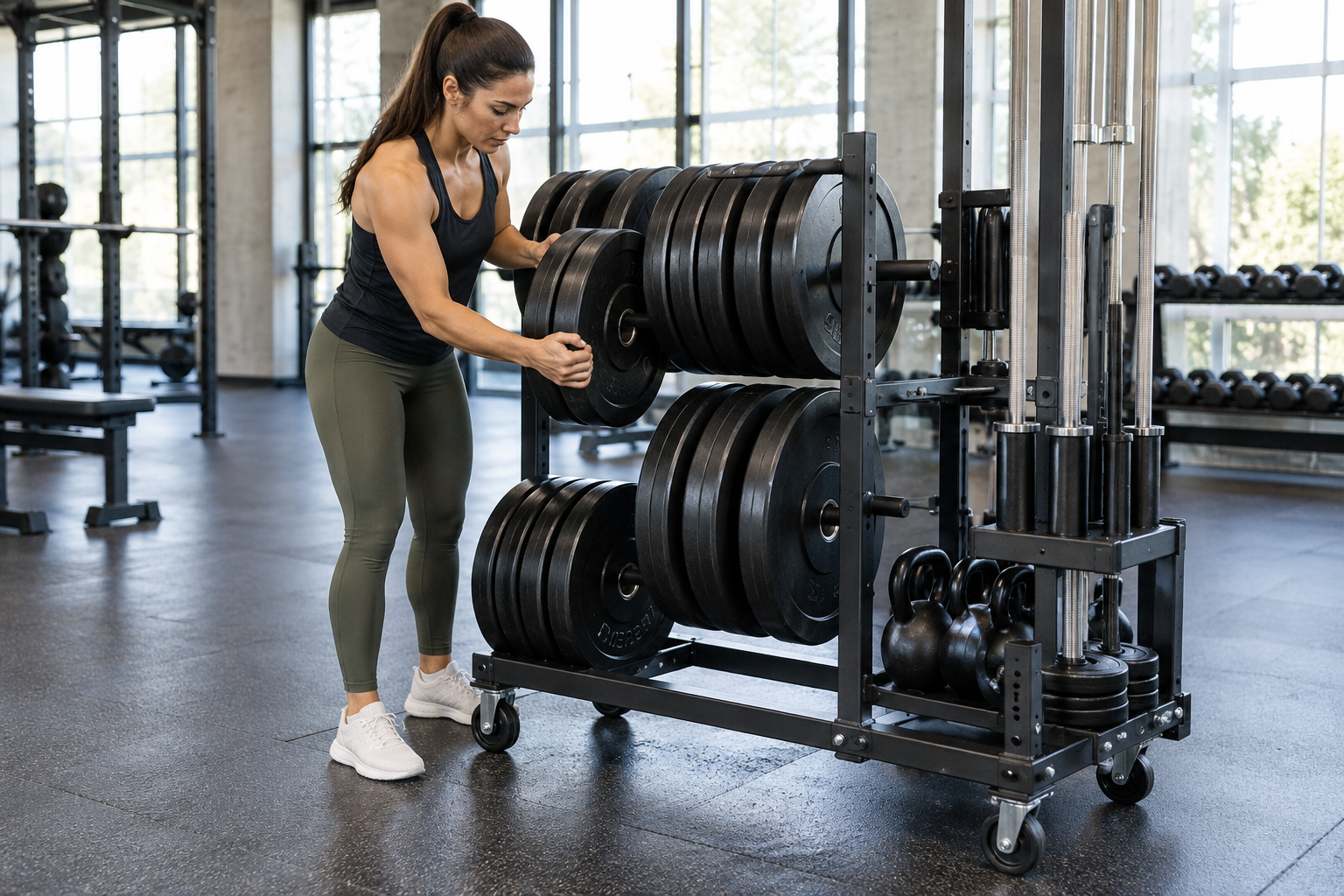
How to organize a weight trolley in the gym: space, safety, and efficiency
A professional weight room must allow users to quickly locate, pick up, and replace equipment without creating obstacles in training areas. A weight trolley contributes to this goal by concentrating various loads in an organized structure, reducing the presence of plates and other accessories on the floor. Its effectiveness, however, depends on the chosen position, the distribution of the weights, and the usage procedures adopted by the gym.
Understanding how to organize a weight trolley in the gym means simultaneously evaluating load capacity, accessibility, stability, and movement flows. A correctly sized trolley can facilitate the work of instructors and improve room organization, while an inefficient layout can generate unnecessary movement and increase the risk of accidental collisions or falls.
For a gym manager or purchasing officer, weight organization also represents a design choice. It is not enough to purchase a high-capacity support: you must verify which equipment will be stored, how frequently it will be used, and which spaces must remain free. This guide explores the practical criteria for designing an orderly, efficient station consistent with the needs of a professional strength room.
- Function of the weight trolley in the strength room
- Analyzing types and quantities of weights
- Correctly distributing loads on the trolley
- Choosing the best position in the gym
- Organizing weights and sizes for quick access
- Safety, stability, and handling
- Materials, maintenance, and periodic checks
- Operational procedures to maintain order
- Evaluating the investment and planning the growth of the weight room
Function of the weight trolley in the strength room
The weight trolley is a structure designed to collect and organize equipment used in strength training. Depending on the configuration, it can accommodate plates, dumbbells, or other accessories compatible with the available supports. Some models are equipped with wheels to facilitate movement, while others are intended to remain in a stable position. This distinction must be considered before defining usage methods.
In a professional gym, the trolley performs an organizational function as well as a storage one. It allows for an identifiable position to be assigned to equipment and helps keep training surfaces clear. When weights are stored correctly, users can more easily find the necessary sizes and instructors can monitor the availability of materials.
The effectiveness of the system depends on the relationship between the trolley and the surrounding stations. A high-capacity structure located far from usage areas may force users to frequently carry heavy loads. Conversely, a position too close to the barbells may hinder movement and reduce operating space.
Advantages for gym organization
A well-designed storage system helps reduce equipment dispersion and facilitates reordering operations. This aspect becomes particularly important during peak hours, when multiple people are using plates and accessories simultaneously.
The presence of defined positions can also help staff quickly recognize any shortages or anomalies. Visual organization thus contributes to the daily management of the strength room.
Difference between a trolley and a fixed rack
A mobile trolley can be useful when the room layout changes frequently, for example during personal training sessions or circuit activities. A fixed rack may be more suitable for stations that require a permanent load arrangement.
The choice must consider the frequency of movement, the required capacity, and the characteristics of the floor. Mobility represents an advantage only when the trolley is designed to be moved safely under the intended conditions.
Analyzing types and quantities of weights
Before organizing the trolley, it is necessary to take an inventory of the equipment to be stored. The total quantity is not the only important piece of data: it is necessary to distinguish sizes, the diameter of the plates, their thickness, and the possible presence of handles or coatings. These characteristics determine the necessary space and compatibility with the supports.
A room dedicated to powerlifting may use numerous heavy plates, while a general fitness area might require a greater variety of light and intermediate sizes. In both cases, the configuration must be consistent with the activities actually performed. A trolley designed without considering the composition of the equipment risks having underutilized supports and others that are constantly overloaded.
It is useful to distinguish between equipment used daily and materials used only on specific occasions. The most popular weights should be easily accessible, while those used less frequently can be stored in secondary positions, provided their placement meets stability requirements.
Creating an inventory of available sizes
An effective inventory should report the nominal weight, quantity, type, and main dimensions of each plate. It is also advisable to record any differences between models, especially when the gym uses cast iron plates, bumper plates, and products with different coatings.
This information allows you to calculate the total weight to be stored and to verify if the declared capacity of the trolley is sufficient. The inventory should be updated when components are purchased or replaced.
Verifying support compatibility
The pins intended for plates must have dimensions compatible with the central hole. The usable length must also allow the plates to be inserted without exceeding the limits provided by the manufacturer.
Do not assume that a support suitable for Olympic plates is automatically compatible with every other type of weight. Dimensional verification avoids insertion difficulties and incorrect support conditions.
Correctly distributing loads on the trolley
Weight distribution is one of the most important aspects of organization. Every trolley has an overall load capacity and, when specified, different limits for individual shelves or pins. These values must be respected regardless of the apparently available space. The physical possibility of inserting other plates does not imply that the structure can support them safely.
In general, keeping heavier loads in lower areas can help lower the center of gravity of the structure. However, the arrangement must follow the manufacturer's instructions, especially when the trolley has a particular geometry or supports designed for specific sizes. An asymmetrical distribution can compromise stability during use or movement.
The distribution of loads on weight holders must also consider the frequency of pick-up. Placing all heavy plates in hard-to-reach places can increase the effort required by users. The goal is to find a balance between structural stability and ergonomics, always respecting the manufacturer's technical specifications.
Center of gravity and structural stability
The center of gravity depends on the position and quantity of the loaded weights. When a high mass is concentrated at the top, the structure can become more sensitive to lateral stress.
It is advisable to distribute the plates in a balanced way between the sides and verify that the trolley remains stable during normal pick-up operations. The configuration must also be evaluated when some supports are empty.
Maximum load and load per support
The declared capacity represents an operating limit that must not be exceeded. When the manufacturer specifies capacities for shelves or pins, these values must also be respected.
For professional management, it may be useful to prepare an internal schedule with the expected load for each position. This facilitates control and reduces the risk of adding equipment beyond the available capacity.
Choosing the best position in the gym
The position of the trolley must be defined by considering the layout of stations and the habitual paths of users. In a strength room, weights are frequently transported between supports and barbells. Reducing movement distances can make training more efficient, but it must not compromise the freedom of movement in operational areas.
The trolley should be placed on a stable and sufficiently even surface. It is important to avoid positions that interfere with entrances, exits, evacuation routes, or access to equipment. The space required to pick up the plates must also be considered in the design.
Proper space organization in the weight room requires observing the actual behavior of users. During peak hours, an apparently convenient position can become a point of congestion. Before defining a permanent location, it is therefore useful to verify movement flows.
Proximity to racks, benches, and barbells
Placing plates near the stations that use them most frequently can reduce movement. However, the trolley must not interfere with the area needed to perform squats, deadlifts, or presses.
It is advisable to provide enough space to allow for plate removal even when other people are using adjacent stations. The layout should avoid dangerous intersections between users carrying loads.
Circulation paths and accessibility
The main paths must remain clear and easily passable. A trolley placed in a walkway can hinder movement and increase the risk of accidental collisions.
The design must also consider the accessibility of different areas and any requirements applicable to the structure. The necessary distances depend on the room configuration and should not be established through arbitrary measurements.
Organizing weights and sizes for quick access
Once the position is defined, it is necessary to establish a recognizable criterion for distributing the sizes. Organization can follow nominal weight, plate type, or intended use. The important thing is to adopt a consistent logic that is easily understood even by users visiting the gym for the first time.
Grouping plates of the same size allows you to quickly identify the desired load. Whenever possible, it is useful to keep pairs used simultaneously on both sides of the barbell close together. This layout can reduce the time required to prepare the station.
Labels can facilitate the recognition of supports, especially when the gym has numerous sizes. However, signage should not replace a physically safe layout. Plates should only be placed on compatible supports and in compliance with the available capacity.
Progressive arrangement of sizes
A practical criterion consists of grouping plates by weight, maintaining an easily recognizable sequence. The progression can be organized in increasing order or by category, provided it remains constant.
The arrangement must still respect stability requirements. It is not advisable to place a heavy size at the top just to maintain a perfect numerical order.
Separating traditional plates and bumper plates
When the room uses different types of plates, it may be useful to assign specific supports. Bumper plates may have greater thicknesses than compact metal plates and therefore require more space.
Separation also facilitates the correct use of equipment. Users can identify plates intended for specific exercises without having to search for them among materials with different characteristics.
Safety, stability, and handling
The safety of the trolley depends on its construction quality, load distribution, and usage methods. A mobile structure must be moved only under the conditions provided by the manufacturer. The presence of wheels does not imply that the trolley can be moved freely when fully loaded.
During plate pick-up, it is important to avoid sudden movements and verify that the structure remains stable. If the trolley has brakes or wheel locking systems, these must be used according to the instructions. An involuntary movement during loading can create dangerous conditions.
The safety of weight trolleys also requires periodic checks of connections, supports, and wheels. Any deformation, abnormal play, or problems in the locking systems must be evaluated before continuing to use the equipment.
How to move a mobile trolley
Before moving, it is necessary to verify that the path is clear and that the floor is compatible with the wheels. Thresholds, height differences, and uneven surfaces can compromise stability during movement.
Movement must respect the manufacturer's indications regarding load and transport methods. When necessary, weights must be removed before movement.
Removal and repositioning of plates
Users must remove plates using stable grips and controlled movements. It is important to avoid dragging weights on the supports or dropping them against the structure.
Repositioning must take place by verifying that the plate is fully inserted and correctly supported. A plate left in a precarious position can slide and cause damage or accidents.
Materials, maintenance, and periodic checks
A professional weight trolley must be designed to withstand repeated stress. The structure may use welded or assembled metal elements, with finishes intended to protect surfaces from wear. Quality depends on the overall design, connections, and declared load capacity, not just the apparent thickness of the components.
Surfaces in contact with plates can be subject to abrasion and impact. In a gym with intensive use, it is important to periodically check the condition of the supports and the possible presence of deformations. The wheels, when present, require specific checks to identify wear and rotation problems.
Maintenance should be included in the general equipment control program. Cleaning, visual inspections, and checking of locking systems help keep the trolley in proper working condition.
Evaluating materials and finishes
Metal structures must have characteristics consistent with the expected capacity. It is advisable to check the technical information provided by the manufacturer and any indications regarding environmental conditions.
Finishes can help limit corrosion phenomena, but they must be kept in good condition. Any surface damage must be evaluated according to the recommended maintenance procedures.
Planning periodic checks
Checks should include frame integrity, support condition, tightening of connections, and wheel functionality. The frequency must be defined in relation to the intensity of use and the manufacturer's indications.
A verification log can help the room manager monitor anomalies and interventions performed. If damage that compromises safety is detected, the trolley must be removed from use until the problem is resolved.
Operational procedures to maintain order
Effective organization does not depend only on the chosen structure. It is necessary to define simple procedures that allow users to correctly replace weights after each exercise. Without shared rules, even a well-designed trolley can become messy and difficult to use.
Signage can indicate the expected positions for each size, while staff can periodically verify that the arrangement is respected. In a busy room, quick checks during the day can prevent the accumulation of misplaced plates.
It is useful to involve instructors in defining procedures. Staff who use the stations daily can identify practical problems, such as supports that are difficult to reach or sizes located too far from main equipment.
Communicating clear rules to users
Instructions should be simple and easily understandable. Replacing every plate in its assigned position, avoiding overloads, and keeping walkways clear are fundamental behaviors.
Communication can be integrated into the welcome for new members and the guidance provided by instructors. Consistent management fosters the maintenance of order without requiring continuous intervention.
Periodically checking the effectiveness of the arrangement
The initial configuration may require changes when activities change or the number of users increases. It is therefore useful to observe which sizes are used most frequently and which supports are difficult to reach.
Any changes must maintain compliance with load limits and stability conditions. The goal is to improve accessibility without compromising the safety of the structure.
Evaluating the investment and planning the growth of the weight room
For a gym manager, understanding how to organize a weight trolley in the gym means evaluating the contribution this equipment can make to the overall management of the strength room. An adequate storage system can reduce clutter, facilitate station preparation, and improve load accessibility. The value of the investment depends on the ability to meet the real needs of the facility.
Before purchasing, it is advisable to compare capacity, footprint, type of supports, and mobility options. A trolley with numerous pins might not be the best solution if the gym primarily uses very thick plates. Likewise, a compact structure may prove insufficient when an expansion of the equipment is planned.
The choice of professional gym weight holders should be integrated into space planning and purchasing. Considering load arrangement from the beginning allows you to avoid subsequent non-functional modifications and maintain greater consistency between equipment and usage paths.
Sizing the trolley considering future expansions
A growing gym may plan to purchase additional plates and accessories. It is therefore useful to evaluate if the available capacity is sufficient even for a reasonable increase in equipment, without exceeding structural limits.
The possibility of adding a second support may be preferable to overloading the existing one. Design should maintain flexibility without sacrificing order and safety.
Evaluating total management cost
The initial price represents only part of the investment. Structural durability, ease of maintenance, quality of wheels, and compatibility with available plates affect long-term cost-effectiveness.
It is advisable to compare solutions with verifiable technical characteristics, considering the frequency of use and the operating conditions of the gym. An adequately sized structure can reduce the need for premature replacements and simplify daily management.
A well-organized weight trolley must integrate with training stations, keep loads accessible, and meet stability requirements. The purchase decision should therefore derive from an analysis of existing equipment, user flows, and future needs. In this way, the investment helps build an orderly, functional strength room capable of supporting continuous professional use.
Comments (0)