
Trolley
You have no items in your shopping cart

 Budgets
 Dumbers
 Discs
 Benches
 Racks and Rigs
 Weights Holders
 Isotonic machines
 Calisthenics
 Cardio
 Kettlebells
 Flooring
 Gym Set
 Accessories
 Combat
 ARTI MARZIALI
 CONTAINER GYM
 Tug-Of-War
 Used Gym Equipment
 PILATES MACCHINARI
 GINNASTICA ARTISTICA
 CAMPI DA PADEL
 Prodotti in Pronta Consegna
 Informazioni
 IRONMAN
 Gift Card
- Donatif
- General information
- 0 I like it
- 130 Views
- 0 comments
- gym flooring, safety flooring, gym safety, shock-absorbing materials
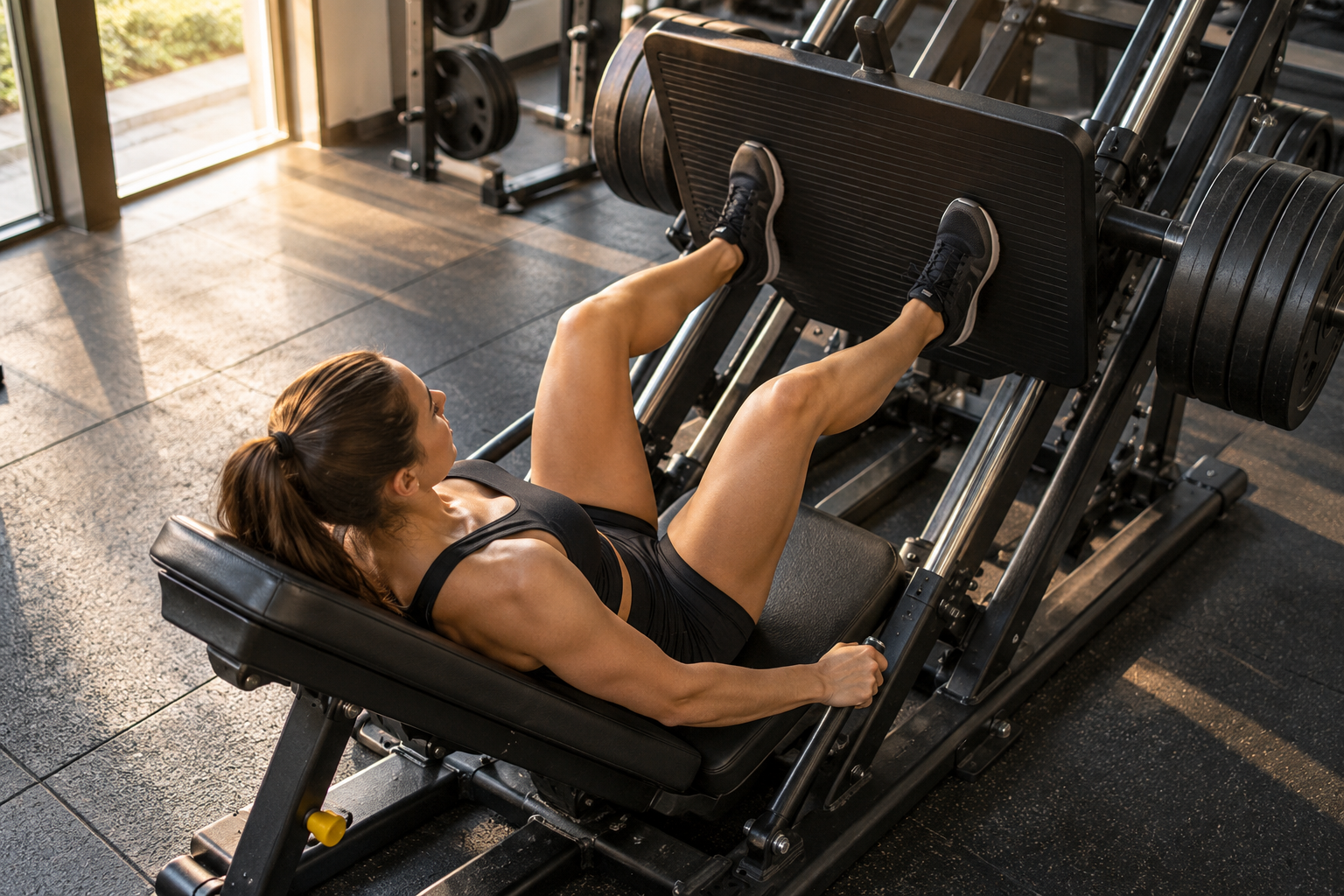
How to adjust the leg press to train legs safely
Understanding how to adjust the leg press to train the legs is essential for correctly using one of the most widespread machines in professional gyms. Adjustment is not just about the seat position or the selected load, but includes several elements that influence movement quality, joint comfort, and the ability to train the lower limbs in a controlled manner.
For gym managers, technical directors, and fitness professionals, knowing these adjustments also means assessing how adaptable a machine is to users with different anthropometric characteristics. A correctly configured leg press allows for organizing sessions that are more consistent with individual goals, while inadequate settings can cause postural compensations, movement limitations, and difficulties in managing loads.
The ideal adjustment depends on the type of machine, the user's mobility, body proportions, and the training program. Therefore, there is no universal setting valid for everyone. This guide analyzes the practical criteria for configuring the leg press, recognizing the most frequent errors, and evaluating the technical characteristics that affect daily use in professional fitness facilities.
- How the leg press works and which adjustments to consider
- How to adjust the seat and backrest
- How to correctly position your feet on the footplate
- How to set the depth of the movement
- How to choose the load and manage repetitions
- Frequent errors in leg press adjustment
- Differences between the main types of leg press
- Adjustments and management of the leg press in the gym
- How to evaluate the leg press as a professional investment
How the leg press works and which adjustments to consider
The leg press is a machine designed to perform a pushing movement through the coordinated extension of the hip and knee. During the exercise, quadriceps, glutes, and other lower limb muscles are primarily involved, with a variable contribution depending on the machine configuration, range of motion, and individual characteristics.
Compared to free-weight exercises, the leg press offers a constrained trajectory determined by the mechanical structure. This can facilitate movement management, but it does not eliminate the need to control posture, load, and joint range. The presence of a backrest does not automatically guarantee a correct position, especially when the seat is adjusted in a way that is incompatible with the user's mobility.
Before starting a session, it is necessary to identify the available adjustment systems and verify that they are functional. Some models allow modifying the distance between the seat and the footplate, others offer different backrest inclinations or adjustable starting positions. The actual possibilities depend on the machine's construction and must be verified through the manufacturer's instructions.
The components that influence the training position
The main elements include the seat, backrest, footplate, handles, safety systems, and resistance mechanism. In weight stack machines, there are selectors that allow modifying the resistance through preset increments, while in free-weight versions, compatible discs are used with the appropriate supports. Each component must be checked before use, paying particular attention to the correct insertion of pins and the operation of stopping devices.
Why adjustment must be individual
Two people of the same height may have different femur and tibia lengths, as well as different hip and ankle flexion capabilities. For this reason, copying the adjustment used by another athlete is not a reliable criterion. An appropriate configuration allows maintaining stable contact with the support points and completing the movement without obvious compensations.
How to adjust the seat and backrest
The position of the seat represents one of the most important aspects in configuring the leg press. An excessively short distance from the footplate can lead the user to reach a hip flexion greater than what can be controlled, while too high a distance can unnecessarily limit the available range. The objective is to identify a stable initial position compatible with the intended movement.
When the machine has a sliding seat, it is advisable to start with an intermediate adjustment and verify the position through a few light repetitions. During the approach phase to the footplate, the pelvis should remain supported by the backrest without lifting or rotating markedly. If this happens, it is necessary to re-evaluate the initial distance, the range of movement, or both.
The backrest must allow comfortable support for the dorsal region and the pelvis. It is not correct to assume that a certain inclination is always better, because the relationship between backrest, seat, and footplate changes according to the mechanical design. In professional machines with multiple adjustments, it is important to verify the stability of each position before applying significant loads.
How to find the correct distance from the footplate
A practical procedure consists of sitting down, placing both feet on the footplate, and slowly simulating the descent phase with minimal resistance. The distance is adequate when it allows controlled flexion of the knees while keeping the pelvis and back in a stable position. If the knees come very close to the torso and the pelvis tends to lose contact with the backrest, the adjustment or depth must be modified.
How to evaluate backrest inclination
In models that allow modifying the inclination, the choice must consider comfort, mobility, and stability. A more reclined backrest is not necessarily safer, and a more vertical one is not automatically more effective. It is necessary to observe the user's behavior during the entire movement, verifying that no compensations appear in the lumbar region or difficulties in maintaining a regular push.
How to correctly position your feet on the footplate
The foot position on the leg press influences the distribution of stress and the way joints are involved during the push. A reasonable initial configuration generally involves feet fully supported, with a distance approximately similar to hip or shoulder width. This indication represents a starting point to be adapted to the user's characteristics.
During execution, it is important to maintain stable support, preventing the heels from unintentionally lifting off the footplate. The knees should move consistently with the orientation of the feet, without collapsing inward. The angle of the toes can vary moderately depending on individual anatomy, provided the movement remains controlled and does not cause discomfort.
Modifying foot placement can change joint demands, but it does not allow completely isolating a single muscle. For example, moving the feet higher or lower modifies the geometric relationships between hip, knee, and ankle. However, the concrete effect also depends on the machine's trajectory and the depth reached, so it is preferable to avoid absolute statements about muscle recruitment.
Higher or lower feet on the footplate
A relatively high position can modify the excursion required of the ankle and the distribution of movement between hip and knee. A lower position can increase the demand for ankle flexion and modify joint work, but it is not appropriate when it prevents keeping the heel flat. The choice must favor a repeatable and comfortable trajectory, avoiding seeking a presumed muscular advantage through extreme positions.
How to choose support width
A narrower or wider support may be comfortable for different users. The width must allow the knees to follow a natural trajectory without forcing the hips into positions that are difficult to control. In the presence of joint limitations or pain, it is appropriate to request an individual evaluation by a qualified professional rather than randomly modifying the position.
How to set the depth of the movement
The depth of movement must be established considering available mobility and the ability to maintain a stable posture. There is no universally correct knee flexion angle for all people and all machines. The useful depth is the one that allows performing the descent phase without losing control of the pelvis, excessively altering foot support, or feeling pain.
During the eccentric phase, the load should be accompanied progressively, avoiding letting it drop by inertia. The speed must allow the user to recognize the point beyond which posture begins to change. A deeper descent does not necessarily represent an improvement if it is achieved through lumbar compensations or loss of stability.
The pushing phase also requires attention. The movement should occur through a coordinated extension of the lower limbs, without uncontrolled accelerations and without using rebound in the bottom position. In the final part, it is advisable to avoid pushing violently towards a joint lockout, maintaining resistance control and respecting the machinery's characteristics.
How to recognize the loss of pelvic stability
One of the most evident signs of excessive depth is the lifting or rolling of the pelvis relative to the backrest. When this phenomenon appears, the user should reduce the range of motion and check the seat adjustment. It is not necessary to reach a preset depth if it compromises maintaining a controlled position.
How to progressively increase excursion
For an inexperienced user, it may be useful to start with a moderate movement and gradually increase the range when control and mobility allow it. This progression must take place without forcing and without considering maximum depth as a mandatory goal. The quality of repetitions represents a more useful indicator than the simple distance covered by the footplate.
How to choose the load and manage repetitions
Choosing the load must follow machine adjustment and technique verification. Using high resistance before finding the correct position makes it harder to recognize errors and can increase the risk of uncontrolled movements. In initial trials, it is therefore appropriate to favor a light load, sufficient to perceive the trajectory without compromising posture.
The training load should be consistent with the user's experience, the expected number of repetitions, and program goals. For example, a set oriented toward technical learning generally requires resistance that allows maintaining constant control. An experienced athlete can use higher intensities, but the ability to complete repetitions must not be evaluated separately from execution quality.
Another important element concerns the difference between the weight indicated on the machine and the actually perceived resistance. In inclined, horizontal, or lever leg presses, geometry, friction, and transmission systems can significantly modify the relationship between nominal load and required force. For this reason, directly comparing kilograms used on different machines can yield unreliable interpretations.
How to increase load without losing control
A reasonable progression involves gradual increases only when the user manages to complete the programmed repetitions while maintaining stable technique. If increasing the load causes an involuntary reduction in depth, asymmetric pushing, or loss of contact with the backrest, it is appropriate to re-evaluate the resistance. Recording load, repetitions, and adjustments helps distinguish real improvements from variations due to configuration.
Breathing and execution rhythm
During exercise, it is useful to coordinate breathing with the movement phases, avoiding holding breath involuntarily for prolonged periods. Respiratory strategies can change according to intensity and experience level and must be adapted to individual conditions. A controlled rhythm also allows recognizing any differences between the two legs and stopping the set before technique noticeably worsens.
Frequent errors in leg press adjustment
Many problems during leg press use stem from a combination of inadequate adjustments and loads inconsistent with the user's capabilities. A common error consists of setting the machine by looking only at the apparent distance between the seat and footplate, without checking what happens during the deepest phase of the movement.
A second error concerns using particularly high, low, or wide foot positions with the goal of concentrating work on a specific muscle area. These variations can modify exercise mechanics, but do not automatically guarantee superior results. When they compromise stability or joint comfort, the possible theoretical benefit loses practical relevance.
It is also frequent to observe users increasing load while progressively reducing repetition range without a precise methodological choice. In this case, comparison with previous performance becomes scarcely meaningful. A repeatable adjustment and a defined excursion instead allow monitoring progress with greater reliability.
Unstable knees and lifted heels
If knees tend to shift abruptly inward or heels lose contact with the footplate, it is necessary to check foot position, depth, and load. The problem can depend on various factors and must not be automatically attributed to a single muscle weakness. Temporarily reducing resistance allows better observation of the trajectory and finding a more controllable configuration.
Incorrect use of safety systems
A particularly relevant error in free-weight machines consists of neglecting stopping devices or modifying safety positions without knowing how the machine works. Before starting, it is essential to check manufacturer instructions, the correct position of stops, and the ability to safely interrupt movement. Procedures can vary considerably among different models.
Differences between the main types of leg press
Professional leg presses do not all feature the same structure. There are horizontal, inclined, vertical models, and lever versions with different resistance systems. This variety makes it necessary to distinguish general posture indications from specific adjustment procedures provided for each machine.
The choice of type also influences the user experience. A machine with a weight stack can allow rapid resistance changes, a useful feature in environments with frequent user rotation. A free-weight version instead requires moving discs and careful management of loading and unloading operations.
For a purchasing manager, the difference does not concern only achievable intensity. Accessibility, occupied space, ease of adjustment, safety devices, and compatibility with the facility's public must be considered. The machine best suited for a strength-training-oriented center might not match the one preferable for a generalist gym.
Adjustment of the inclined leg press
In the inclined leg press, the user pushes a sled along guides oriented relative to the floor, according to the geometry provided by the model. It is important to check backrest position, distance from the footplate, and the operation of locking systems. The weight of loaded discs does not directly correspond to the force needed to move the sled, since inclination, moving mass, and friction come into play. Adjustments must therefore be verified on the machine actually used.
Adjustment of the horizontal leg press
The horizontal leg press generally presents a configuration with a seat and predominantly horizontal pushing movement, although construction details vary. In weight stack models, selecting resistance can be particularly simple. It is still necessary to check the initial distance and available excursion, avoiding assuming that the seated position automatically guarantees a movement suitable for any user.
Adjustments and management of the leg press in the gym
In a professional gym, the leg press is used by people with very different levels of experience, mobility, and goals. The ease with which settings can be modified therefore represents an important operational element. Unintuitive adjustments can slow down transitions between users and increase the probability of incorrect use.
Technical staff should know the main characteristics of the installed machine and be able to explain how to set seat, backrest, and starting position. A standardized procedure can include checking safety devices, initial adjustment, a few trial repetitions, and checking stability during movement.
Professional management also requires attention to maintenance. Guides, bearings, pins, padding, and adjustment systems are subjected to repeated use. Scheduled checks according to manufacturer instructions allow identifying wear, abnormal play, and sliding difficulties before they compromise equipment functioning.
How to facilitate adjustment for users
Clear indications near the machine can help users recognize the main adjustment points. It is useful to explain that the position must be individually adapted and that the first check concerns stability during a light repetition. For inexperienced users, initial supervision by an instructor remains preferable to simply consulting an informational sign.
### A practical checklist before each session
An operational check can follow a simple sequence: check general machine status, set the seat, check the backrest, position feet, check safety devices, select initial resistance, and try a few repetitions. During the trial, it is necessary to observe heel support, knee trajectory, pelvic stability, and movement control. If pain appears, the exercise must be interrupted and the situation adequately evaluated.
How to evaluate the leg press as a professional investment
For a gym manager, understanding how to correctly adjust a leg press also helps recognize which technical characteristics hold concrete value when choosing equipment. A machine should not be evaluated solely based on declared maximum load or aesthetic appearance. The ability to adapt to different users, the quality of adjustment systems, and the availability of safety devices directly impact the daily experience.
Commercial evaluation should start from the operational context. In a fitness center with high user rotation, adjustment speed, clarity of instructions, and simplicity of load selection can prove particularly important. In a facility dedicated primarily to strength, frame robustness, sled characteristics, load capacity, and the ability to customize the starting position may take on greater relief.
To compare alternatives, it is useful to examine the technical data sheets of professional isotonic machines, checking dimensions, adjustment systems, construction characteristics, and installation requirements. Commercial documentation should be integrated, when possible, with a practical test and manufacturer information regarding maintenance, warranty, and conditions of use.
Technical criteria to compare before purchase
Among the most useful parameters are overall footprint, space needed to access the machine, compatibility with different body types, availability of documented adjustments, and quality of stopping devices. It is also appropriate to check maximum allowed load, characteristics of support surfaces, and installation instructions. None of these elements, considered in isolation, allows establishing which model is best for every gym.
How to distinguish initial price and management cost
The purchase price represents only part of the investment. Transport, assembly, any maintenance interventions, spare parts, and machine downtime can affect the overall cost over time. To make a reliable comparison, it is useful to request information on planned maintenance operations, availability of wear-prone components, and assistance conditions. Economic differences must be evaluated through verifiable data, avoiding assuming that a higher price automatically guarantees greater durability.
How to arrive at a choice consistent with your gym
A defensible decision stems from alignment between technical characteristics, user types, and space organization. Before purchasing, it is useful to define who will predominantly use the machine, what adjustments will be necessary, how frequently loads will be modified, and what resources will be available for maintenance. This approach allows narrowing down alternatives without relying exclusively on commercial descriptions and allows choosing a leg press that meets the facility's operational needs in the medium and long term.
Comments (0)