
Trolley
You have no items in your shopping cart

 Budgets
 Dumbers
 Discs
 Benches
 Racks and Rigs
 Weights Holders
 Isotonic machines
 Calisthenics
 Cardio
 Kettlebells
 Flooring
 Gym Set
 Accessories
 Combat
 ARTI MARZIALI
 CONTAINER GYM
 Tug-Of-War
 Used Gym Equipment
 PILATES MACCHINARI
 GINNASTICA ARTISTICA
 CAMPI DA PADEL
 Prodotti in Pronta Consegna
 Informazioni
 IRONMAN
 Gift Card
- Donatif
- General information
- 0 I like it
- 204 Views
- 0 comments
- gym flooring, safety flooring, gym safety, shock-absorbing materials
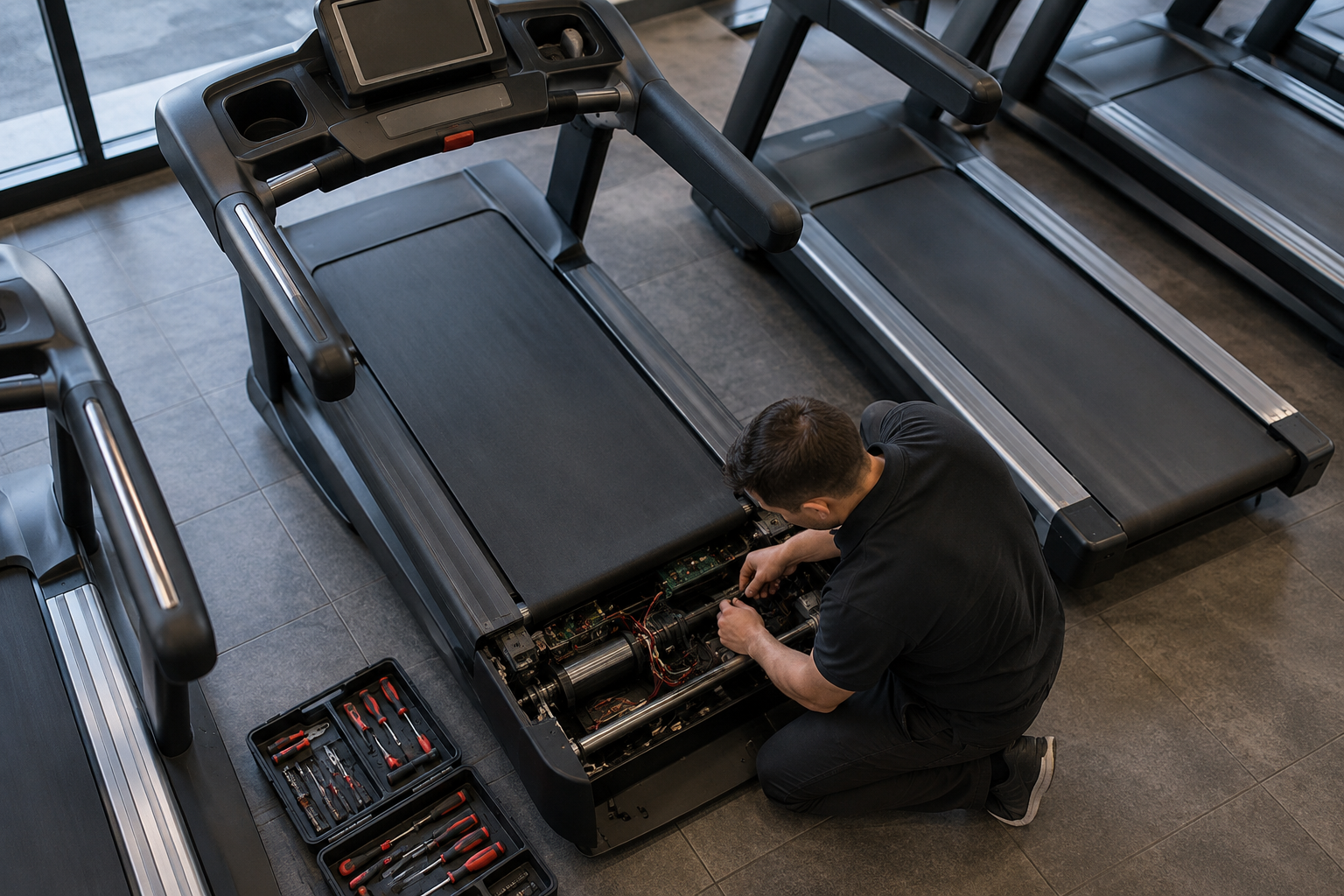
Gym Treadmill Installation and Testing
The treadmill arrives packaged, but the availability of the machine depends on a sequence of activities still to be coordinated. Internal route, position, room conditions, and documentation must be prepared before the appointment. For the manager, organizing these steps means knowing which tasks belong to the facility and which services are included in the assignment given to the operators.
The gym treadmill installation and testing must refer to the actual model and supply. The word testing requires precise content: it is necessary to clarify which activities are planned, by whom they are performed, and which outcomes will be documented. It should not be automatically interpreted as an indistinct confirmation of the entire room or of conditions that do not fall within the intervention.
This guide describes work coordination and manager preparation, without providing independent assembly or electrical connection instructions. The assigned operators follow relevant skills and directions. The objective is to make the transition from delivered product to organized workstation legible, with documents and references available for use and subsequent management.
- Confirm model and included services
- Check the route from arrival to the room
- Prepare the position through model instructions
- Clarify systems and preparations before the appointment
- Coordinate work without foreseeable interference
- Define final checks and report content
- Integrate the workstation into daily management
Confirm model and included services
Before the appointment, it is necessary to verify which model and equipment were confirmed in the order.
The sheet used to prepare the space must correspond to the actual machine. If a different product was proposed during negotiation, the relevant data must be re-examined, avoiding maintaining a layout developed for a configuration that will not be delivered.
The treadmill supply must describe transport, handling, and assembly when planned. A generic delivery item does not clarify up to which point the material is brought. The manager must know the perimeter of the services and organize excluded activities, keeping the receipt of packages distinct from the completion of agreed services.
Identify the ordered configuration
The configuration must be identifiable even in operational communications, so that transporter and installer receive coherent information. Any relevant options must appear in the final proposal. This clarity allows connecting the room plan to what will arrive, without reconstructing the equipment when the machine is already waiting to be transferred to the room.
Clarify the content of the operational delivery
The operational delivery must have recognizable content: planned activities, expected documents, and instructions for subsequent steps. The client should ask for clarifications on the meaning of the terms used in the offer. If a service is not included, it must be attributed to an appropriate contact person, avoiding each party assuming it will be performed by someone else.
Check the route from arrival to the room
The route must be examined through package dimensions and procedures planned by those in charge.
Stairs, doors, and maneuvering areas can influence handling. The measurements of the assembled machine do not automatically describe everything needed for internal transport, just as the presence of an elevator does not confirm by itself that the route is suitable.
The treadmill handling must be organized with the competent parties. Gym staff should not anticipate disassembly or specialized transfers without relevant instructions. The manager can provide photographs, data, and accesses, keeping logistical preparation distinct from the technical methods by which components will be moved and installed according to the product.
Collect relevant measurements and obstacles
Measurements and obstacles must be communicated in a legible way, signaling any unverified data. If the route changes due to work or other activities, operators must be informed through agreed channels. This prevents the appointment from being maintained based on conditions that no longer correspond to those actually available on the scheduled day.
Coordinate receipt and temporary storage
Receipt and storage require a contact person and an agreed position when delivery and assembly take place at different times. Packaging should not occupy paths necessary for the room without a plan. The program must clarify who will receive the material and how the steps up to the access of the installation team will be managed.
Prepare the position through model instructions
The position must be verified through instructions relevant to the treadmill, considering usage and assistance.
The static perimeter alone does not describe all necessary conditions. The layout should make accesses and the relationship with neighboring stations legible, avoiding the machine being placed in the remaining available space without an evaluation of its real operation.
The placement in the cardio room must remain consistent with the chosen model. If dimensions or installation conditions change, the drawing must be updated. Commercial comparison can provide product data, while relevant building checks require appropriate skills and are not replaced solely by the ability to fit the machine into the room.
Consider operational dimensions and access
Operational dimensions must be derived from relevant references, without transferring measurements from a different treadmill. The manager should be able to explain to those in charge which activities take place in neighboring areas and which paths must remain available. This overall reading helps verify organization beyond the position represented in the floor plan.
Connect the choice to building conditions
Building conditions may require specific in-depth analysis regarding surfaces, loads, or other relevant aspects. Noise and vibrations must be considered in the context of neighboring environments. Flooring does not automatically guarantee compatibility, and product data must be made available to the professionals involved according to project needs.
Clarify systems and preparations before the appointment
Information regarding power supply must refer to the model and be made available to competent parties.
The manager should not deduce compatibility from the mere fact that a socket is present in the room. Conditions must be verified through relevant references, without transforming an organizational guide into an independent procedure for connecting or adapting the system.
The room preparation must have a list of activities attributed to identified contact persons. The machine installer and other professionals may have different perimeters. The client must know which conditions must be completed before arrival, so as not to ask the team to resolve on-site work that does not fall within the agreed assignment.
Gather machine requirements
Requirements must be retrieved before consolidating the schedule, especially if the machine replaces a different model. A previously used system does not automatically confirm every new configuration. The manager collects data and coordinates interlocutors, while technical checks and interventions follow skills and conditions appropriate to the case.
Attribute activities to appropriate contact persons
Preparations can be reported in a sheet with activities, contact person, and status. A complex document is not needed, but what is missing to proceed must be clear. If a condition is not ready, the calendar must be updated through agreed channels instead of presuming that the arrival of the equipment will allow completing the installation anyway.
Coordinate work without foreseeable interference
On the day of the intervention, the area and accesses must correspond to the agreed conditions.
Staff must know which stations are affected and how to manage users during work. Organizational preparation does not replace the technical methods of those in charge, but it prevents the activity from taking place among obstacles or expectations different from those on which it was scheduled.
To explore models and data of professional cardio equipment, relevant configuration information can be requested. Commercial consultation remains distinct from the organization of the intervention on the ordered product. The plan must maintain the connection between machine, place conditions, and services actually purchased, without attributing additional services solely to belonging to the same catalog category.
Make the agreed area available
The available area must allow those in charge to operate according to relevant conditions. If other work occupies the route or the expected position, the problem must be communicated and managed. The proximity of the opening date does not automatically modify necessary preparations nor authorize staff to introduce unagreed technical solutions.
Manage variations and packaging materials
Variations and packaging management must follow the perimeter of the supply. The manager should know which materials will be removed and which tasks remain with the facility. An update of the organization makes it possible to keep calendar and activities coherent, preventing the end of assembly from being slowed down by services considered included only out of habit or interpretation.
Define final checks and report content
The planned checks must be explained in relation to the model and the assignment.
The client should know who will perform them and what documentation they will receive, without attributing to the word testing a broader meaning than the agreed content. A generic confirmation of completed work does not clarify which activities were performed and which conditions were considered.
The installation report should make the machine and performed services recognizable, together with relevant instructions received from the facility. The document must remain connected to the inventory and the offer, so that the manager can retrieve it even after a change of contact person. Outcomes must be used within their perimeter, avoiding extensions to subsequent configurations that were not evaluated.
Connect the outcome to actual activities
The connection to actual activities allows understanding how to use the result to organize the workstation. If a formulation is not clear, the client should ask for explanations before summarizing it as a general confirmation. The content must be legible even for those who will follow ordinary management without having participated in preparation or assembly.
Gather instructions and still open points
Instructions and still open points must have a recognizable follow-up. Any further activities must not disappear when the appointment is closed administratively. The availability of the workstation follows outcomes and conditions relevant to the situation, without assuming that the simple presence of the assembled machine equals the completion of every planned step.
Integrate the workstation into daily management
After the intervention, the treadmill must enter the inventory with relevant documents and references.
Staff must know how to retrieve instructions and which channel to use for a report. This step makes management less dependent on the memory of the person who followed the purchase and allows connecting subsequent activities to the correct machine.
Recurring activities must be organized according to product instructions and appropriate skills. Cleaning and observation do not equal every technical intervention, while a report must contain concrete information. The room program must keep references available and make it understandable which actions belong to the staff and which require a competent person.
Make instructions and reports accessible
Instructions must concern the actual model, avoiding transferring settings or procedures from the previous machine without verification. If users express doubts about controls, staff can collect difficulties and ask for relevant clarifications. Understandable information helps assistance, while individual training programs remain separate from product installation.
Follow initial usage observations
Initial observations may concern legibility, access, and workstation operation in the real layout. Any anomalies must follow the planned procedure, without improvised tests to check if they reappear. The configuration is thus inserted into the service through documents, references, and recognizable activities, maintaining the connection between performed intervention and ordinary gym management.
Comments (0)