
Trolley
You have no items in your shopping cart

 Budgets
 Dumbers
 Discs
 Benches
 Racks and Rigs
 Weights Holders
 Isotonic machines
 Calisthenics
 Cardio
 Kettlebells
 Flooring
 Gym Set
 Accessories
 Combat
 ARTI MARZIALI
 CONTAINER GYM
 Tug-Of-War
 Used Gym Equipment
 PILATES MACCHINARI
 GINNASTICA ARTISTICA
 CAMPI DA PADEL
 Prodotti in Pronta Consegna
 Informazioni
 IRONMAN
 Gift Card
- Donatif
- General information
- 0 I like it
- 164 Views
- 0 comments
- gym flooring, safety flooring, gym safety, shock-absorbing materials
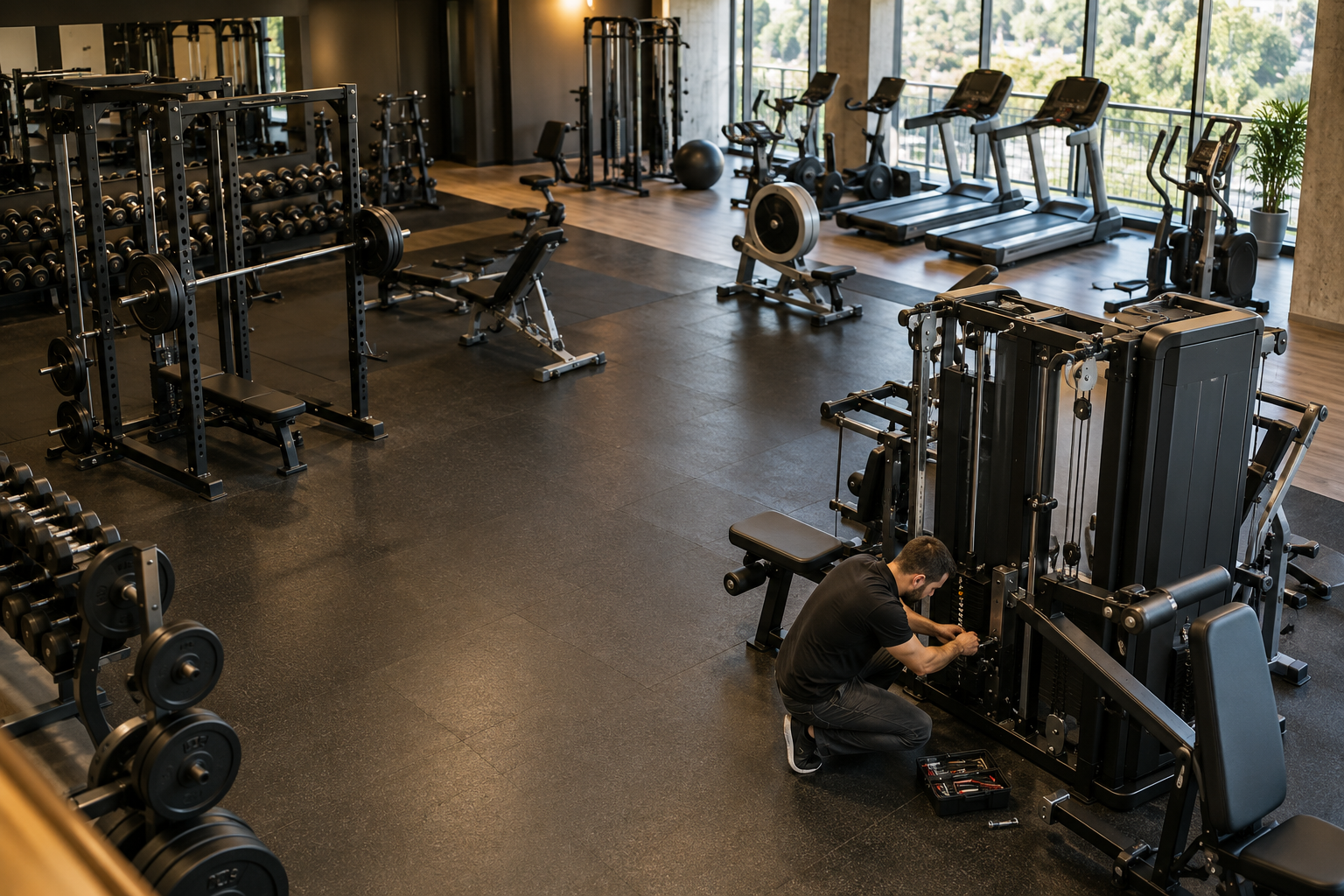
How to identify the compatible spare part for a fitness machine
A similar image may seem sufficient to recognize a fitness machine spare part. When it comes to ordering, however, questions arise about version, dimensions, and configuration. The problem is not solved by choosing the component that looks most like the existing one: a verifiable connection is needed between the equipment, the proposed part, and the instructions received from the competent subject.
To understand how to identify the compatible spare part for a fitness machine, it is best to organize the request into a sequence: identify the machine, describe the need, gather the references, and obtain the relevant confirmation. The manager prepares the information and coordinates the steps, while technical diagnosis and evaluations remain linked to the appropriate skills.
The method serves as an organization of the request and not as a universal repair procedure. A mechanical part and an electronic component may require different data. The collection sheet must therefore remain simple enough to be used and precise enough to prevent the supplier from interpreting generic information as confirmation of a configuration that has not been identified.
- Start from the machine's identity
- Describe the need before naming the part
- Gather component codes and documentation
- Verify the compatibility of the proposed alternative
- Prepare an order that keeps the connection legible
- Record delivery, installation, and outcome
- Reuse information for subsequent requests
Start from the machine's identity
The first piece of information is the actual model, followed by the references that make it possible to distinguish the version.
Serial number when available and manufacturer data help the search. The name used in the gym can be useful for orientation, but it must not replace product identification in assistance requests and subsequent orders.
The machine identification sheet should also report location and internal code, keeping them distinct from the manufacturer's references. The gym's code serves to connect history and workstation; the product data serves to recognize the configuration. This separation remains useful when a machine is moved or the layout of the room changes.
Copy the available references
References must be copied correctly and accompanied by legible photographs when useful. If a nameplate is deteriorated, the problem must be reported along with the available elements. It is not advisable to complete an uncertain datum through comparison with a similar machine, because the error can go unnoticed until the component is delivered.
Connect the internal code to the product
Connection to the inventory makes it possible to retrieve previous documents and interventions without starting from scratch every time. A request can thus indicate the machine and relevant history, instead of using a description like the black model near the entrance. Information must be kept updated when configuration or components relevant to identification change.
Describe the need before naming the part
A machine showing an anomaly does not automatically indicate which part needs to be replaced.
The request should explain what has been observed and what evaluations are already available. This prevents the name of an informally suggested component from becoming the starting point of an order, without having clarified the relation to the actual problem.
The spare part request must distinguish between an already identified need and a symptom still to be evaluated. In the first case, the references of the technical proposal can be transmitted; in the second, it is necessary to ask which path is relevant. The manager must not turn a photograph or a noise into an independent diagnosis to speed up the purchase of the material.
Separate observation and diagnosis
Observation can indicate the involved element, date, and circumstances of appearance, maintaining a descriptive language. There is no need to reproduce a defect through makeshift tests or ask users to continue exercising. The collected information must help the assigned person understand the context and define the insights pertinent to the machine.
Report the available technical outcome
If a technical report exists, the reference must be linked to the request and the configuration. It is necessary to know whether the document already identifies the part or requires further checks. This reading avoids ordering based on a phrase taken out of context and keeps any conditions still open visible before confirmation.
Gather component codes and documentation
A component's code can be useful when it is legible and refers to the correct part.
However, it must be transmitted together with the machine data, avoiding treating it as sufficient information in any situation. If the reference comes from a document, it is necessary to verify that the document actually concerns the model and version present.
The components catalog can help identify an item, but its relevance must be clear. A similar representation alone does not confirm equivalence. The manager should keep the title, version, and available references, so that the interlocutor can understand where the code comes from and what doubts remain to be resolved.
Use legible and relevant references
Photographs can show markings or visible details without requiring unexpected disassembly. Staff should not open parts of the machine just to look for a code, if the operation is not part of the activities pertinent to their role. In these cases, the request must clarify which data are accessible and which require a competent person in charge.
Preserve the document's context
Context also helps prevent errors between nearby items in the same list. The reference must be kept connected to the object and the destination machine, without being reduced to a sequence copied in an isolated message. When the document does not answer the question, it is preferable to record the uncertainty and ask for targeted confirmation.
Verify the compatibility of the proposed alternative
An alternative can be proposed when the original part is not available or when the supplier indicates a replacement solution.
The proposal must remain referred to the specific equipment. The fact that a component can be physically mounted does not clarify all pertinent conditions, which must be evaluated through data and skills appropriate to the case.
The compatibility confirmation must allow linking the machine and the proposed component, with any explicit conditions. The purchaser should ask for sufficient clarifications to understand the offer without reconstructing it through assumptions. If additional activities or updates are planned, they must be described and considered before authorizing the order or scheduling replacement.
Ask on what data the confirmation is based
Confirmation must use available product references, not just a generic declaration of equivalence. This helps keep the request, quote, and delivery consistent. When the interlocutor reports that information is missing, collection must address those data rather than searching for a seemingly identical component in a different listing.
Recognize necessary conditions and modifications
Conditions may concern configuration and intervention, depending on the type of part. The manager must know which activities are included and which require further steps. A complete proposal allows understanding the intervention project, avoiding considering the purchase of the spare part as a solution already concluded for every technical need of the machine.
Prepare an order that keeps the connection legible
The order must show a recognizable description of the part and the reference to the destination machine when relevant.
This makes it possible to compare what is delivered with the accepted proposal. Useful information must not remain only in the memory of the person who followed the request, especially when purchase and intervention are coordinated by different contact persons.
To learn more about products and configurations of fitness equipment, you can request information referring to concrete needs. Consulting the catalog does not automatically confirm the availability of every spare part nor compatibility with the installed fleet. The order must remain connected to the collected data and the relevant confirmation on the proposed component.
Identify material and destination machine
The reference to the machine helps prevent a part from being destined for a similar but different workstation. If components are ordered for multiple pieces of equipment, associations must be clear. A simple summary makes it possible to organize reception and appointments without reconstructing the meaning of the materials only when operators arrive in the room.
Separate product and intervention services
Material, transport, and installation can be treated separately. The manager must know the perimeter of the proposal and any additional services required. Component availability does not coincide with the availability of the person in charge, and the delivery date must not be communicated automatically as the date of return to use for the machine concerned.
Record delivery, installation, and outcome
Upon receipt, the material references must remain linkable to the order and the intended machine.
Any differences must be clarified through agreed channels before considering the supply completed. Document management helps prevent a part from being installed based solely on resemblance or because it has been awaited for a long time to resume service.
The intervention follows the skills and instructions pertinent to the product. The manager can prepare access and documents, while technical activities belong to the appropriate persons in charge. The report must make it possible to identify what was performed and what instructions were received, keeping visible any steps still necessary before the ordinary availability of the workstation.
Keep references received with the material
Material references can be kept together with relevant documents and communications, avoiding archives disconnected from inventory. This makes it easier to follow the case when the contact person changes. Traceability does not require a complex procedure: it must allow reconstructing which part was proposed, ordered, and destined for the specific machine.
Update the file after the intervention
After the intervention, the file must be updated with performed activities and relevant outcome. A generic note like replaced part offers little information for future requests. Return to use follows the conditions and procedures applicable to the situation, without assuming that the arrival of the material or an informal test is sufficient to close every step.
Reuse information for subsequent requests
A completed request can become a useful reference, provided it remains tied to the correct case.
The manager can retrieve data and documents already collected instead of reconstructing them. However, they must not automatically consider the same solution valid for another machine or for a similar symptom, because product and conditions may require different verifications.
The expense of subsequent requests must be evaluated through material and services actually proposed. A historical price does not constitute a current condition, and a previous intervention does not eliminate the need to confirm the configuration. The file helps make comparison more precise, keeping confirmed references, availability to be verified, and activities yet to be defined distinguishable.
Build a useful history without automatisms
History can show involved components and recurring problems, but it does not replace a diagnosis. Information must be used to formulate better questions and coordinate assistance. An ordered list reduces ambiguities without turning the manager into a person tasked with deducing technical causes from the simple number of interventions present in the log.
Update references when configuration changes
When the configuration changes, references must be updated in a recognizable way. This prevents a future request from using outdated documents without realizing it. Identifying the compatible spare part thus becomes a repeatable sequence of information and confirmations, connected to the real machine and the outcomes of the interventions actually performed.
Comments (0)