
Trolley
You have no items in your shopping cart

 Budgets
 Dumbers
 Discs
 Benches
 Racks and Rigs
 Weights Holders
 Isotonic machines
 Calisthenics
 Cardio
 Kettlebells
 Flooring
 Gym Set
 Accessories
 Combat
 ARTI MARZIALI
 CONTAINER GYM
 Tug-Of-War
 Used Gym Equipment
 PILATES MACCHINARI
 GINNASTICA ARTISTICA
 CAMPI DA PADEL
 Prodotti in Pronta Consegna
 Informazioni
 IRONMAN
 Gift Card
- Donatif
- General information
- 0 I like it
- 167 Views
- 0 comments
- gym flooring, safety flooring, gym safety, shock-absorbing materials
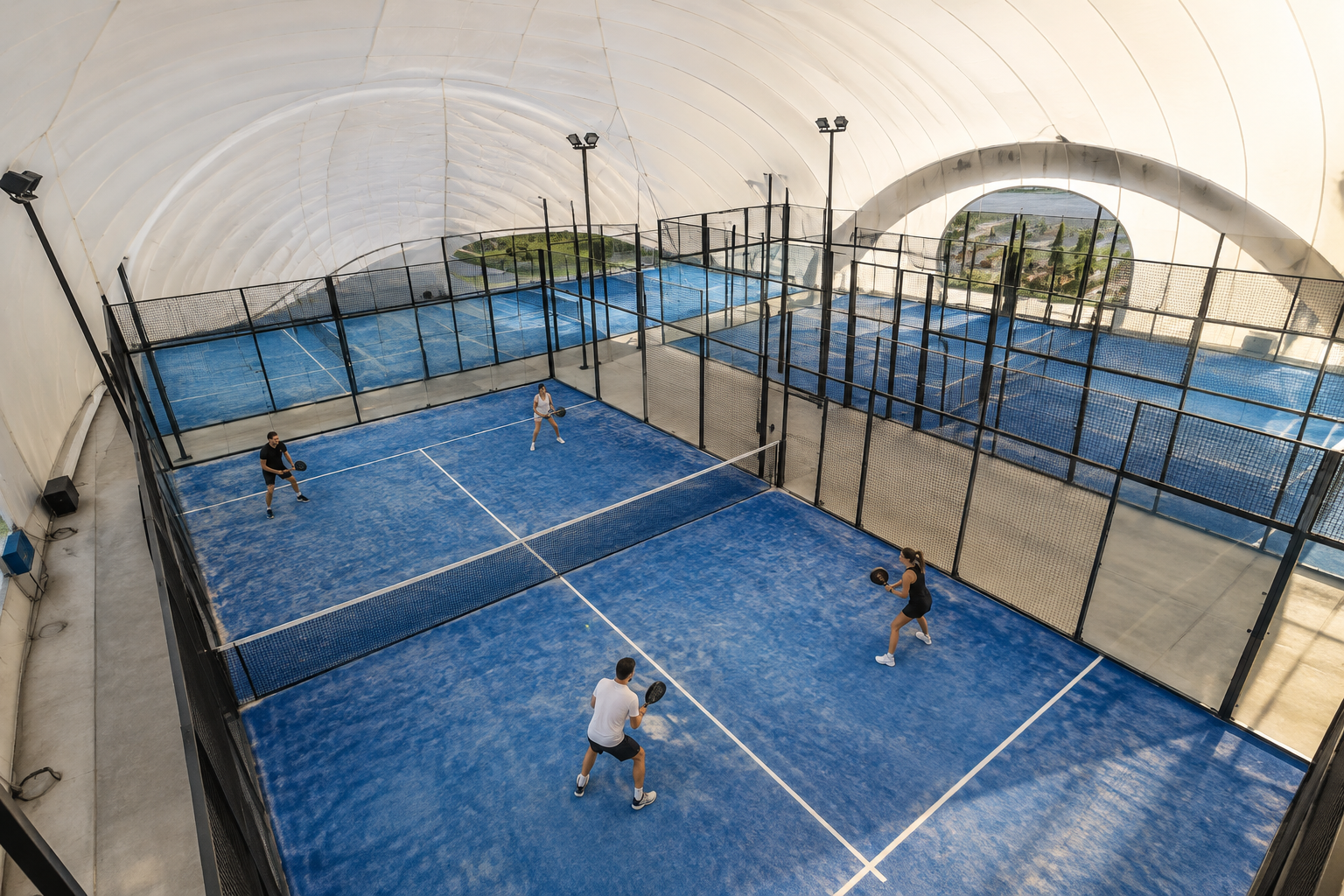
Advantages and limits of inflatable covers for padel courts
The ability to protect a court from external conditions can make a cover attractive for a padel center. The investment, however, also involves systems, organization, and the relationship with the site. To evaluate it, one must understand which system is proposed and what conditions are necessary to use it, without attributing to the word inflatable a technical meaning sufficient to describe every available solution.
The advantages and limits of inflatable covers for padel courts depend on the actual configuration and the project. A manager should compare planned activities, documentation, declared performance, and operational commitments. This analysis precedes revenue assumptions: the cover must be compatible with the location and the organization that will maintain it in the expected conditions.
The guide proposes evaluation criteria, without attributing costs, installation times, or universally valid requirements to a specific product. Technical checks and relevant requirements must be defined with competent professionals regarding the specific case. The expected result is a legible comparison between alternatives, with documented advantages and recognized limits before approving the expense.
- Identify the proposed system before comparing offers
- Evaluate the operational advantage compared to the uncovered court
- Verify site integration and project conditions
- Consider gaming experience and environmental comfort
- Examine the organization required during operation
- Compare initial costs, consumption, and recurring activities
- Decide through a consistent comparison of alternatives
Identify the proposed system before comparing offers
The trade name must be accompanied by a description of how it works.
It is necessary to know which elements support the envelope and which systems are required for the configuration. Without this information, there is a risk of comparing different solutions based on similar images, attributing the same operational obligations or conditions of use to them.
For air-supported systems, DUOL manufacturer's technical documentation describes pressure monitoring and backup power supply solutions. These aspects show why the comparison must include the systems and procedures relevant to the proposed system. However, a manufacturer's equipment should not be automatically attributed to all covers presented as inflatable.
Ask how the cover is supported
The request should include a descriptive diagram and the list of included equipment. The manager must be able to understand which parts are essential for operation and which constitute options. This allows reading the estimate through a recognizable perimeter, rather than comparing a base price with a proposal that includes a different level of systems and services.
Describe the combination of structure and systems
Structure, accesses, and systems must be examined as a whole. A commercially interesting component alone does not make the project adequate. Questions should refer to the intended use and the site, asking what data is already available and what assessments must be completed before confirming the configuration and economic conditions.
Evaluate the operational advantage compared to the uncovered court
The expected advantage must be linked to the actual operation of the center.
It is useful to observe when activities are interrupted and what conditions determine them, without turning every unbooked hour into a loss due to the absence of a cover. The initial reconstruction helps define the problem that the investment is supposed to address.
The continuity of padel activity also depends on organization, demand, and expected conditions of use. Greater potential court availability does not automatically equate to additional bookings. The business plan should distinguish these elements and keep commercial assumptions recognizable, especially if the center does not yet have sufficient data.
Analyze the effectively observed interruptions
Interruptions can be recorded with date, duration, and reason, using consistent categories. This alone does not produce a reliable forecast, but it allows formulating more precise questions about the required performance. The technical proposal must therefore be compared with the conditions that the manager wants to address, avoiding universal descriptions of usability in every situation.
Distinguish technical availability and commercial demand
Additional demand requires a separate evaluation, based on the center's context and explicit assumptions. The manager can examine unmet requests and seasonality, without treating the cover as a revenue guarantee. The operational advantage remains a condition to be related to the service and the ability to attract actual use.
Verify site integration and project conditions
The project must start from the real location: available area, court characteristics, pathways, and relationship with neighboring environments.
A product's commercial information does not replace this analysis. It is useful to know what data the proponent requires and what site conditions may influence configuration, work, or the very possibility of carrying out the intervention.
The feasibility of the cover includes assessments relevant to the solution and the context. Anchors, systems, and other technical aspects must be examined by competent professionals. Applicable requirements also require specific verification, avoiding the deduction of a simplified path from the mere description of a structure as removable or temporary.
Gather data on area and accesses
A useful survey should allow representing the court, surrounding spaces, and access paths. If the project concerns an already active center, it is necessary to consider how the work will be organized. This information makes it possible to request a site-specific proposal, with more precise performance and conditions than an offer formulated on preliminary data.
Entrust in-depth studies to appropriate expertise
The manager should know who coordinates the in-depth studies and which decisions depend on the results. When a verification is open, the estimate must make this understandable. The goal is not to eliminate every preliminary phase, but to prevent an amount or an indicative drawing from being interpreted as confirmation of the intervention without the necessary assessments.
Consider gaming experience and environmental comfort
The cover must be evaluated in relation to the planned sports activity, as well as protection from the outside.
Usable volume, lighting, and the relationship between the envelope and the court require relevant design. Declared characteristics must refer to the proposed configuration, without deducing the gaming experience from photographs taken in different contexts.
The comfort of the covered court must be discussed through documented conditions and performance. The manager should clarify how air exchange and environmental management are treated according to the planned system. It is not advisable to attribute uniform results to a material or a trade name without knowing the systems and assumptions on which the project is based.
Verify volumes, lighting, and visibility
Visibility must be considered together with the arrangement of fixtures and the characteristics of the envelope. A relevant lighting design allows evaluating expected conditions, while a promotional image offers limited information. The client should ask what deliverables will be produced and what data supports the declared performance for their court.
Ask for conditions and performance data
Performance must be read together with the reference context and operating conditions. When a proposal describes a comfortable environment, it is necessary to understand what elements are included to achieve it. Answers must distinguish what belongs to the basic supply, what is optional, and what depends on further site verifications.
Examine the organization required during operation
The offer must make it possible to understand what management activities are required of the center.
Staff must know their role and the relevant support channels. A solution described as automated still requires clarifying who receives operational information, what procedures are planned, and which decisions are up to the competent subjects.
The management of the padel cover must be scheduled before opening. Manuals, documentation, and references must be accessible to those in charge. Comparison between suppliers should also consider how this information is transferred, preventing daily organization from depending on informal explanations received from only one person during installation.
Define checks and management of reports
Checks and responses to a report must follow the indications relevant to the system. The manager should not invent thresholds or actions based on a different case. Instead, they must ask what activities are planned, what information must be recorded, and what conditions require the involvement of support or designated professionals.
Coordinate procedures and designated staff
Procedures must be understandable across different work shifts and coordinated with the center's activity. Documentation should distinguish ordinary tasks and specialized interventions, indicating the necessary references. This makes it possible to evaluate compatibility between the proposed system and available organization, before making financial commitments based solely on material supply.
Compare initial costs, consumption, and recurring activities
The price of the cover must be read together with the performance required for the project.
Site preparation, systems, installation, and services can be included or treated separately. The comparison should report these differences, avoiding placing a preliminary proposal and a solution defined with a broader perimeter on the same level.
Evaluations on consumption and management require data referring to the configuration and operational assumptions. The manager should know the source of the estimates and the conditions considered. A generic amount does not allow predicting the expense of one's own center, just as a value declared without context does not allow a reliable economic comparison.
Make the economic perimeter homogeneous
An economic table can separate structure, work, systems, and services, indicating inclusions and exclusions. To explore the commercial context of padel courts, relevant information on available solutions can be requested. The verification of a specific cover remains distinct from the presence of the category in the catalog.
Keep operating assumptions visible
Recurring expenses should be identified through documented activities and conditions, keeping estimates and confirmed commitments separate. It is not necessary to produce an artificially precise total when essential data is missing. It is more useful to make legible what information is needed to complete the evaluation and what variables can modify the economic picture over time.
Decide through a consistent comparison of alternatives
The comparison should refer each solution to the same expected service and the same site.
An inflatable cover should be evaluated together with relevant alternatives, considering documented performance and required organization. The point is not to identify a universally better technology, but to understand which proposal responds to the project and what conditions limit its application.
The investment plan must keep operational advantage, hypothesized demand, and total cost distinct. These components influence each other, but require different information. A reasoned decision makes the steps visible and allows updating the picture when better data arrives, rather than defending an initial forecast as if it were already a result.
Evaluate advantages and limits in the same scenario
Alternatives can be described through the same usage schedule, court requirements, and level of service. Each difference must be recorded with available information and missing verifications. This allows the manager to discuss limits and opportunities in a concrete way, without giving decisive weight solely to the declared speed of installation.
Close verifications before ordering
Before ordering, configuration, included performance, expected documentation, and conditions still to be resolved must be identified. Relevant technical assessments must support the choice of site and system. The investment is thus approved on the basis of a recognizable proposal, linked to the real management of the center and the responsibilities of the parties involved.
Comments (0)