
Trolley
You have no items in your shopping cart

 Budgets
 Dumbers
 Discs
 Benches
 Racks and Rigs
 Weights Holders
 Isotonic machines
 Calisthenics
 Cardio
 Kettlebells
 Flooring
 Gym Set
 Accessories
 Combat
 ARTI MARZIALI
 CONTAINER GYM
 Tug-Of-War
 Used Gym Equipment
 PILATES MACCHINARI
 GINNASTICA ARTISTICA
 CAMPI DA PADEL
 Prodotti in Pronta Consegna
 Informazioni
 IRONMAN
 Gift Card
- Donatif
- General information
- 0 I like it
- 126 Views
- 0 comments
- gym flooring, safety flooring, gym safety, shock-absorbing materials
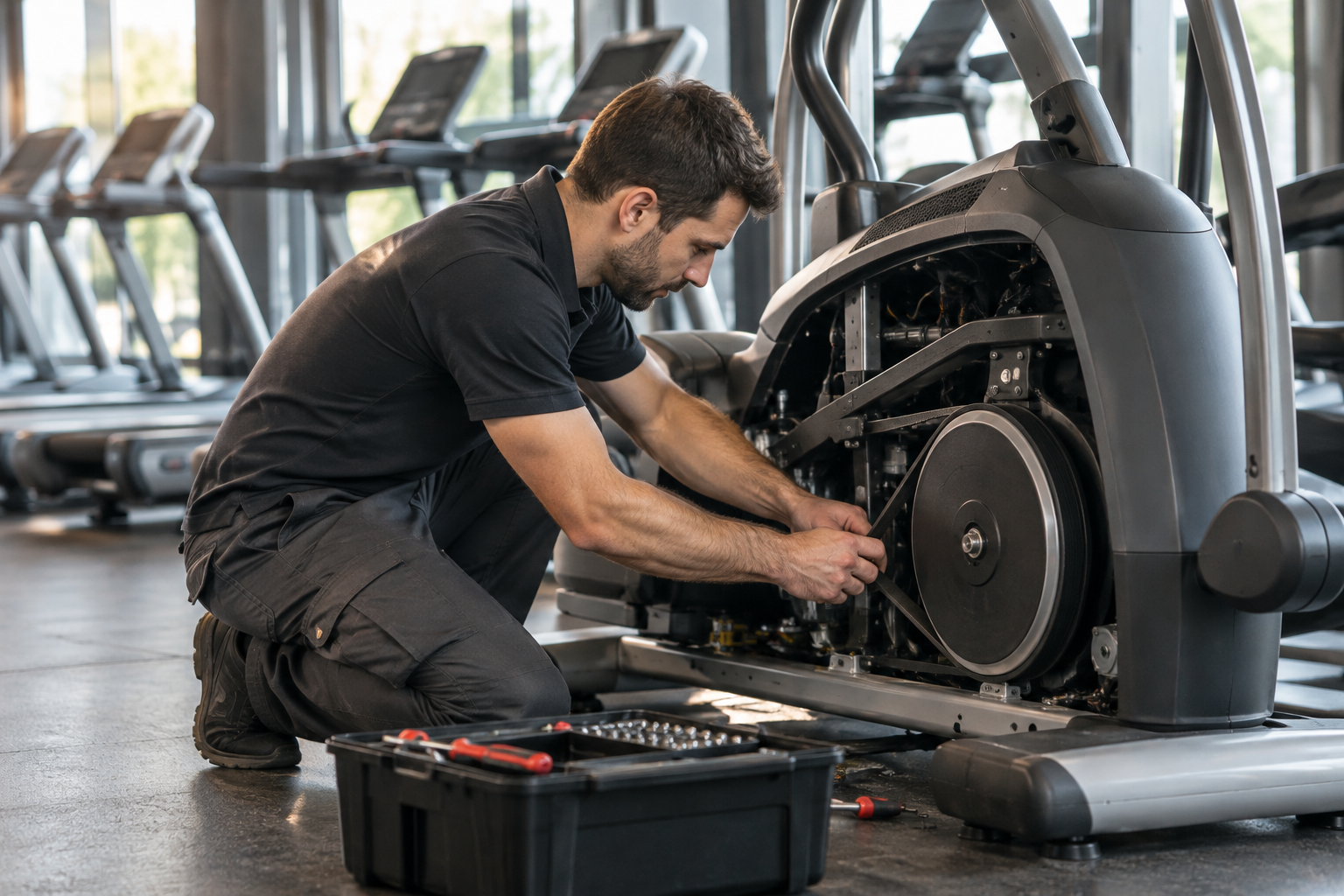
Maintenance and Spare Parts for Professional Cardio: Organizing the Fleet
When multiple pieces of cardio equipment share the same room, the manager's problem is not simply repairing a machine. They must know which stations are available, which are awaiting service, and which activities are already scheduled. A spare parts request can involve reception, instructors, and maintenance, while users continue to ask when they will be able to use the desired function.
Maintenance and spare parts for professional cardio therefore requires fleet management: information linked to individual products and an overall view of the service. Treadmills, bikes, ellipticals, and rowers may have different indications. The program must respect them without grouping every machine under a universal frequency or an indistinguishable procedure for control, cleaning, and intervention.
This guide focuses on operational coordination. It does not propose remote diagnostics, intervals valid for every model, or a list of spare parts to be purchased in advance without verification. The objective is to prepare a system that allows gathering useful reports, requesting precise assistance, and planning relevant activities while keeping statuses, responsibilities, and still-open economic conditions visible.
- Create an inventory useful for daily management
- Build a calendar based on existing products
- Make reports useful for technical support
- Manage spare parts identification and procurement
- Coordinate interventions with room availability
- Document outcomes and read recurring problems
- Plan spending through fleet data and priorities
Create an inventory useful for daily management
The inventory should make it possible to recognize each station without depending on its position in the room.
A stable code remains valid when a machine is moved or the layout is changed. Model and manufacturer references complete the identification, so that a report can be linked to the correct equipment even in the presence of apparently identical products.
The professional cardio fleet must be described through actual products and configurations. A list that only reports the number of treadmills or bikes is insufficient for ordering components and scheduling specific activities. Information must be updated when a machine enters, is replaced, or temporarily leaves service for an intervention.
Assign a stable identifier
The internal code should be readable for the staff collecting reports. A complex classification is not needed, but rather a reference that avoids descriptions like the second machine near the window. The location can be noted separately and updated, keeping the history linked to the product rather than to the spot in the room.
Link model, documents, and location
Relevant documents include available instructions and reports, with references to previous activities. The location helps organize access, while the link to the model makes it possible to request correct information. If essential data is missing, the program must record the need to retrieve it through appropriate channels, without completing the inventory with deductions.
Build a calendar based on existing products
The calendar must start from the indications applicable to the individual pieces of equipment.
Cleaning, checks, and maintenance may require different methods and frequencies. Fleet management serves to coordinate these activities without erasing the differences: a common deadline for administrative convenience does not replace what is required by the product and the relevant conditions of use.
Cardio maintenance scheduling should distinguish between routine staff activities and specialized interventions. The manager must know who performs each task and which document describes its procedures. This reduces ambiguity between observing an anomaly, performing an authorized preparation, and technically intervening on a machine.
Gather activities relevant to each model
Activities can be collected by machine and then reported in an overall room calendar. Each entry should maintain the link to the relevant reference, allowing updates when products or indications change. Open deadlines must remain visible, preventing a monthly summary from hiding interventions that have already been postponed or not completed.
Assign tasks to the correct skills
The assignment must be compatible with the staff's training and role. Familiarity with a machine does not automatically make any operation on it appropriate. When the program requires an external appointee, the facility can prepare access and documents, keeping logistical coordination and technical activities necessary for the product concerned distinct.
Make reports useful for technical support
A useful report identifies the machine, date, and observed behavior.
Display messages, noises, or irregularities must be reported precisely without asking users to continue exercising to reproduce the problem. Staff collects what emerged during use and applies the established procedure to manage equipment availability.
The anomaly log should link initial observation, actions taken, and follow-up of the case. An isolated message does not make it known whether the problem has already been evaluated or is still awaiting a response. The facility must be able to identify a contact person and reconstruct the transition from the report to the relevant assistance request.
Describe symptom and observed circumstances
Circumstances can include the moment of appearance and indicative frequency, keeping the description distinct from interpretation. A symptom observed on different machines does not prove a common cause. The technician must receive information referring to individual products, while the overall picture can help the manager recognize which requests are recurring in the room.
Avoid informal diagnosis as the basis for the order
An informal diagnosis should not automatically become a spare parts order. A component mentioned by staff or a user must be verified through relevant references and skills. Separating these steps avoids committing a budget to a part that might not solve the problem or might not be compatible with the installed version.
Manage spare parts identification and procurement
The order must link the spare part and the machine through verifiable data.
Model, version, and relevant references help technical support confirm the proposal. External similarity is not enough to establish compatibility, and the existence of products in the same category does not prove that components can be transferred from one machine to another.
Consulting professional cardio equipment can help gather commercial information on relevant products. For the already installed fleet, the reference remains the specific equipment. Identification, component availability, and intervention conditions must be confirmed separately, without deriving a service promise solely from the presence of the category in the catalog.
Confirm the component on the specific machine
The request file should keep the identifier of the proposed part and the confirmation received, together with the target machine. This makes it easier to compare the quote, delivery, and intervention report. If an alternative is suggested, its compatibility and conditions of use must be verified before authorizing purchase or replacement.
Evaluate organized availability without arbitrary stock
Stock can be evaluated only through real needs, compatibility, and product conditions, without building universal lists of parts to keep always available. The manager should ask for a reasoned proposal and also consider how components will be stored and identified, avoiding purchases that become unusable or ambiguous material when needed.
Coordinate interventions with room availability
Management must distinguish between open requests, scheduled visits, components waiting, and completed interventions.
These statuses have different consequences for users and staff. A readable calendar avoids treating spare parts shipment as the machine's availability date, especially when a further appointment and checks relevant to the intervention will be needed.
Cardio service continuity requires a view of available functions in addition to the count of stopped machines. The manager can organize activities according to real conditions without forcing the use of a station awaiting evaluation. Information must remain coherent across different shifts and channels through which users receive updates.
Separate visit, delivery, and return to use
The visit must be prepared with access to the machine, documentation, and area availability as agreed. A team present without the necessary conditions may not complete the work, even if the component has arrived. The plan must therefore connect logistics and technical activities, keeping the subjects in charge of each step recognizable.
Communicate statuses coherently
Communications should use understandable statuses and distinguish confirmed appointments from indicative times. The return-to-use date should not be brought forward relative to outcomes and conditions relevant to the situation. When the program changes, the contact person must update information, preventing reception and instructors from continuing to report outdated forecasts.
Document outcomes and read recurring problems
The report must make the machine, activities performed, and received instructions recognizable.
A recording limited to the word resolved offers little information for the next case. The history should make it known which components were involved and which checks or further activities remain open, maintaining the connection with the room program.
Overall reading can show repeated reports or difficulties in organizing assistance. This information helps formulate more precise requests but does not replace technical evaluation. Two similar symptoms must not be automatically grouped into the same fault, especially when they concern different models, versions, or conditions of use.
Update the history after each activity
After the intervention, the contact person updates the inventory and calendar with what was actually executed. New relevant indications must be accessible to whoever will monitor the machine in the future. Return to service follows applicable outcomes and procedures, preventing informal testing from being considered a substitute for required checks.
Compare episodes without deducing automatic causes
Comparison between episodes can use coherent categories: symptom, machine, period, and action taken. Differences must remain visible because they help technical support understand the context. The manager can use the picture to coordinate priorities and requests without attributing a technical meaning to the frequency of reports that has not been verified.
Plan spending through fleet data and priorities
The budget should distinguish relevant maintenance, open requests, and possible replacements.
These items require different decisions and must not disappear into a generic total. The economic program becomes more readable when each expense is linked to a defined machine or service, with confirmed amounts separated from estimates and conditions still to be clarified.
The renewal of a station must be evaluated alongside the costs and consequences of the proposed intervention. There is no universal threshold that automatically determines the choice. The manager must gather comparable information and consider delivery, installation, and management of the previous equipment when relevant, avoiding comparisons between different economic perimeters.
Distinguish recurring activities and open interventions
Recurring activities can be planned according to product references, while open requests require updates on quotes and appointments. Priorities must not be deduced solely from the commercial value of the machine. Technical conditions and service organization must be considered through relevant information and skills appropriate to the case.
Compare repair and renewal on homogeneous bases
For comparison between repair and new supply, it is useful to keep the technical proposal, documented costs, and service conditions. Hypotheses on future use must remain recognizable without attributing an arbitrary residual lifespan to the machines. Fleet management thus offers a concrete basis for deciding investments and assistance through the real cardio park.
Comments (0)