
Trolley
You have no items in your shopping cart

 Budgets
 Dumbers
 Discs
Discs
 Benches
 Racks and Rigs
 Weights Holders
 Isotonic machines
 Calisthenics
 Cardio
 Kettlebells
 Flooring
 Gym Set
 Accessories
 Combat
 ARTI MARZIALI
 CONTAINER GYM
 Tug-Of-War
 Used Gym Equipment
 PILATES MACCHINARI
 GINNASTICA ARTISTICA
 CAMPI DA PADEL
 Prodotti in Pronta Consegna
 Informazioni
 IRONMAN
 Gift Card
- Donatif
- General information
- 0 I like it
- 469 Views
- 0 comments
- gym flooring, safety flooring, gym safety, shock-absorbing materials
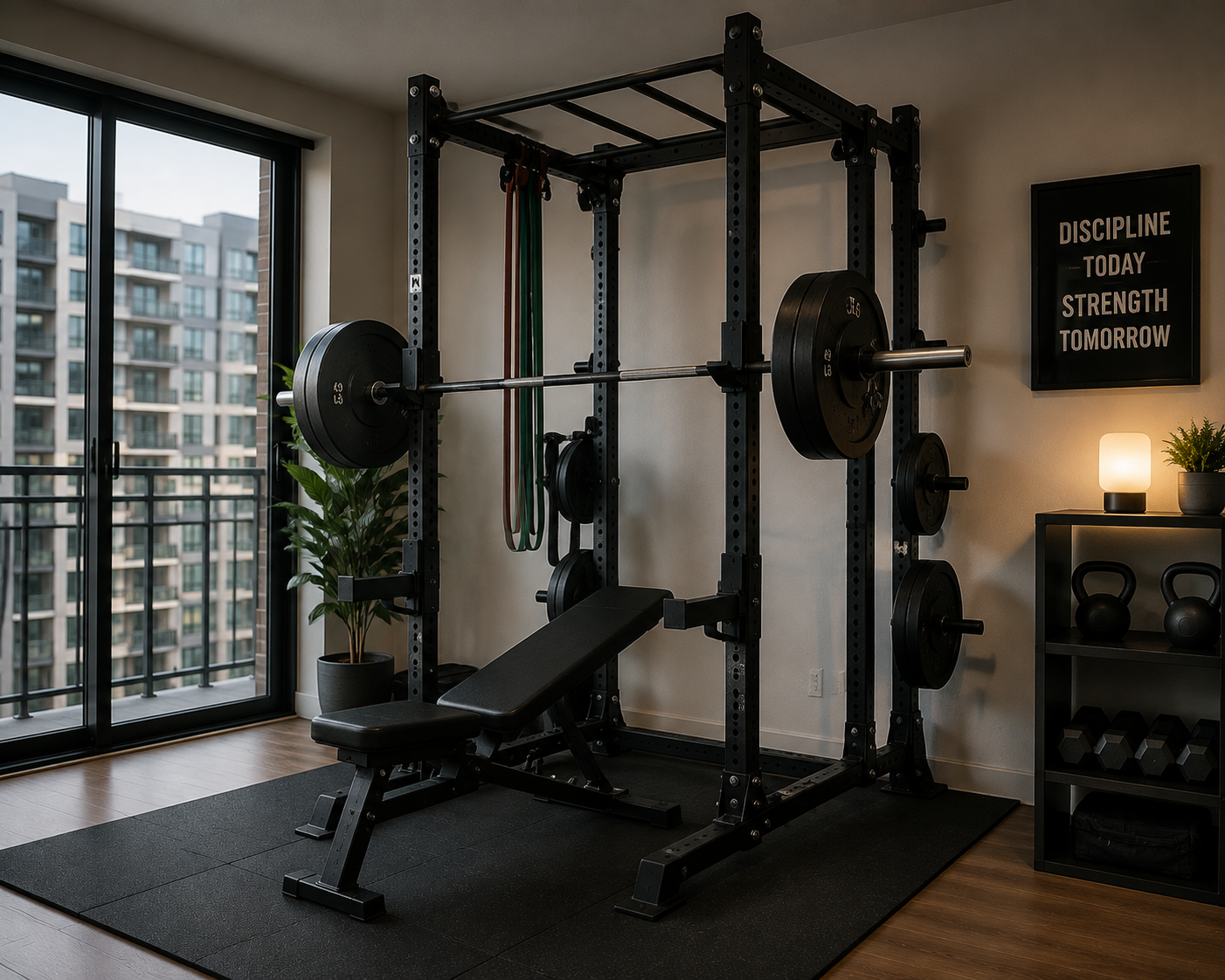
Rack Installation in an Apartment Building: A Guide to Noise and Floor Load Capacity
Creating a home gym inside an apartment has become an increasingly popular choice. Having the ability to train at any time of the day, without commuting and without depending on gym hours, represents a significant advantage. However, installing a home gym rack in an apartment building requires some technical assessments that go well beyond simply choosing the equipment.
The most frequent concerns involve the floor's ability to support loads, the noise generated during exercises, the vibrations transmitted to neighbors, and floor protection. Many give up on the idea of training with a barbell, thinking it is impossible to do so in an apartment, when in reality, with the right planning, it is possible to create a safe, quiet, and perfectly compatible setup for apartment living.
This guide analyzes all the fundamental aspects to consider before installation: from verifying the floor's load capacity to choosing the ideal position for the rack, from using anti-vibration platforms to solutions for reducing noise and impacts during squats, bench presses, and deadlifts.
- Evaluate the available space
- Floor load capacity and load distribution
- How to reduce noise and vibrations
- Platforms and protective flooring
- Positioning the rack correctly
- Training while respecting the building
- Errors to avoid
- A well-designed installation pays off
Evaluate the available space
Even before purchasing the rack, it is important to carefully analyze the environment where it will be installed. You must consider not only the footprint of the structure but also the space needed to load the barbell, use an adjustable bench, perform exercises safely, and move freely during training.
Ceiling height is one of the first elements to check. Exercises like military presses, pull-ups, or the use of overhead accessories require adequate vertical space. In some cases, it may be preferable to opt for compact racks or folding models to better adapt to the apartment's characteristics.
It is also advisable to choose a room that is rarely used in the evening hours and, when possible, far from neighbors' bedrooms. Proper space planning contributes to both the user's comfort and the reduction of potential sources of disturbance.
Measure with precision
Before purchasing, it is appropriate to verify the available width, depth, and height, also considering accessories that might be installed in the future.
Leave space for movement
A functional gym should not feel congested. Maintaining adequate free space improves safety, comfort, and training quality.
Floor load capacity and load distribution
One of the aspects that generates the most concern involves home gym floor load capacity. In reality, in most modern residential buildings, a correctly used rack does not represent a structural problem, provided that loads are distributed evenly and excessive concentrations in very limited points are avoided.
It is important to distinguish between static load and dynamic load. The weight of the rack, plates, and the athlete constitutes the static load, while the impacts generated by dropping the barbell during deadlifts or other exercises produce much higher dynamic loads, which are responsible for most of the vibrations perceived.
When planning training with particularly heavy loads or living in very old buildings, it may be useful to seek the opinion of a qualified technician. A preliminary check allows you to train with greater peace of mind and to design the station correctly.
Static loads
The rack, barbell, plates, and athlete generally distribute weight over a relatively large surface, especially if adequate flooring is used.
Dynamic loads
Impacts represent the main source of stress for the floor. Reducing them means protecting both the building and the acoustic comfort of the apartment building.
How to reduce noise and vibrations
Noise does not depend exclusively on the weight used, but above all on how it is transmitted to the floor. A barbell set down with control produces a completely different impact compared to one dropped after a heavy set.
To limit apartment squat rack noise, it is essential to focus on training technique, avoid bouncing the plates, and use surfaces capable of absorbing part of the energy generated during exercises.
Choosing rubber bumper plates can also help significantly reduce noise compared to traditional cast iron plates, especially during Olympic lifts or deadlifts.
Controlled technique
Always guide the barbell during the descent to limit impacts and drastically reduce the transmission of vibrations to the building's structure.
Train at the right times
Scheduling workouts during time slots compatible with normal apartment life is a simple form of respect that helps avoid unnecessary conflicts.
Platforms and protective flooring
The most effective solution for protecting the floor and reducing vibrations is to use an apartment deadlift platform made with materials capable of absorbing impacts. A good platform distributes weight better and limits the direct transmission of stress to the floor.
In addition to the platform, installing rubber rack flooring under the entire training area helps improve comfort, stability, and acoustic insulation. The thickness of the rubber should be chosen based on the intensity of use and the loads normally employed.
These elements not only serve to protect the home's floor but also increase the durability of the equipment and improve the feeling of stability during exercises.
Why use rubber flooring
High-density rubber reduces vibrations, protects the original floor, and improves grip during training.
When a dedicated platform is needed
Those who frequently perform deadlifts or use heavy loads benefit greatly from a specific platform designed to absorb impacts.
Positioning the rack correctly
The position of the rack within the room affects both practicality and load distribution. Generally, it is preferable to place it near a load-bearing wall, avoiding placing it in the center of large surfaces lacking structural supports.
It is also necessary to leave enough space in front of and to the sides of the structure to allow for loading the barbell, the athlete's passage, and the potential use of accessories such as benches, spotter arms, or landmines.
Proper installation also includes perfectly leveling the rack and periodically checking the tightness of all hardware, so as to keep the structure stable over time.
Utilize load-bearing walls
When possible, installing the rack near structural elements contributes to better load distribution.
Verify perfect support
A completely stable structure reduces oscillations, noise, and component wear during workouts.
Training while respecting the building
Living peacefully with other residents also means adopting some simple precautions during training. Avoiding dropping the barbell, using suitable plates, and maintaining responsible behavior significantly reduces the risk of complaints.
It is also advisable to schedule workouts at times compatible with the building's regulations, favoring daytime and evening hours without extending sessions into the night.
The combination of good technique, adequate flooring, and quality equipment allows for a surprisingly quiet training environment even when using heavy loads.
Good habits
Training with control and attention is the simplest way to reduce any form of disturbance to other residents.
Choose quality components
Stable racks, bumper plates, and professional flooring contribute significantly to the acoustic comfort of the entire station.
Errors to avoid
One of the most frequent errors is installing the rack directly on the floor without any protection. In addition to damaging the surface, this choice significantly increases the transmission of vibrations and noise.
Another error concerns underestimating the space needed for training. An environment that is too cramped limits movement and can compromise safety while using the barbell.
Finally, it is important to avoid exercises that involve the uncontrolled release of the load if you do not have flooring properly designed to absorb impacts.
Do not improvise the installation
Careful planning allows you to avoid subsequent modifications and ensures a more functional, safe, and quiet gym.
Prevention is always the best choice
Investing from the beginning in quality flooring, accessories, and materials allows you to avoid future problems and improve the training experience.
A well-designed installation pays off
Installing a rack in an apartment is absolutely possible, provided you approach the project with attention to technical aspects. Evaluating the floor's load capacity, using protective surfaces, and adopting measures to reduce noise and vibrations allows you to train safely without compromising the comfort of other residents.
Careful design also allows you to preserve the floor, improve equipment stability, and obtain an efficient home gym even in limited spaces. Investing in quality components means reducing maintenance and increasing the lifespan of the entire setup.
To learn more about the features of structures designed for home training and to evaluate the configurations best suited to your needs, you can consult the section dedicated to home gym racks. A conscious choice allows you to create a professional, quiet space ready to support years of training even inside an apartment building.
Comments (0)