
Trolley
You have no items in your shopping cart

 Budgets
 Dumbers
 Discs
Discs
 Benches
 Racks and Rigs
 Weights Holders
 Isotonic machines
 Calisthenics
 Cardio
 Kettlebells
 Flooring
 Gym Set
 Accessories
 Combat
 ARTI MARZIALI
 CONTAINER GYM
 Tug-Of-War
 Used Gym Equipment
 PILATES MACCHINARI
 GINNASTICA ARTISTICA
 CAMPI DA PADEL
 Prodotti in Pronta Consegna
 Informazioni
 IRONMAN
 Gift Card
- Donatif
- General information
- 0 I like it
- 444 Views
- 0 comments
- gym flooring, safety flooring, gym safety, shock-absorbing materials
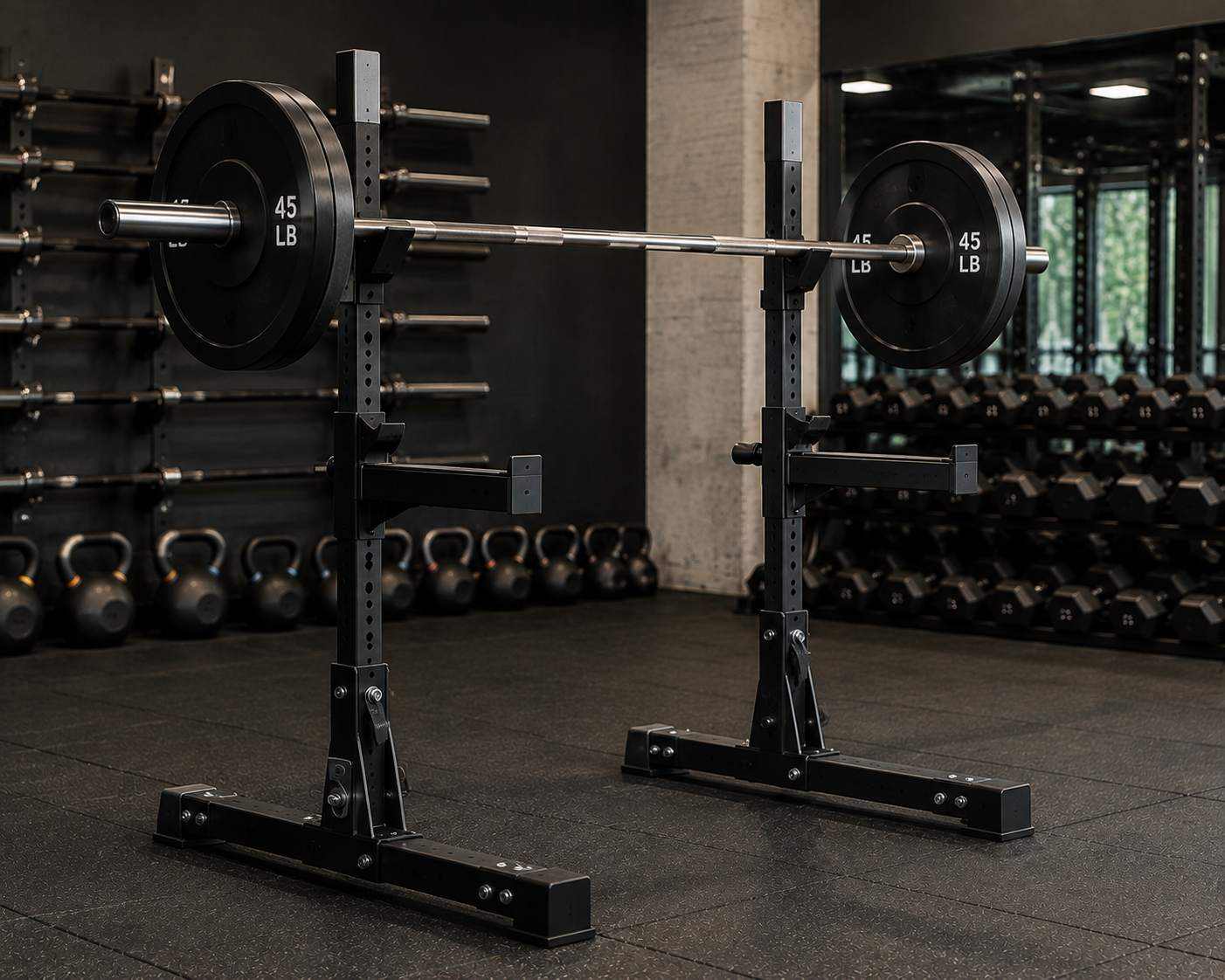
Independent Barbell Stands: When Are They the Best Choice for a Home Gym?
Those looking to create an efficient home gym are often faced with an important choice: buying a full power rack or opting for independent barbell stands. Both solutions allow for the performance of fundamental exercises like squats, military presses, and bench presses, but they address very different needs in terms of available space, budget, and flexibility of use.
In recent years, professional squat stands have undergone significant evolution. Modern models offer precise adjustments, more stable bases, and high load capacities, becoming a valid alternative to traditional racks for those who train at home. This solution is particularly interesting for students living away from home, people living in small apartments, or those who wish to train in the living room without permanently occupying a room.
In this guide, we analyze the advantages, limitations, and selection criteria for independent stands, comparing them with traditional racks and explaining when they truly represent the best investment for an advanced home gym.
- What are independent barbell stands
- The main advantages
- Limitations to know before purchasing
- Who they are recommended for
- How to choose the right model
- Comparison with power racks
- Evaluating the long-term investment
- How to make the best decision
What are independent barbell stands
Independent stands consist of two separate columns that support the barbell during the starting and finishing phases of an exercise. Unlike a traditional rack, they are not connected by a fixed structure and can be positioned at the desired distance.
This configuration ensures significant freedom of use and allows the station to be easily adapted to different exercises and types of barbells. Furthermore, at the end of the workout, the stands can be moved and stored, taking up very little space.
Many professional models include millimeter-precise height adjustments, non-slip feet, and locking systems that improve safety and practicality during daily training.
How they work
Each stand is adjusted independently to the desired height. Once positioned correctly, they allow you to unrack and rerack the barbell naturally during squats, presses, and other multi-joint exercises.
Materials and construction
Quality models use high-thickness steel, reinforced welds, and wear-resistant paint. The build quality directly affects the stability, durability, and overall safety of the equipment.
The main advantages
The main strength is versatility. The stands can be used in practically any environment, even where a fixed rack would be too bulky.
The ability to move them easily makes this solution ideal for those who use the living room or a multi-purpose room as a training area. Once the session is over, simply move them against a wall or store them in a closet.
From an economic point of view, they often represent an attractive choice thanks to their affordable price, allowing you to allocate part of the budget to the purchase of higher-quality barbells, plates, or benches.
Portability
The low weight compared to a rack allows the stands to be easily transported, even in the event of a move or change of residence.
Ease of storage
Ease of storage is one of the main reasons that drive many users toward this solution, especially in homes with limited space.
Limitations to know before purchasing
Despite the numerous advantages, independent stands also have some limitations that are important to evaluate carefully.
The main one concerns safety during particularly heavy training sessions. In the absence of integrated safety bars, many exercises require greater attention or the use of compatible spotter arms.
Furthermore, stability depends heavily on the build quality and the correct positioning of the stands on the floor.
Safety-related aspects
Those who train alone with heavy loads should consider models equipped with specific accessories or evaluate a full power rack if the primary goal is the highest level of protection.
Handling heavy loads
It is essential to always respect the load capacity declared by the manufacturer and periodically check the condition of the adjustments and locking systems.
Who they are recommended for
Independent stands are an excellent choice for those who have a home gym with little space and still want to train with fundamental exercises.
They are particularly suitable for students living away from home, young professionals, and those living in apartments where every square meter counts. Even those who want a temporary station to assemble and disassemble quickly can benefit greatly from this solution.
Intermediate users often find squat stands to be the best compromise between functionality, cost, and footprint.
Beginners
For those starting to train, they represent a smart investment that allows you to gradually build a home gym without immediately facing the expense of a professional rack.
Expert users
Many expert athletes also use independent stands as a second training station or in homes where a fixed rack cannot be installed.
How to choose the right model
Before purchasing, it is important to evaluate load capacity, steel quality, base width, and simplicity of adjustments.
The best adjustable barbell stands allow you to quickly change the height without compromising stability, adapting to different exercises and users.
It is also worth checking compatibility with any spotter arms and other accessories that can increase safety and versatility over time.
Adjustment system
Adjustments must be quick, precise, and secure, avoiding structural play during use.
Base stability
A wide and well-designed base reduces the risk of unwanted movement and improves the feeling of solidity during training.
Comparison with power racks
The power rack remains the most complete solution in terms of safety and the ability to perform numerous exercises with dedicated accessories.
Independent stands, however, are clearly superior when space is the main design constraint of the home gym.
For many users, the ideal compromise consists of initially purchasing professional stands and evaluating a possible upgrade only when needs change or a dedicated room becomes available.
Space management
A rack occupies a fixed surface and often requires more available height, while the stands can be removed completely after each workout.
Value for money
From an economic point of view, squat stands often allow you to achieve high performance with a significantly lower investment.
Evaluating the long-term investment
Buying quality equipment means reducing the likelihood of premature replacements and maintaining high performance for many years.
It is advisable to rely on specialized brands that offer reliable warranties, spare parts, and support over time. To explore products dedicated to the home gym, you can consult the independent barbell stands available in the Donatif catalog.
A well-considered purchase allows you to build a modular home gym, ready to evolve along with your training needs.
Long-term durability
A sturdy structure retains precision and reliability even after years of frequent use.
Possibility of expansion
Many users subsequently integrate adjustable benches, Olympic barbells, and other accessories without having to replace the stands purchased initially.
How to make the best decision
The choice between independent stands and a power rack depends mainly on the available space, budget, and the type of training planned.
Those looking for maximum flexibility, minimal footprint, and ease of transport will find squat stands to be an extremely effective solution, especially for well-organized home workouts.
By carefully evaluating build quality, load capacity, adjustment systems, and the future prospects of your home gym, you will be able to make an informed investment, balancing safety, practicality, and long-term performance.
Comments (0)