
Trolley
You have no items in your shopping cart

 Budgets
 Dumbers
 Discs
Discs
 Benches
 Racks and Rigs
 Weights Holders
 Isotonic machines
 Calisthenics
 Cardio
 Kettlebells
 Flooring
 Gym Set
 Accessories
 Combat
 ARTI MARZIALI
 CONTAINER GYM
 Tug-Of-War
 Used Gym Equipment
 PILATES MACCHINARI
 GINNASTICA ARTISTICA
 CAMPI DA PADEL
 Prodotti in Pronta Consegna
 Informazioni
 IRONMAN
 Gift Card
- Donatif
- General information
- 0 I like it
- 475 Views
- 0 comments
- gym flooring, safety flooring, gym safety, shock-absorbing materials
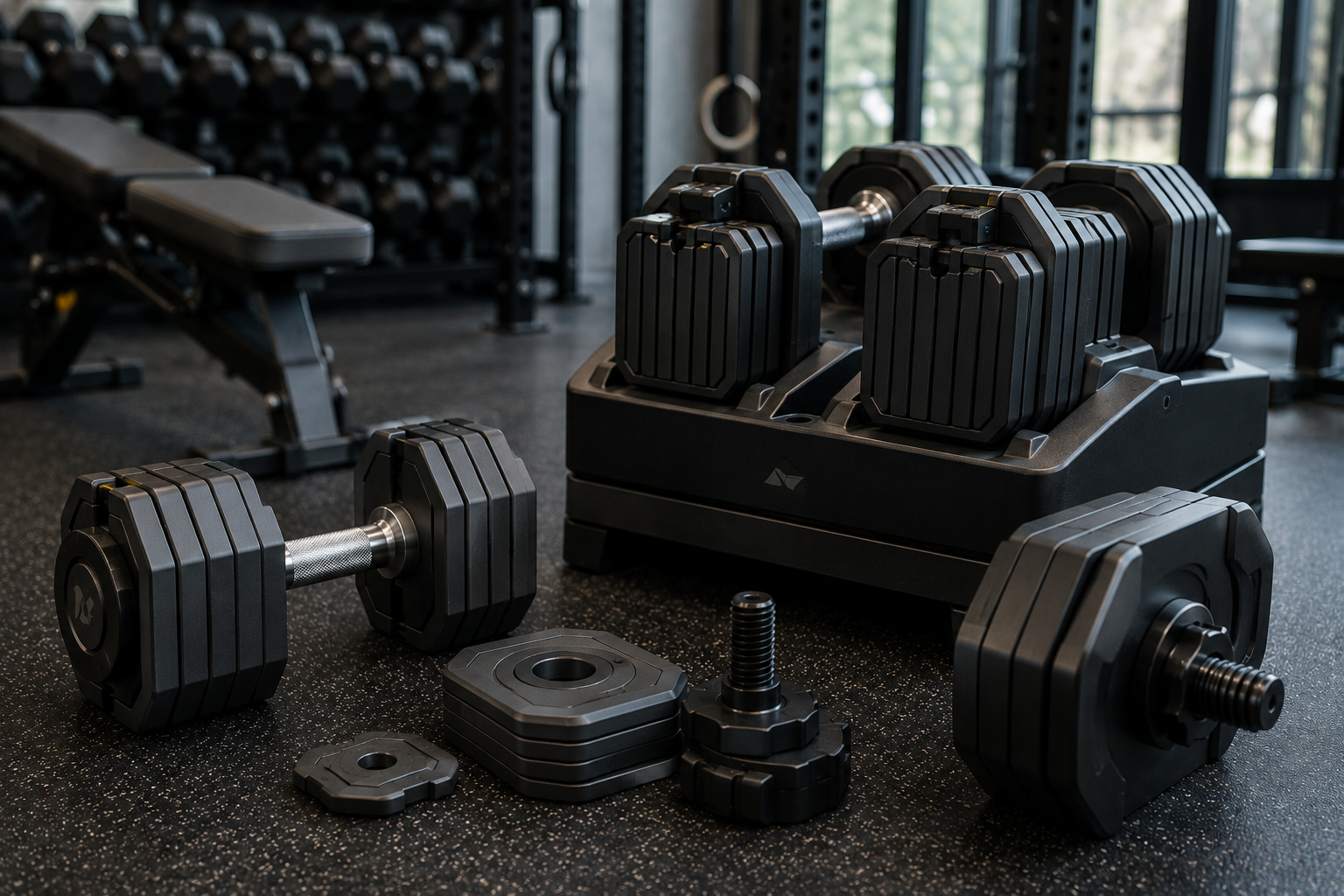
Modular dumbbells and multi-diameter compatibility: how to reuse your old weight plates in a professional system
When renovating a gym or expanding a weight training area, one of the most common mistakes is thinking that all the equipment already purchased must be replaced. Many enthusiasts and professionals actually own cast iron weight plates of different sizes accumulated over time, purchased for different needs or coming from previous training setups.
The ability to recover this material represents a significant economic and strategic advantage. Modular dumbbells allow you to create flexible, adaptable solutions capable of making the most of the weights you already have, avoiding waste and transforming an old kit into a more modern and functional system.
Compatibility between different diameters, such as 25 mm, 28 mm, and 50 mm, however, requires careful technical evaluation. Knowing the differences between standards, correctly using available accessories, and designing a coherent system allows you to obtain reliable equipment without having to start from scratch.
- Differences between 25mm, 28mm, and 50mm diameters
- How weight plate compatibility works
- The advantage of a multi-diameter system
- The role of weight adapters
- Making the most of old cast iron plates
- How to choose a modular system
- An investment focused on waste reduction
Differences between 25mm, 28mm, and 50mm diameters
The diameter of the weight plate hole is one of the main elements to consider when talking about equipment compatibility. In the fitness market, there are several standards that have spread over time, each with specific characteristics and different intended uses.
Plates with a smaller diameter, such as 25 mm, are often found in home kits and entry-level setups. 28 mm plates, on the other hand, represent a very common standard for modular equipment and allow for a good combination of practicality and robustness.
50 mm systems belong to the Olympic standard and are generally associated with professional environments where high loads and equipment designed for intensive use are utilized.
Difference between 28mm vs 50mm plates
The comparison between 28mm vs 50mm plates does not only concern the size of the hole, but also the type of intended use. A 50 mm Olympic plate can offer greater robustness and handling more suitable for high loads, while the 28 mm format is often more practical for those who already own many compatible weights.
The correct choice therefore depends on the available equipment and the goals of the gym, not exclusively on the standard considered most professional.
The evolution of training systems
Over the years, many users have accumulated plates from different setups. A modern system must therefore also consider the need to integrate existing materials.
Modularity becomes a fundamental element because it allows you to adapt the equipment to real needs without imposing a complete replacement.
How weight plate compatibility works
The compatibility between dumbbells and plates depends mainly on the ratio between the sleeve diameter and the internal hole of the weight. Before purchasing new components, it is therefore necessary to check the measurements of the equipment already present.
A preliminary analysis allows you to avoid unnecessary purchases and design a more efficient configuration. This approach is particularly important for those who have invested in quality plates over the years and want to continue using them.
Compatibility does not only concern physical assembly, but also the safety of the system during training.
Verifying measurements and technical characteristics
Before integrating new modular dumbbells, it is advisable to check the hole diameter, the thickness of the plates, and the type of fastening system required.
These details allow you to create a stable configuration suitable for the intended use.
Importance of correct fastening
A reliable connection between the dumbbell and the plates is essential to ensure safety during every exercise. Correctly designed components reduce unwanted movement and improve the perception of solidity.
In a modular system, the quality of the fastening becomes one of the most important elements of the entire configuration.
The advantage of a multi-diameter system
A multi-diameter system offers a particularly interesting solution for those who want flexible equipment. The ability to use plates with different characteristics allows you to expand the available configurations without eliminating material already purchased.
This approach follows a philosophy based on modularity and resource optimization, two aspects that are increasingly important for both enthusiasts and professional facilities.
Instead of considering old plates as a limitation, it is possible to transform them into a resource that is still useful within a more advanced system.
More configurations with less equipment
Modularity allows you to create different weight combinations using the same basic components. This allows you to quickly adapt the equipment to users with different strength levels.
For personal trainer studios and gyms with limited space, this feature represents a significant operational advantage.
Reducing unnecessary purchases
Recovering already available plates means reducing duplicate investments and making better use of the budget allocated for equipment.
A strategy based on intelligent reuse allows you to allocate resources to other gym improvements.
The role of weight adapters
Adapters are a useful tool when you want to integrate components with different standards. Gym weight adapters allow you to create greater compatibility between equipment that would not normally be directly usable together.
Their function must, however, be evaluated considering construction quality, measurement precision, and overall system safety.
When adapters are an effective solution
Adapters can be particularly useful for those who already own a significant quantity of plates and want to expand training possibilities without purchasing a completely new set.
They are a practical solution to increase the versatility of existing equipment.
Choosing reliable adapters
Not all adapters offer the same level of precision. A suitable product must ensure a stable coupling and maintain safety even during frequent use.
The quality of accessory components directly influences the reliability of the entire system.
Making the most of old cast iron plates
Many plates purchased over the years maintain high functional value. Cast iron is a resistant material and can continue to be used effectively if integrated into a compatible configuration.
Dumbbells for cast iron plates allow you to take advantage of this possibility, transforming material already present into a training solution that is still current.
This philosophy reduces waste and allows you to build a more economically sustainable system.
Giving equipment a second life
An old weight kit does not necessarily have to be replaced when the user's needs change. With the right solutions, it can become part of a more complete system.
This approach enhances the initial investment made over time.
Savings and budget optimization
Reusing available plates allows you to reduce the overall cost of upgrading equipment.
The budget can thus be allocated to improving other elements of the gym while maintaining high general quality.
How to choose a modular system
Choosing a modular system must consider compatibility, material quality, ease of use, and the possibility of future expansion. A good product must adapt to current needs but also accommodate any changes over time.
Intelligent equipment design allows you to get more value from every component purchased.
The importance of modularity
A modular system allows you to modify configurations and loads without completely replacing the equipment.
Thinking about future needs
A choice oriented toward compatibility offers greater freedom when you decide to expand your training space.
An investment focused on waste reduction
Choosing a system compatible with already available plates represents a concrete way to protect the value of equipment purchased over time.
The ability to integrate different components through modular solutions allows you to build a more efficient gym, avoiding complete replacements and unnecessary waste.
An approach based on compatibility, material quality, and flexibility allows you to transform an old weight kit into a professional configuration ready to grow along with the user's needs.
Comments (0)