
Trolley
You have no items in your shopping cart

 Budgets
 Dumbers
 Discs
Discs
 Benches
 Racks and Rigs
 Weights Holders
 Isotonic machines
 Calisthenics
 Cardio
 Kettlebells
 Flooring
 Gym Set
 Accessories
 Combat
 ARTI MARZIALI
 CONTAINER GYM
 Tug-Of-War
 Used Gym Equipment
 PILATES MACCHINARI
 GINNASTICA ARTISTICA
 CAMPI DA PADEL
 Prodotti in Pronta Consegna
 Informazioni
 IRONMAN
 Gift Card
- Donatif
- General information
- 0 I like it
- 9 Views
- 0 comments
- gym flooring, safety flooring, gym safety, shock-absorbing materials
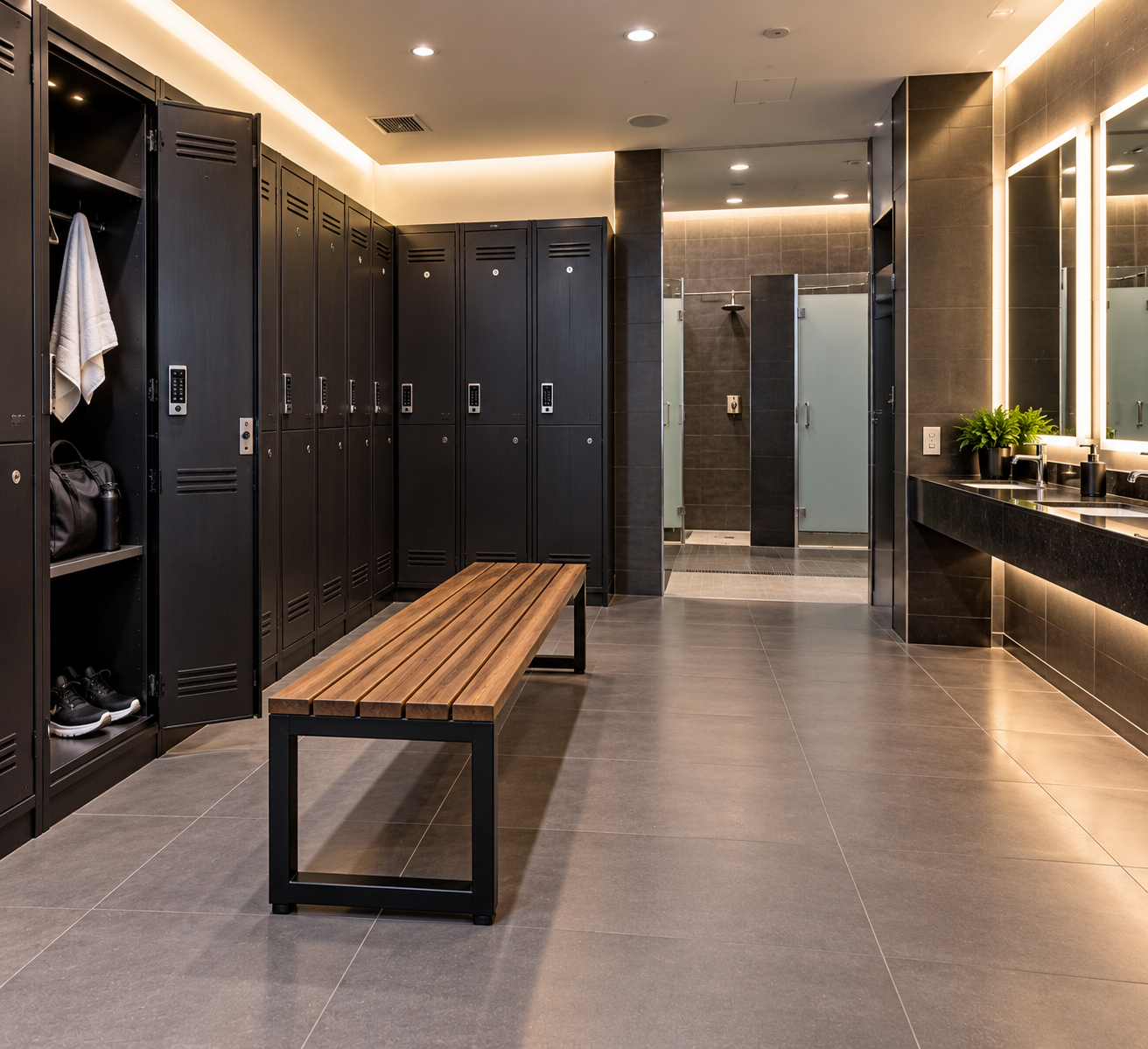
Gym locker room maintenance: cleaning and furniture inspection
Gym locker room maintenance directly impacts user safety, furniture durability, and the perceived quality of the facility. A clean environment lacking technical checks can in fact present deteriorated elements, loose fixtures, or damaged surfaces that increase the risk of accidents and lead to higher restoration costs.
For a gym manager, it is therefore useful to adopt a scheduled maintenance plan that distinguishes cleaning activities from periodic inspections. Each check must be verifiable, documented, and repeatable so that early signs of wear can be promptly identified before they turn into extraordinary interventions.
This guide proposes operational criteria to organize locker room maintenance, define inspection frequencies, and evaluate when to intervene on lockers, benches, accessories, locks, and surfaces. In-depth discussions dedicated to space design, sizing, or materials are handled separately and are not the subject of this article.
- Quick answer
- What to check in the locker rooms
- Cleaning and inspection frequencies
- How to organize cleaning and maintenance
- Signs of wear not to be overlooked
- When to replace or repair furniture
- How to document maintenance
- Why maintenance is an investment
What does gym locker room maintenance include?
Gym locker room maintenance includes scheduled cleaning, furniture inspection, fastener verification, surface checks, replacement of worn components, and recording of performed interventions. Separating hygiene activities from technical ones helps keep environments efficient and reduces the risk of sudden breakdowns.
Operations must be planned according to the facility's usage intensity, the average number of daily users, and the characteristics of the installed furniture.
A written plan also facilitates the scheduling of interventions and allows monitoring the conservation status of the various equipment present in the locker rooms over time.
What criteria should be used?
Checks should follow standardized checklists reporting the date, verified area, any anomalies found, and corrective actions taken. This way, each inspection is comparable with previous ones.
What is the objective?
The objective is not only to keep environments clean but to preserve furniture functionality, reduce premature replacements, and guarantee constant usage conditions.
What to check during each inspection?
Verifications must involve all elements subject to daily use and greater wear.
A checklist helps not to overlook less obvious components that are fundamental for safety.
The outcomes of the checks must be recorded uniformly.
Lockers and closing systems
Check door integrity, hinge functionality, locks, closing systems, handles, feet, and structural stability. Check for any deformations due to humidity and the presence of corrosion on metal parts.
Benches and accessories
Verify fixtures, stability, chipping, worn surfaces, protruding elements, coat hooks, mirrors, dispensers, baskets, and installed accessories. If the locker rooms include areas with elements dedicated to equipment organization, it can also be useful to evaluate easily sanitized and replaceable gym accessories.
How often should checks be performed?
Frequencies depend on usage volume and the number of users, but it is advisable to distinguish between daily, periodic, and extraordinary activities.
Scheduling reduces the risk of small defects evolving into more costly breakdowns.
Every facility should adapt the calendar to its own organization.
Daily checks
General visual inspection, order verification, removal of any evident damage, functional check of the most used closures, and immediate reporting of anomalies.
Periodic checks
On a weekly or monthly basis, it is appropriate to check fasteners, tightness, furniture stability, surface condition, presence of oxidation, integrity of silicone seals, and full functionality of accessories.
How to organize cleaning and maintenance?
Cleaning procedures must be compatible with the installed materials to avoid premature deterioration.
Products that are too aggressive can compromise coatings, laminates, and metal components.
Manufacturer instructions always represent the primary reference for detergents and usage methods.
Surface cleaning
Use detergents suitable for the materials present, avoiding abrasive products when not specified by the manufacturer. Pay particular attention to frequent contact points such as handles, closures, and seats.
Preventive maintenance
Lubricate moving components when specified, promptly replace deteriorated small parts, restore surface protections, and correct minor misalignments before they cause major damage.
Which signs of wear require attention?
Early recognition of the first symptoms of deterioration allows scheduling interventions without interrupting service.
Many anomalies start with small, easily solvable defects.
Ignoring such signs increases the probability of complete replacements.
Structural signs
Bench oscillations, lockers not perfectly aligned, fasteners tending to loosen, door deformations, and localized yielding require technical control.
Surface signs
Bulges, panel peeling, rust, anomalous discolorations, cracks in plastic materials, and loss of finishes indicate the need to evaluate a corrective intervention.
When to replace or intervene on furniture?
Not every defect requires replacing the entire element. Many components can be restored through targeted interventions.
The evaluation must consider safety, repair cost, and spare parts availability.
Timely maintenance normally extends the useful life of the furniture.
When is a repair sufficient?
Replacing hinges, locks, feet, handles, or fasteners can fully restore functionality when the main structure is intact.
When is replacement advisable?
If damage affects load-bearing elements, compromises safety, makes correct use impossible, or spare parts are no longer available, replacement generally represents the most effective solution.
How to document maintenance activities?
Recording interventions facilitates the control of activities performed and makes planning future maintenance easier.
Documentation also allows identifying any recurring critical issues.
A standard procedure reduces the risk of forgetting important verifications.
Maintenance log
Noting the date, checked area, operator, detected anomalies, performed interventions, and replaced material allows building an easily searchable history.
Technical references
For detergents, cleaning methods, spare parts, and usage limits, it is appropriate to refer to the manuals of the manufacturers of the installed furniture and equipment, as well as any internal procedures adopted by the facility.
Why is maintenance an investment?
Scheduled maintenance management allows distributing interventions over time, limiting operational downtime, and maintaining the high perceived quality of environments intended for users.
The availability of documented periodic checks also facilitates the economic planning of replacements, avoiding emergency interventions and helping preserve the overall value of the furniture installed in the locker rooms.
Integrating inspections, cleaning, and preventive maintenance into a single operational procedure makes management costs more predictable and keeps gym locker rooms functional in the long term.
Comments (0)