
Trolley
You have no items in your shopping cart

 Budgets
 Dumbers
 Discs
Discs
 Benches
 Racks and Rigs
 Weights Holders
 Isotonic machines
 Calisthenics
 Cardio
 Kettlebells
 Flooring
 Gym Set
 Accessories
 Combat
 ARTI MARZIALI
 CONTAINER GYM
 Tug-Of-War
 Used Gym Equipment
 PILATES MACCHINARI
 GINNASTICA ARTISTICA
 CAMPI DA PADEL
 Prodotti in Pronta Consegna
 Informazioni
 IRONMAN
 Gift Card
- Donatif
- General information
- 0 I like it
- 1 Views
- 0 comments
- gym flooring, safety flooring, gym safety, shock-absorbing materials
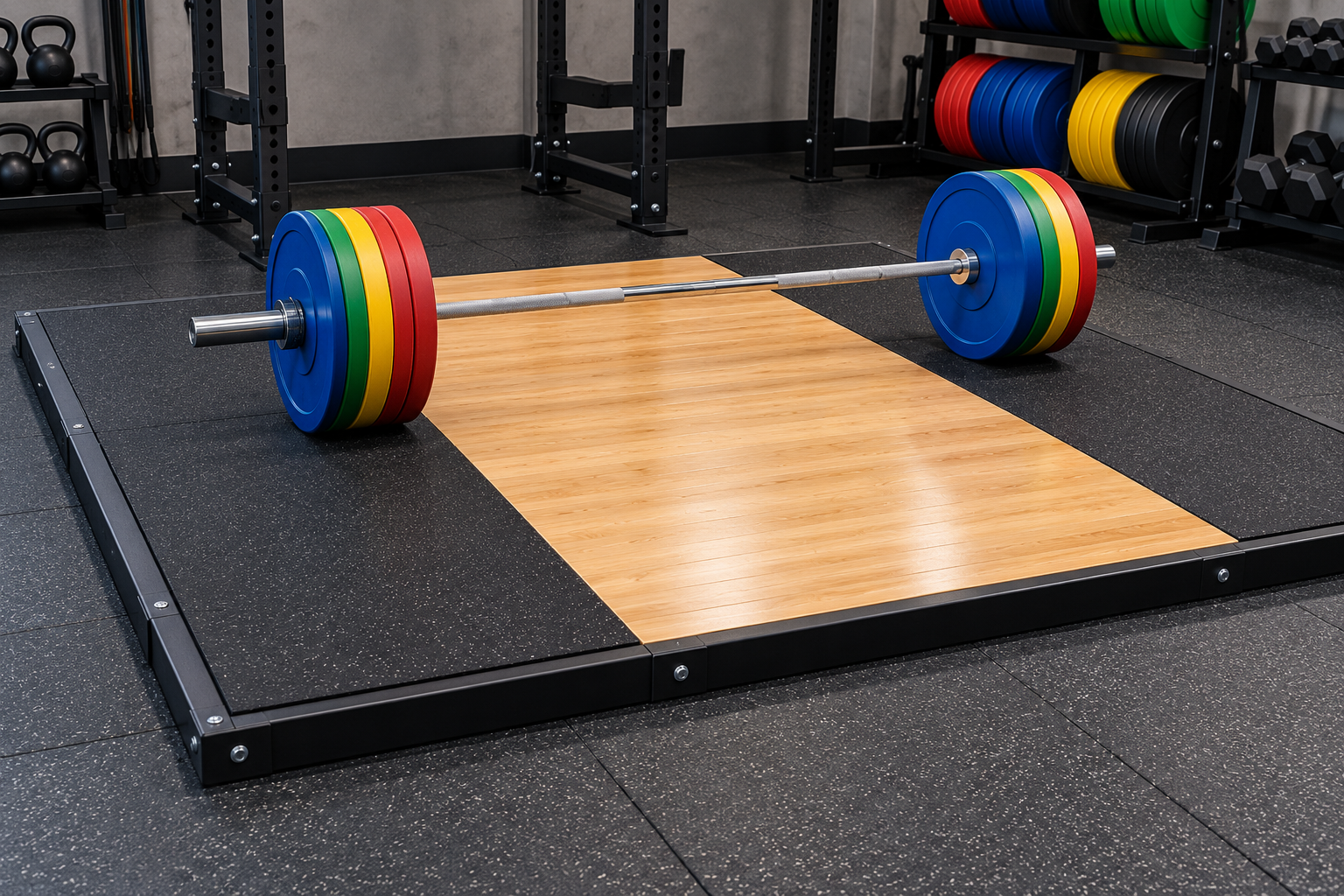
Lifting platform for weightlifting: requirements and usage
The lifting platform dedicated to weightlifting represents the benchmark for performing technical movements such as the snatch and clean and jerk in an organized environment designed to handle the stresses of barbell training. Its function is not limited to offering a support surface, but contributes to floor protection, load distribution, and the stability of the entire station.
To achieve adequate performance, it is important to carefully evaluate construction requirements, space configuration, materials, and installation methods. A platform designed in a way consistent with the type of use facilitates the technical execution of exercises and improves training area management.
This guide illustrates the main criteria for choosing a platform intended for weightlifting, explaining how to use it correctly and what aspects to consider when designing a professional gym or an advanced home gym.
- Quick answer
- What requirements it must have
- How to use the platform correctly
- How to design the training area
- Materials and configuration
- Safety during use
- Errors to avoid
- FAQ
- Evaluating the investment
What requirements must a weightlifting platform have?
A lifting platform for weightlifting should be designed considering the intended use, quality of materials, dimensions, structural stability, compatibility with flooring, and subfloor characteristics. The goal is to ensure safety, continuity of use, and an environment suited to the technical movements of Olympic weightlifting.
Each installation should be sized according to available space and expected training intensity.
When applicable, it is advisable to consult the manufacturer's technical documentation and the guidelines of relevant sports federations, always verifying relevance to the context of use.
The discipline determines the requirements
A platform intended for weightlifting must be chosen based on the specific needs of Olympic movements and not merely on aesthetic features or price.
The platform is part of the room design
The configuration must integrate with flooring, equipment, and circulation paths to ensure a functional environment.
What features really matter?
The evaluation should include structure, build quality, load distribution capacity, surface stability, and compatibility with the planned type of training.
The assembly system, wear resistance, and ease of maintenance also affect the platform's lifespan and the continuity of use of the station.
Rather than seeking a single technical parameter, it is appropriate to evaluate the system as a whole.
Structural stability
A stable structure helps maintain consistent platform performance during repeated training sessions.
Support compatibility
The quality of the subfloor directly affects the behavior of the entire station and the distribution of stresses.
How to use the platform correctly?
The platform should be used exclusively for the activities provided for by the manufacturer, respecting the operating procedures indicated in the technical documentation.
During training, it is important to keep the area free of obstacles, verify surface stability, and organize accessories so as not to interfere with the athlete's movements.
To learn more about the various available configurations, you can consult the section dedicated to lifting platforms, which is useful for comparing systems designed for different training methods.
Execution of Olympic movements
The platform surface must allow the execution of exercises such as the snatch and clean and jerk in conditions of stability and continuity.
Station management
Barbells, plates, and accessories should be placed to facilitate training without hindering movements.
How to properly design the area?
The design of the area dedicated to weightlifting should consider the space needed for the athlete, passageways, the position of other equipment, and floor protection.
An orderly configuration improves safety, facilitates training supervision, and makes maintenance operations simpler.
In professional facilities, it is useful to plan a layout that allows multiple users to train without mutual interference.
Room layout
The arrangement of platforms should encourage fluid pathways and adequate distance from other stations.
Operational space
The surrounding area must allow barbell loading and the complete execution of exercises.
What materials to choose?
Materials influence wear resistance, impact behavior, and the ease of maintenance of the platform.
The choice should be made considering intensity of use, training frequency, and the characteristics of the surrounding flooring.
A well-designed configuration helps preserve the functionality of the station throughout its lifecycle.
Absorption elements
Components intended to absorb impacts must be compatible with the type of training and the platform structure.
Support surface
The finish must ensure stability, durability, and ease of cleaning during daily use.
How to use the platform safely?
Before each workout, it is advisable to check platform stability, surface integrity, and the absence of loose or damaged components.
Scheduled maintenance and periodic checks allow any anomalies to be identified before they can compromise station functionality.
Following the manufacturer's instructions represents the most effective method to preserve performance and safety over time.
Preliminary checks
A quick visual inspection of the structure and surface should precede each training session.
Preventive maintenance
Scheduled interventions help keep the platform efficient and reduce the risk of premature wear.
What errors are best avoided?
One of the most common mistakes is choosing a platform without evaluating the type of discipline practiced and the gym configuration.
It is also advisable to avoid installations on inadequately prepared supports or neglecting periodic structural maintenance.
Even an incorrect arrangement of the station can limit the safety and functionality of the training environment.
Choosing based on price alone
A complete technical evaluation allows you to correctly compare different solutions and identify the one best suited to your needs.
Neglecting checks
Constant maintenance helps preserve the characteristics of the platform and prolong its lifespan.
Frequently asked questions
Is a weightlifting platform also suitable for a home gym?
Yes, provided that the available space, room structure, and station configuration are compatible with the planned type of training.
Can it also be used for the deadlift?
It depends on the construction characteristics of the platform and the intended use indicated by the manufacturer. It is always advisable to check the technical documentation.
How much does maintenance matter?
Regular maintenance helps maintain the performance, stability, and safety of the platform over time.
Why choosing the correct platform represents an investment?
A platform designed for weightlifting improves room organization, facilitates technical training, and contributes to the protection of flooring and equipment.
Analyzing materials, configuration, installation methods, and technical documentation allows you to make a choice based on verifiable criteria rather than initial cost alone.
Accurate design allows you to create an efficient station, easily manageable and capable of adapting to the future evolution of the gym or home gym.
Comments (0)