
Trolley
You have no items in your shopping cart

 Budgets
 Dumbers
 Discs
Discs
 Benches
 Racks and Rigs
 Weights Holders
 Isotonic machines
 Calisthenics
 Cardio
 Kettlebells
 Flooring
 Gym Set
 Accessories
 Combat
 ARTI MARZIALI
 CONTAINER GYM
 Tug-Of-War
 Used Gym Equipment
 PILATES MACCHINARI
 GINNASTICA ARTISTICA
 CAMPI DA PADEL
 Prodotti in Pronta Consegna
 Informazioni
 IRONMAN
 Gift Card
- Donatif
- General information
- 0 I like it
- 339 Views
- 0 comments
- gym flooring, safety flooring, gym safety, shock-absorbing materials
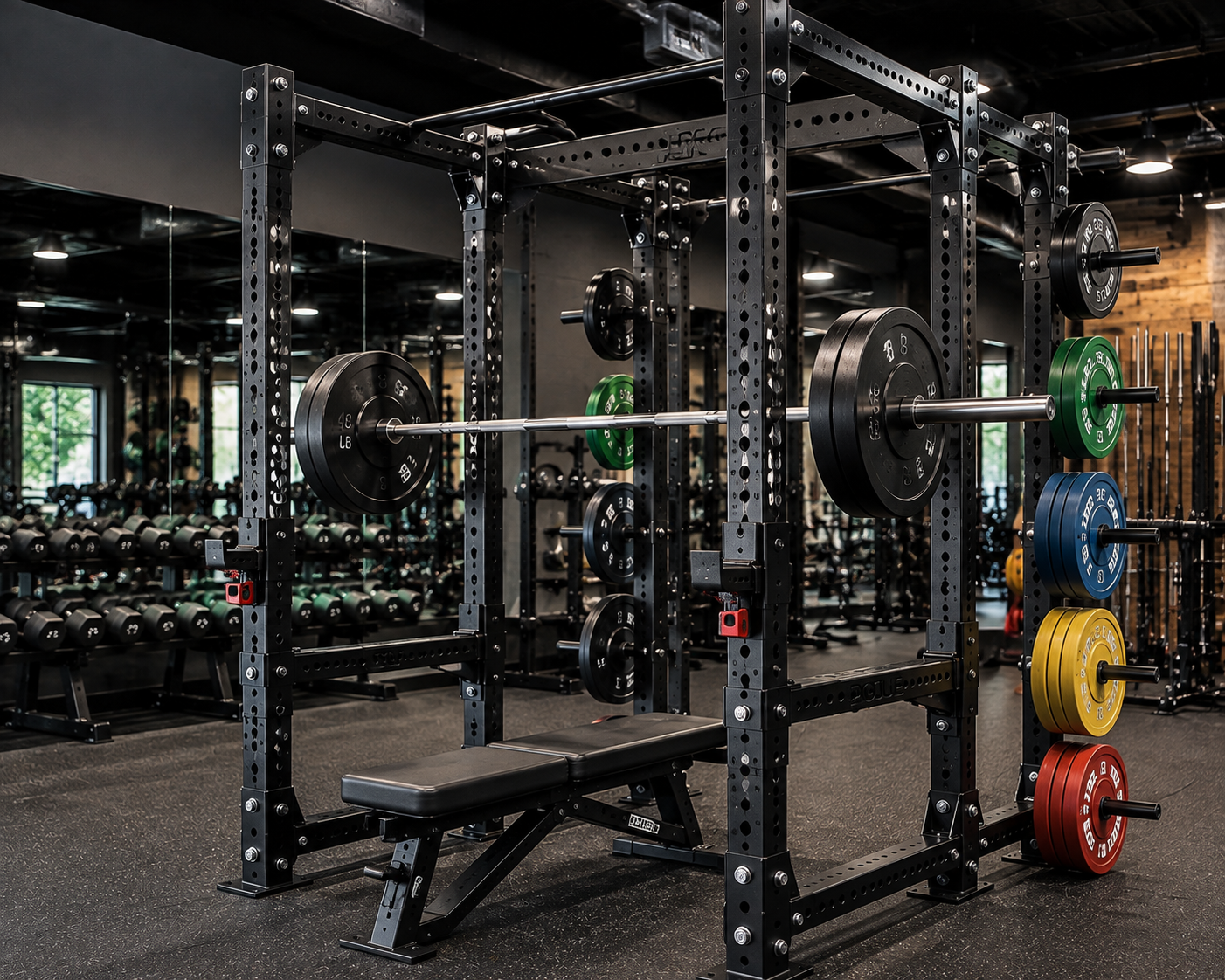
Why the Rack Hole Diameter is Fundamental for Your Future
When buying a power rack, most people focus on load capacity, steel thickness, or the overall dimensions of the structure. These are certainly important aspects, but there is a technical detail that influences the value of the investment much more in the long term: the diameter of the holes on the uprights.
What may seem like a secondary detail actually determines compatibility with dozens of accessories, the possibility of upgrading your equipment over the years, and the freedom to choose components produced by different brands. Buying a rack with a non-standard size can mean finding yourself limited in future expansions, forced to use only the original manufacturer's accessories, or, in the worst case, unable to add new features.
In this guide, we analyze in detail why the hole diameter represents one of the most important elements in choosing a rack, comparing the most common standards, the concept of universal compatibility, and features like Westside Spacing that can make a difference during training and in future upgrades.
- Why the hole diameter is important
- The most common standards
- Accessory compatibility
- What is Westside Spacing
- Thinking about future upgrades
- Errors to avoid
- How to choose the right rack
- An investment that lasts over time
Why the hole diameter is important
Every accessory intended for a rack uses mounting pins that must perfectly match the diameter of the holes on the structure. If these measurements do not match, the accessory cannot be installed correctly or will be unstable and unsafe.
This means that the hole diameter does not only affect the initial purchase, but determines the entire ecosystem of accessories that you will be able to use in the following years. The more common the standard, the greater the freedom to choose between different manufacturers.
Those who consider the rack a long-term investment should evaluate this parameter with the same attention reserved for the robustness of the structure or the declared load capacity.
Why standards exist
Manufacturers use dimensional standards to ensure precision, safety, and interchangeability of accessories. The most common standards facilitate the expansion of equipment over time.
The advantages of a common standard
Choosing a rack with common measurements means being able to compare numerous accessories without being tied to a single brand.
The most common standards
In the European and international market, you can find racks with 16 mm, 25 mm, 28 mm, and 50 mm holes. Each has specific characteristics and a different level of prevalence.
16 mm racks are generally associated with compact and lightweight structures, while models with 25 mm and 28 mm holes represent a very popular choice in the home gym sector for the good balance between robustness and availability of accessories.
High-end professional structures frequently use 50 mm systems, which are particularly suitable for intensive applications and large-sized accessories.
Comparison between 16 mm and 25 mm
The comparison between rack hole diameter of 16 mm and 25 mm mainly concerns the future availability of compatible components. The most common systems generally offer a much wider catalog.
When to choose 50 mm
Racks with 50 mm holes are designed primarily for professional structures that require maximum solidity and a wide range of premium accessories.
Accessory compatibility
One of the most important aspects concerns the possibility of installing components from different manufacturers. A rack compatible with common standards offers greater freedom of configuration.
Among the most requested items are compatible rack accessories such as spotter arms, pulley systems, landmines, plate storage, safety straps, dip stations, and numerous other dedicated solutions.
Before purchasing, it is always advisable to check not only the hole diameter but also the size of the uprights and the distance between them, so as to avoid unexpected incompatibilities.
J-cups for racks
J-Cups are probably the most used accessory. They must adapt perfectly to both the hole diameter and the upright section to ensure stability and safety.
Universal compatibility
The greater the prevalence of the chosen standard, the easier it will be to find components even in the years following the purchase of the rack.
What is Westside Spacing
Among the technical features most appreciated by powerlifting enthusiasts is westside spacing rack, which is a hole arrangement with reduced spacing in the central area of the rack.
This configuration allows for much more precise adjustments of the height of the J-Cups and safety systems, improving comfort and ergonomics during exercises like squats and bench presses.
While not essential for all users, it represents a significant advantage for those looking for extremely accurate adjustments.
More precise adjustments
A smaller distance between the holes allows for small adjustments that improve barbell positioning.
Who it is useful for
Powerlifters, advanced athletes, and users who frequently perform exercises with heavy loads particularly appreciate this solution.
Thinking about future upgrades
Many buy a rack with an essential configuration and then add accessories in the following years. This strategy allows you to spread out the expense while maintaining high equipment quality.
If the rack uses a non-standard size, every upgrade could become more expensive or even impossible. It is therefore important to evaluate the project as a whole and not just the initial price.
A modular system is a smart choice because it allows you to adapt the gym to new goals without replacing the main structure.
The power of modularity
An open platform allows you to progressively expand the rack's functionality while keeping the budget under control.
Protecting the investment
Choosing established standards avoids having to completely change equipment when training needs increase.
Errors to avoid
The most common mistake is to evaluate only the price of the rack, neglecting aspects related to future compatibility. A small initial saving can translate into much higher costs in the medium term.
Another frequent mistake is buying accessories without checking all the necessary measurements: hole diameter, upright dimensions, structure depth, and load capacity must always be checked.
Finally, it is advisable to avoid proprietary racks with completely non-standard systems, unless there are very specific needs or closed projects that do not involve expansions.
Don't look only at the cost
The value of a rack depends above all on the possibility of accompanying the evolution of training over the years.
Check all dimensions
A simple dimensional incompatibility can prevent the use of even very common accessories on the market.
How to choose the right rack
The choice should start with an assessment of future goals. Those who plan to progressively expand their gym should lean towards established and easily available standards.
It is important to check the accessory catalog available at the time of purchase, considering not only current needs but also those that could emerge in the coming years.
To learn more about the features of the different available configurations and evaluate solutions designed to offer maximum compatibility, you can consult the section dedicated to power racks, where there are models designed to facilitate future upgrades.
Evaluate quality and compatibility
The best choice is one that combines structural solidity, availability of accessories, and the possibility of evolution over time.
Think long-term
A rack purchased today should also be able to satisfy the training needs of the coming years without requiring complete replacements.
An investment that lasts over time
The hole diameter represents one of the least conspicuous but most important elements in choosing a rack. Compatibility, safety, and freedom of customization depend on this detail.
Opting for common standards means being able to choose from numerous accessories, compare different manufacturers, and update your station without limitations imposed by the original structure.
Considering these aspects before purchasing allows you to avoid costly mistakes and build a truly modular gym, ready to accompany every evolution of your training journey and the investment made.
Comments (0)