
Trolley
You have no items in your shopping cart

 Budgets
 Dumbers
 Discs
Discs
 Benches
 Racks and Rigs
 Weights Holders
 Isotonic machines
 Calisthenics
 Cardio
 Kettlebells
 Flooring
 Gym Set
 Accessories
 Combat
 ARTI MARZIALI
 CONTAINER GYM
 Tug-Of-War
 Used Gym Equipment
 PILATES MACCHINARI
 GINNASTICA ARTISTICA
 CAMPI DA PADEL
 Prodotti in Pronta Consegna
 Informazioni
 IRONMAN
 Gift Card
- Donatif
- General information
- 0 I like it
- 558 Views
- 0 comments
- gym flooring, safety flooring, gym safety, shock-absorbing materials
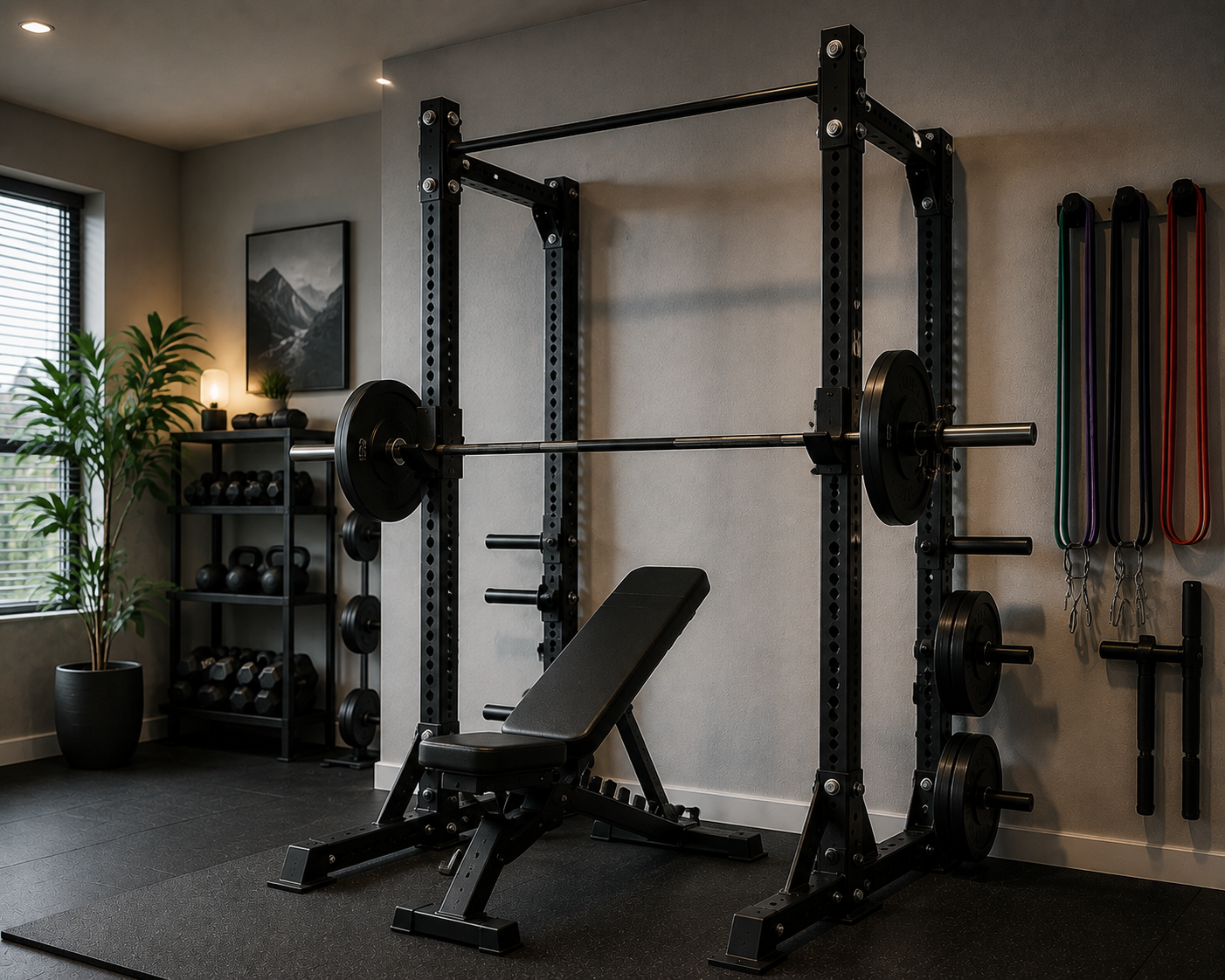
Power Rack vs Half Rack: Which to Choose for Powerlifting?
When building a home gym dedicated to powerlifting, one of the most important decisions concerns the choice of the main structure. The most frequent doubt is whether to invest in a full power rack or an half rack. Both solutions allow you to perform squats, bench press, and military press with a barbell, but they present substantial differences in terms of safety, stability, freedom of movement, and the possibility of future gym evolution.
For a strength athlete, the quality of the rack is not a simple detail: it represents the reference point for every workout. When working with heavy loads, every structural element influences confidence during execution, the technical quality of the movement, and the ability to push to the max without compromising safety.
In this guide, we analyze in detail the comparison between power rack vs half rack powerlifting, highlighting advantages, limitations, and ideal contexts of use to help you choose the solution best suited to your strength goals.
- Power Rack and Half Rack: main differences
- Safety during fundamental exercises
- Structural stability with heavy loads
- Freedom of movement and biomechanics
- Footprint and home gym organization
- Expandability and accessories
- Which rack to choose based on your profile
- The best investment for powerlifting
Power Rack and Half Rack: main differences
The power rack is a completely enclosed structure composed of four main uprights connected to each other. This configuration creates a real safety cage within which barbell exercises are performed.
The half rack instead uses two front uprights with a more open structure. While maintaining high robustness, it offers a less bulky configuration and leaves greater freedom for movements outside the structure.
From a construction point of view, both solutions can be extremely solid, but their design philosophy is different: the power rack prioritizes maximum safety, while the half rack seeks a balance between protection, accessibility, and space optimization.
The power rack configuration
The presence of the four uprights allows for the installation of safety bars, safety pins, strap systems, and numerous accessories, offering an extremely versatile platform for strength training.
The half rack configuration
The half rack reduces the front footprint and allows you to work in front of the structure, making it highly appreciated in home gyms where space is a determining factor.
Safety during fundamental exercises
In powerlifting, safety is one of the most important aspects, especially when training without a spotter. Squats and bench press with heavy loads require reliable systems capable of stopping the barbell in case of failure.
The power rack excels in this aspect thanks to the completely internal safety systems, which allow the athlete to push close to failure while maintaining a high margin of protection.
The half rack can be equipped with high-quality spotter arms, but these work outside the structure and require particular attention in correct positioning and choosing the appropriate length.
Protection during squats
For those who regularly tackle 1RMs or heavy sets, the power rack generally offers the highest level of safety, allowing you to dump the barbell inside the cage if necessary.
Safety in the bench press
During the bench press, the ability to use adjustable safety bars represents a significant advantage, especially in sessions performed alone.
Structural stability with heavy loads
One of the elements most sought after by strength athletes is the structural rigidity of the rack. A stable structure transmits greater psychological security and improves the quality of execution during fundamental exercises.
Generally, the power rack, thanks to its closed configuration, offers greater resistance to torsion and better force distribution during intensive use.
Even a professional half rack can guarantee excellent performance, provided it is made with high-thickness steel, sufficiently wide bases, and adequate structural reinforcements. Half rack stability actually depends much more on design quality than on the simple number of uprights.
Importance of steel thickness
Robust tubing, precise welds, and stiffening plates directly affect the feeling of solidity perceived during the most demanding workouts.
Anchoring and weight distribution
When provided by the manufacturer, anchoring to the floor or using weight plate holders as ballast helps to further increase overall stability.
Freedom of movement and biomechanics
The open configuration of the half rack offers greater freedom of movement, a feature that some athletes particularly appreciate during squats, military press, and Olympic variations.
Training in front of the structure also allows you to use adjustable benches, accessories, and accessory movements more easily without the limitations imposed by a closed cage.
The power rack, on the other hand, requires many exercises to be performed inside the structure. For most athletes, this does not represent a real limit, but some prefer the feeling of openness guaranteed by the half rack.
Squat execution
Both solutions allow you to perform technically correct squats, provided the adjustments are precise and the structure is adequately sized.
Ease of access
The half rack offers extremely immediate access to the barbell and is often chosen even for functional workouts that involve quick changes of exercise.
Footprint and home gym organization
The available space is one of the decisive factors in the choice. A power rack generally occupies a larger surface area and also requires more overhead clearance to utilize all its features.
The half rack is more compact and allows you to maintain a visually open environment, a feature highly appreciated in home gyms set up in garages, basements, or multi-purpose rooms.
Before purchasing, it is essential to also evaluate the space needed for loading the barbell, using the bench, and the presence of any future accessories.
Training in the garage
Both configurations can work perfectly in a garage, but the half rack generally facilitates the management of tighter spaces.
Planning gym growth
Considering potential expansions from the beginning allows you to avoid premature replacements of the main structure.
Expandability and accessories
One of the main strengths of the power rack is its extraordinary modularity. The presence of four uprights allows you to install a wide range of accessories without compromising the functionality of the structure.
Pull-ups, dip stations, jammer arms, pulley systems, safety straps, monolifts, and numerous other accessories can transform a power rack into a true multi-function station.
Modern half racks also offer excellent customization possibilities, but generally present a few more limitations when you want to install numerous accessories simultaneously.
Future upgrades
Those who plan to progressively expand their home gym should carefully consider the availability of compatible components in the manufacturer's catalog.
Operational versatility
A modular structure allows you to adapt the rack to the evolution of training goals without replacing the main equipment.
Which rack to choose based on your profile
Those who dedicate themselves mainly to powerlifting, frequently face very heavy loads, and train alone generally find the power rack to be the most complete solution from a protection point of view.
The half rack is instead an excellent choice for athletes who want greater freedom of movement, a less bulky structure, and a station capable of easily adapting to other types of training as well.
When the goal is to identify the best squat rack, there is no universal answer: the choice depends on the available environment, the intensity of the workouts, and personal technical preferences.
The competitor's profile
Athletes who prepare for competitions and regularly work with high percentages of their 1RM tend to favor the safety and rigidity offered by a professional power rack.
The home gym enthusiast
Those who want a versatile and compact gym can find the best compromise between functionality, occupied space, and economic investment in the half rack.
The best investment for powerlifting
The choice between power rack and half rack should be evaluated considering the type of training, frequency of use, available space, and growth prospects of your home gym.
To explore structures designed for strength training, you can consult the selection of power rack vs half rack powerlifting available in the Donatif catalog, where construction quality, modularity, and safety are central elements of the design.
Investing in a robust structure designed to support intensive workouts means creating a reliable foundation to improve your performance in the long term. Carefully evaluating safety, expandability, material quality, and actual intended use allows you to choose the rack best suited to your needs, obtaining an efficient, stable training environment ready to accompany every phase of athletic growth.
Comments (0)