
Trolley
You have no items in your shopping cart

 Budgets
 Dumbers
 Discs
Discs
 Benches
 Racks and Rigs
 Weights Holders
 Isotonic machines
 Calisthenics
 Cardio
 Kettlebells
 Flooring
 Gym Set
 Accessories
 Combat
 ARTI MARZIALI
 CONTAINER GYM
 Tug-Of-War
 Used Gym Equipment
 PILATES MACCHINARI
 GINNASTICA ARTISTICA
 CAMPI DA PADEL
 Prodotti in Pronta Consegna
 Informazioni
 IRONMAN
 Gift Card
- Donatif
- General information
- 0 I like it
- 47 Views
- 0 comments
- gym flooring, safety flooring, gym safety, shock-absorbing materials
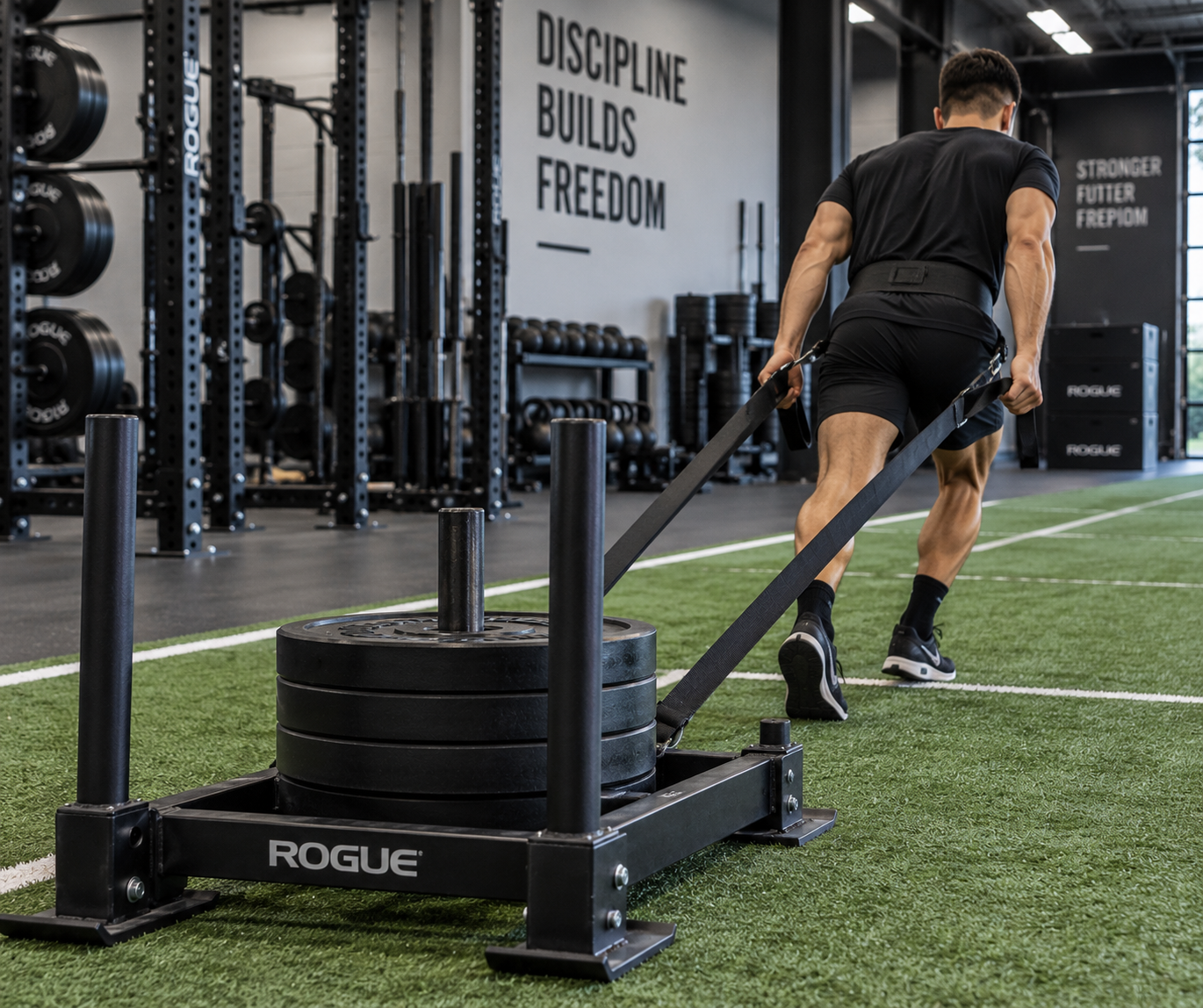
Prowler sled vs pulling sled: differences, benefits, and selection criteria
The comparison between a prowler sled and a pulling sled mainly concerns usage methods, training space organization, and programming goals. Although both belong to the category of functional training sleds, they present characteristics that may make them more suitable for certain contexts.
The choice should not be based solely on price or the possibility of adding load, but on compatibility with the planned exercises, available space, and user level. A comprehensive evaluation makes it possible to identify the most suitable equipment without introducing operational limitations.
This guide compares prowler sleds and pulling sleds through practical criteria, illustrating differences, usage scenarios, design aspects, and mistakes to avoid during selection.
- Quick answer
- What are the main differences
- How to choose between the two solutions
- When to choose the prowler sled
- When to choose a pulling sled
- Space and configuration
- Mistakes to avoid
- How to evaluate the investment
Quick answer
The prowler sled is primarily designed for pushing exercises and can also be used for pulling if compatible with the accessories provided by the manufacturer. A pulling sled, on the other hand, is built to be moved using straps or harnesses. The choice depends on the planned exercises, available space, and the organization of the functional area.
Both solutions require a suitable surface and an area design consistent with the type of intended use.
The manufacturer's instructions always represent the main reference for methods of use, loads, and compatible accessories.
Equipment in the same category
Prowler sleds and pulling sleds share the goal of developing strength and conditioning capacities but differ in configuration and operating modes.
The choice starts from goals
Before purchasing, it is useful to define which exercises will actually be performed with greater frequency.
What are the main differences
The prowler sled is normally equipped with uprights that allow pushing exercises to be performed while keeping the body leaned forward.
The pulling sled is generally connected to the athlete via a belt, a harness, or other systems provided by the manufacturer, allowing exercises where movement derives from traction.
Many models allow both operating modes, but it is always necessary to verify the specific characteristics of the equipment.
Pushing mode
The prowler sled is widely used in sled push exercises, where the athlete directly applies force to the sled's uprights.
Pulling mode
The pulling sled is recommended when the program primarily includes exercises performed via compatible traction systems.
How to choose between the two solutions
The choice should consider the type of workouts, number of users, space availability, and the ability to use the same equipment for multiple exercises.
Ease of area management and the speed with which configuration and accessories can be changed also affect operational efficiency.
To complete the workstation, you can consult the section dedicated to gym accessories, always verifying compatibility with the chosen model.
Versatility
If the program includes different exercises with the same equipment, it is useful to evaluate models that support multiple configurations according to the manufacturer's instructions.
Gym organization
A choice consistent with the layout facilitates lane management and reduces interference between different activities.
When to choose the prowler sled
The prowler sled represents a suitable solution when training predominantly involves pushing exercises on a dedicated lane.
It is frequently used in athletic preparation, functional training, and metabolic circuits that require controlled movements of the sled.
The availability of an adequate lane is one of the main elements to evaluate before purchase.
Push-oriented programs
A dedicated workstation facilitates the repeated execution of exercises without continuously modifying the equipment setup.
Professional use
In sports facilities with high usage frequency, it is useful to provide periodic control and maintenance procedures.
When to choose a pulling sled
A sled designed primarily for pulling may be preferable when the program mainly includes exercises with harnesses or traction systems.
The area configuration must allow complete movement while keeping pathways free of obstacles.
Compatibility with the accessories provided by the manufacturer also represents an important criterion in the evaluation.
Pull-oriented programs
Traction-based drills may require a different spatial organization compared to push-only exercises.
Compatible accessories
Harnesses, belts, and ropes must be used exclusively if provided or approved by the equipment manufacturer.
How space and configuration influence it
Both the prowler sled and the pulling sled require an area free of obstacles and a surface compatible with the type of use.
The lane configuration should allow acceleration, stopping, and repositioning of the equipment without interference from other users.
A sports flooring designed for the intended use helps limit wear on the surface and the sled.
Organizing the layout
The arrangement of equipment should keep pathways intended for the sled separate from areas dedicated to other exercises.
Checking the surface
Cleaning and periodic checks help maintain constant usage conditions for the functional area.
What mistakes to avoid
One of the most common mistakes is choosing the equipment without considering the type of exercises actually programmed.
Also, neglecting available space or using incompatible accessories can limit the workstation's functionality.
A preventive evaluation of the layout makes it possible to avoid subsequent more complex and costly modifications.
Basing on price alone
Initial cost represents only one of the elements to compare alongside versatility, build quality, and space management.
Ignoring design
A poorly functional lane reduces training effectiveness regardless of the chosen model.
How to evaluate the investment
The choice between a prowler sled and a pulling sled should be made considering the training program, the functional area configuration, and the possibility of adapting the workstation to the facility's future needs.
It is advisable to compare build quality, ease of maintenance, availability of compatible accessories, ease of management, and integration with other equipment present in the gym.
When applicable, it is appropriate to consult the manufacturer's manual and any references to relevant technical standards, always verifying methods of use, limits of use, maintenance, and compatibility of accessories before purchase and use.
Elements to compare
Versatility, lane configuration, material quality, maintenance, and space organization represent useful decision-making criteria when choosing between the two types of sled.
Thinking about the gym's evolution
A solution consistent with training programs and any future expansions makes it possible to make the most of the investment in the long term.
Comments (0)