
Trolley
You have no items in your shopping cart

 Budgets
 Dumbers
 Discs
Discs
 Benches
 Racks and Rigs
 Weights Holders
 Isotonic machines
 Calisthenics
 Cardio
 Kettlebells
 Flooring
 Gym Set
 Accessories
 Combat
 ARTI MARZIALI
 CONTAINER GYM
 Tug-Of-War
 Used Gym Equipment
 PILATES MACCHINARI
 GINNASTICA ARTISTICA
 CAMPI DA PADEL
 Prodotti in Pronta Consegna
 Informazioni
 IRONMAN
 Gift Card
- Donatif
- General information
- 0 I like it
- 9 Views
- 0 comments
- gym flooring, safety flooring, gym safety, shock-absorbing materials
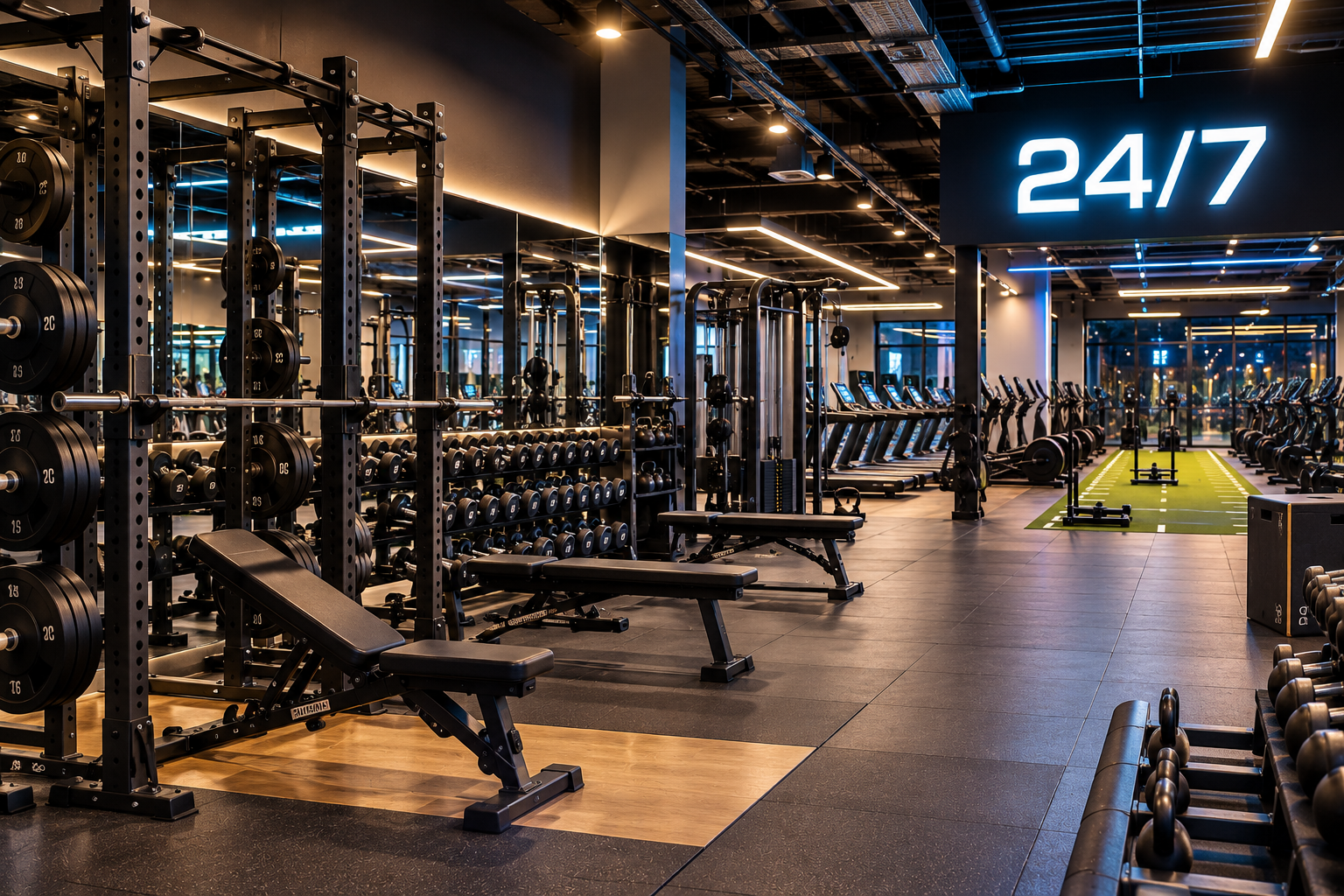
What equipment to choose for a 24/7 gym: practical configuration guide
A 24/7 gym means designing a facility capable of operating continuously with reliable, simple-to-use, easy-to-maintain equipment suitable for intensive use. The choice of equipment must consider durability, space configuration, scheduled maintenance, and compatibility with the gym's management systems.
In a gym open twenty-four hours a day, equipment represents one of the most important elements of the entire project. Its use often occurs without the continuous presence of staff, making it essential to prioritize robust, intuitive, and easily inspectable machines. A correct choice helps improve the user experience and reduce interruptions due to maintenance.
The ideal configuration does not depend exclusively on the number of installed equipment items, but on their ability to meet the needs of the user base, the facility's layout, and the organization of pathways. A balanced design makes it possible to make the most of every available square meter while maintaining high standards of safety and functionality.
- Quick answer
- What features really matter
- Selection criteria
- Compatibility with layout and management
- Comparison table
- Purchase mistakes to avoid
- FAQ
- How to plan investments
What equipment to choose for a 24/7 gym?
A 24/7 gym should prioritize robust, intuitive, easily adjustable equipment designed for continuous use. The ideal configuration includes areas dedicated to cardiovascular work, strength training, functional exercises, and stretching, integrated into a layout that is simple to use and maintain.
The choice should be made considering the expected number of users, frequency of use, and the management model adopted by the facility.
Preventative planning helps avoid redundant purchases and distribute the budget across equipment that is actually used throughout the day.
Objective of the choice
The objective is to create an efficient, reliable, and easily manageable gym even during hours with reduced staff presence.
Design approach
Each piece of equipment should be evaluated as part of a system that includes layout, maintenance, access control, and operational organization.
What features really matter?
Build robustness represents one of the main criteria. Equipment designed for continuous professional use tends to simplify maintenance management and ensure greater operational continuity.
The simplicity of adjustments also plays an important role. Users must be able to quickly adapt the equipment following the manufacturer's instructions without complex procedures.
The availability of technical documentation, spare parts, and maintenance programs constitutes an additional element to consider in the overall investment evaluation.
Robustness and durability
Resistant materials, easily inspectable components, and construction quality promote continuous use and simpler maintenance.
Ease of use
Adjustments should be intuitive and accompanied by clear instructions to reduce errors during equipment use.
What criteria to use in the selection?
The first criterion concerns the user profile. A gym dedicated primarily to autonomous training has different needs compared to a structure with numerous classes or personal training services.
The second criterion concerns available surface area. The distribution of equipment must allow for fluid pathways and easy use of the different areas of the gym.
The third criterion concerns maintenance. It is advisable to prioritize models that allow simple periodic checks and easy access to components subject to inspection.
User analysis
Understanding the habits of members makes it possible to distribute the budget across the most frequently used categories of equipment.
Maintenance scheduling
The availability of technical manuals and maintenance procedures facilitates facility management throughout the entire lifecycle of the equipment.
How to check compatibility with layout and management?
Each new piece of equipment should be evaluated against available space, internal pathways, and the possibility of performing cleaning and maintenance without interfering with the normal use of the gym.
A modular configuration allows for the progressive expansion of the offering without completely changing the layout of the facility.
To learn more about solutions dedicated to professional structures, you can consult professional gym equipment.
Space compatibility
Equipment should be distributed while maintaining easily navigable pathways and well-defined training zones.
Modular configuration
A modular design facilitates future updates and allows the gym to adapt to the evolution of demand.
Criteria comparison table
| Criterion | Why it matters | How to check it |
|---|---|---|
| Robustness | Supports continuous use | Technical data sheets and manufacturer documentation |
| Adjustments | Facilitate use | Practical test and manual |
| Maintenance | Reduces downtime | Scheduled maintenance plan |
| Spare parts | Facilitate technical interventions | Availability declared by the manufacturer |
| Compatibility | Optimizes layout | Space analysis |
| Modularity | Facilitates expansions | Gym configuration |
What mistakes to avoid during purchase?
One of the most frequent mistakes consists of purchasing numerous pieces of equipment without planning the layout and usage flows.
Another mistake concerns choosing based exclusively on the initial price without considering maintenance, spare parts, and durability over time.
It is also advisable to avoid configurations that make technical assistance interventions difficult or limit the possibility of upgrading the gym in subsequent years.
Unplanned layout
A random distribution of equipment reduces gym functionality and makes daily management more complex.
Evaluating only the initial cost
The total cost of management also includes maintenance, assistance, and operational continuity throughout the entire lifecycle of the equipment.
FAQ
Does the equipment need to be different compared to a traditional gym?
Not necessarily. In a 24/7 gym, it is generally appropriate to prioritize professional models designed for intensive use and scheduled maintenance.
How much does the layout matter?
The layout is crucial because it affects safety, flow management, and the ease of use of equipment throughout the day.
When should maintenance be scheduled?
Maintenance should be scheduled starting from the design phase following the instructions provided in the manufacturers' technical documentation.
How to plan investments?
The design of a 24/7 gym should begin with the analysis of available surface area, the user base, and the management model. Subsequently, it is possible to define the equipment mix, space distribution, and the maintenance plan most consistent with the facility's objectives.
When applicable, reference should be made to current building regulations, provisions relating to plant safety, any requirements regarding fire prevention, manufacturers' manuals concerning the installation, use, and maintenance of equipment, and instructions relating to technological systems installed in the gym. Each choice should be verified against the intended use of the facility and applicable regulatory requirements.
A modular approach allows the gym to be developed progressively, adapting the equipment configuration to the evolution of the number of members and services offered. Basing investments on verifiable criteria makes it possible to improve reliability, operational continuity, and management efficiency in the long term.
Comments (0)