
Trolley
You have no items in your shopping cart

 Budgets
 Dumbers
 Discs
Discs
 Benches
 Racks and Rigs
 Weights Holders
 Isotonic machines
 Calisthenics
 Cardio
 Kettlebells
 Flooring
 Gym Set
 Accessories
 Combat
 ARTI MARZIALI
 CONTAINER GYM
 Tug-Of-War
 Used Gym Equipment
 PILATES MACCHINARI
 GINNASTICA ARTISTICA
 CAMPI DA PADEL
 Prodotti in Pronta Consegna
 Informazioni
 IRONMAN
 Gift Card
- Donatif
- General information
- 0 I like it
- 25 Views
- 0 comments
- gym flooring, safety flooring, gym safety, shock-absorbing materials
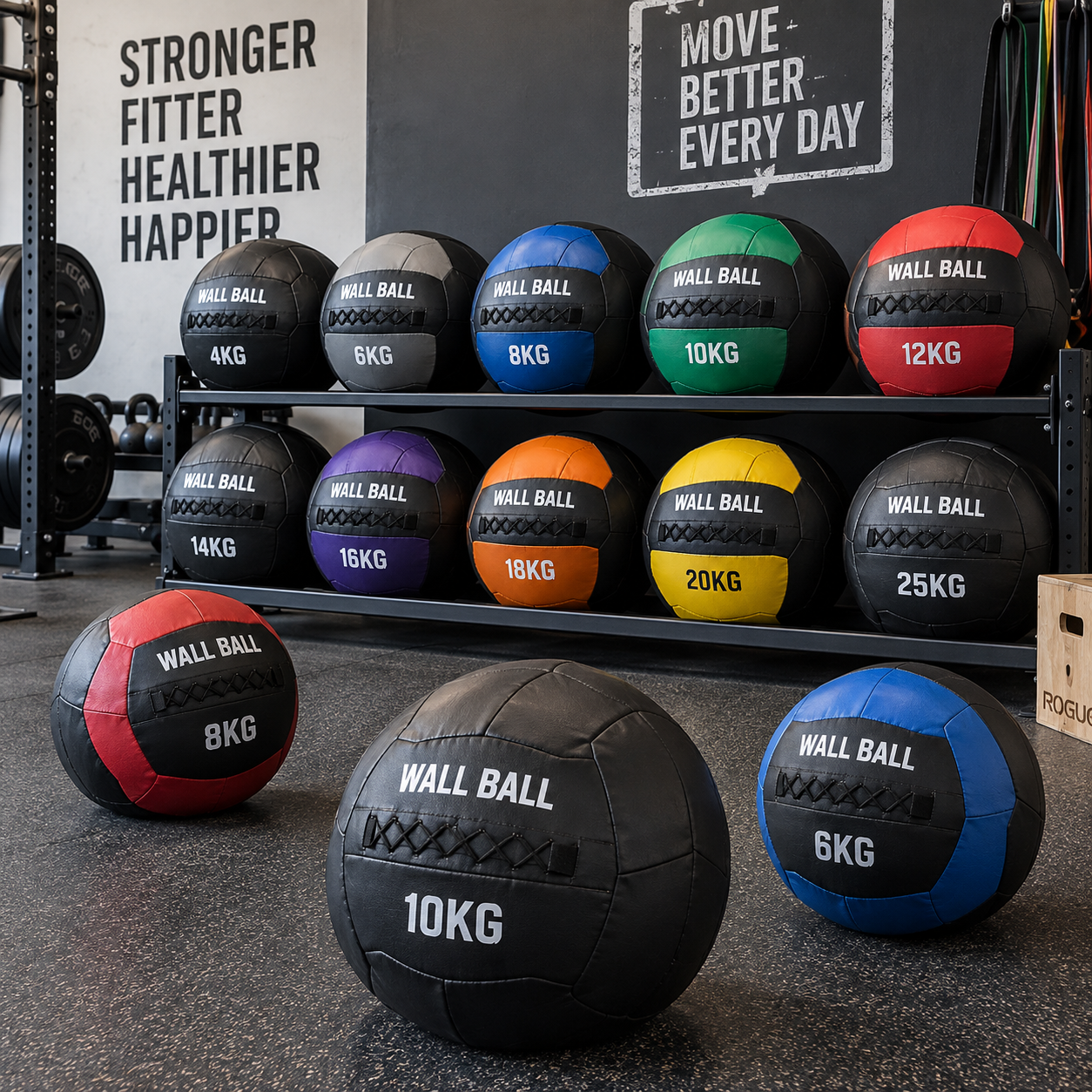
Wall ball: what it is and how to use it
Wall ball is the name of both a piece of equipment and one of the most widespread exercises in functional training. The wall ball is a soft medicine ball designed to be thrown against a vertical target during a movement that combines a squat and an arm press. The goal is to develop strength endurance, coordination, explosiveness, and cardiovascular capacity through a fluid and repeated gesture.
This exercise is used in gyms, functional training boxes, and sports centers because it simultaneously engages the lower and upper body, requires good movement synchronization, and allows the load to be easily adapted based on the user's level. To obtain concrete benefits, however, it is essential to know the correct technique, choose the appropriate weight, and have the necessary space available.
In this guide, we analyze how the wall ball works, how to properly execute the wall ball shot, which errors to avoid, how to choose the ball's weight, and what features distinguish a wall ball from a slam ball, providing practical and verifiable criteria for safe and effective use.
- What a wall ball is
- How to use a wall ball
- How to choose the wall ball weight
- Target height and required space
- Common errors in wall ball shots
- Wall ball vs slam ball
- Safety and maintenance
- How to evaluate the purchase
What a wall ball is
The wall ball is a weighted ball with a soft coating and internal padding designed to be thrown repeatedly against a wall or target. Unlike other medicine balls, it prioritizes grip comfort, impact absorption, and stability during reception.
The diameter generally remains constant regardless of the weight to allow for a uniform technique. The weight, on the other hand, varies depending on the user's training level and goals.
The most representative exercise is the wall ball shot, in which a full squat is performed followed by a rapid extension of the body that imparts the force necessary to throw the ball toward a target positioned high up.
What characteristics it possesses
The main elements to evaluate are the coating, stitch quality, padding uniformity, grip, and weight distribution. A balanced construction makes the throw predictable and improves control during repetitions.
Which muscles it involves
During the movement, the quadriceps, glutes, hamstrings, calves, abs, lats, shoulders, triceps, and stabilizing muscles all work. The gesture also requires coordination between the lower and upper limbs.
How to use a wall ball
The movement begins with the ball held in front of the chest. The feet are roughly shoulder-width apart, and the torso remains stable during the descent into the squat.
Once the desired depth is reached, a powerful extension of the hips, knees, and ankles is executed, transferring energy to the arms as they accompany the throw toward the target.
After contact with the target, the ball is caught in a controlled manner, and the movement immediately continues with a new repetition, maintaining rhythm and fluidity.
Correct sequence
A stable starting position, controlled squat, explosive extension, ball release, soft catch, and immediate return to the squat constitute the complete technical sequence.
Breathing during movement
Inhaling during the descent phase and exhaling during the push facilitates trunk control and helps maintain a constant technique even during longer sets.
How to choose the wall ball weight
The choice of weight must allow for maintaining correct technique throughout the entire set. If the movement loses fluidity or the throw becomes imprecise, the load is probably excessive.
A practical criterion consists of using a ball that allows you to complete all planned repetitions without compromising squat depth, throwing precision, and catch control.
Weight progression should only take place after having consolidated technique, coordination, and the ability to maintain a constant rhythm.
For beginners
Beginners should prioritize a moderate weight, focusing on the quality of the gesture and the synchronization between the squat and the throw before increasing the load.
For expert users
More trained users can progressively increase the weight as long as the movement speed and target precision remain unaltered.
Target height and required space
The wall ball shot requires a vertical target high enough to allow for a natural throwing trajectory. The height used depends on the training program and any standards provided in the discipline practiced.
It is important to verify that the ceiling does not interfere with the ball's trajectory and that the wall is suitable for receiving repeated impacts.
The free space around the athlete must allow for the recovery of the ball without obstacles, guaranteeing safety for both the user and the people present in the area.
How to organize the area
A clear surface, a sturdy wall, and an adequate distance from other users improve safety and training continuity.
Importance of flooring
A shock-absorbing flooring helps protect the floor and limit equipment wear during any accidental drops of the ball.
Common errors in wall ball shots
The most frequent error consists of relying exclusively on arm strength while neglecting the push generated by the legs. In this way, the movement becomes less efficient, and shoulder fatigue increases.
Another common error is interrupting the continuity between the catch and the squat. Fluidity represents, instead, one of the fundamental elements of the exercise.
Even a rigid catch or one distant from the body reduces ball control and can compromise the quality of the set.
Technical errors
An incomplete squat, excessively inclined torso, premature throw, and a lack of full body extension limit the effectiveness of the movement.
How to correct them
Temporarily reducing the weight, slowing down the execution, and working on coordination allow, in most cases, for a rapid improvement in technical quality.
Wall ball vs slam ball
The main difference concerns the intended use. The wall ball is designed to be thrown toward a vertical target and caught again by the user.
The slam ball, instead, is meant to be thrown with force against the floor. It normally features a different structure that limits bounce and withstands very intense direct impacts.
Using each piece of equipment for the exercise it was designed for helps preserve its durability and performance. To learn more about the differences between these tools, you can consult the dedicated guide on throwing medicine balls.
When to choose the wall ball
It is the most suitable solution for metabolic circuits, functional workouts, and repeated wall ball shots with a high work volume.
When to use the slam ball
It is more suited for exercises that involve violent downward throws, explosive movements, and an absence of bounce.
Safety and maintenance
Before each workout, it is advisable to check the integrity of the coating and seams. Clear signs of wear can compromise the grip and durability of the equipment.
The training area must be kept clear to avoid interference during ball retrieval. The target must also be stable and clearly identifiable.
After use, it is advisable to clean the surface of the ball and store it in a dry environment, avoiding prolonged exposure to heat sources.
Recommended checks
Regular verification of seams, deformations, and grip quality helps maintain consistent performance and safety.
How to preserve its lifespan
Avoiding unintended uses, impacts against abrasive surfaces, and improper storage helps prolong the useful life of the equipment.
How to evaluate the purchase
For a gym or sports center, it is worthwhile to select wall balls with differentiated weights so as to adapt the workout to users with different capabilities without modifying the execution technique.
Construction quality, regular shape, coating resistance, and uniform padding distribution directly affect throwing precision and the daily user experience.
Evaluating these aspects together with the expected number of users, available space, and type of programming allows for a more conscious investment and the selection of a solution suited for continuous use in home gyms, functional training boxes, and professional facilities.
Comments (0)