
Trolley
You have no items in your shopping cart

 Budgets
 Dumbers
 Discs
Discs
 Benches
 Racks and Rigs
 Weights Holders
 Isotonic machines
 Calisthenics
 Cardio
 Kettlebells
 Flooring
 Gym Set
 Accessories
 Combat
 ARTI MARZIALI
 CONTAINER GYM
 Tug-Of-War
 Used Gym Equipment
 PILATES MACCHINARI
 GINNASTICA ARTISTICA
 CAMPI DA PADEL
 Prodotti in Pronta Consegna
 Informazioni
 IRONMAN
 Gift Card
- Donatif
- General information
- 0 I like it
- 11 Views
- 0 comments
- gym flooring, safety flooring, gym safety, shock-absorbing materials
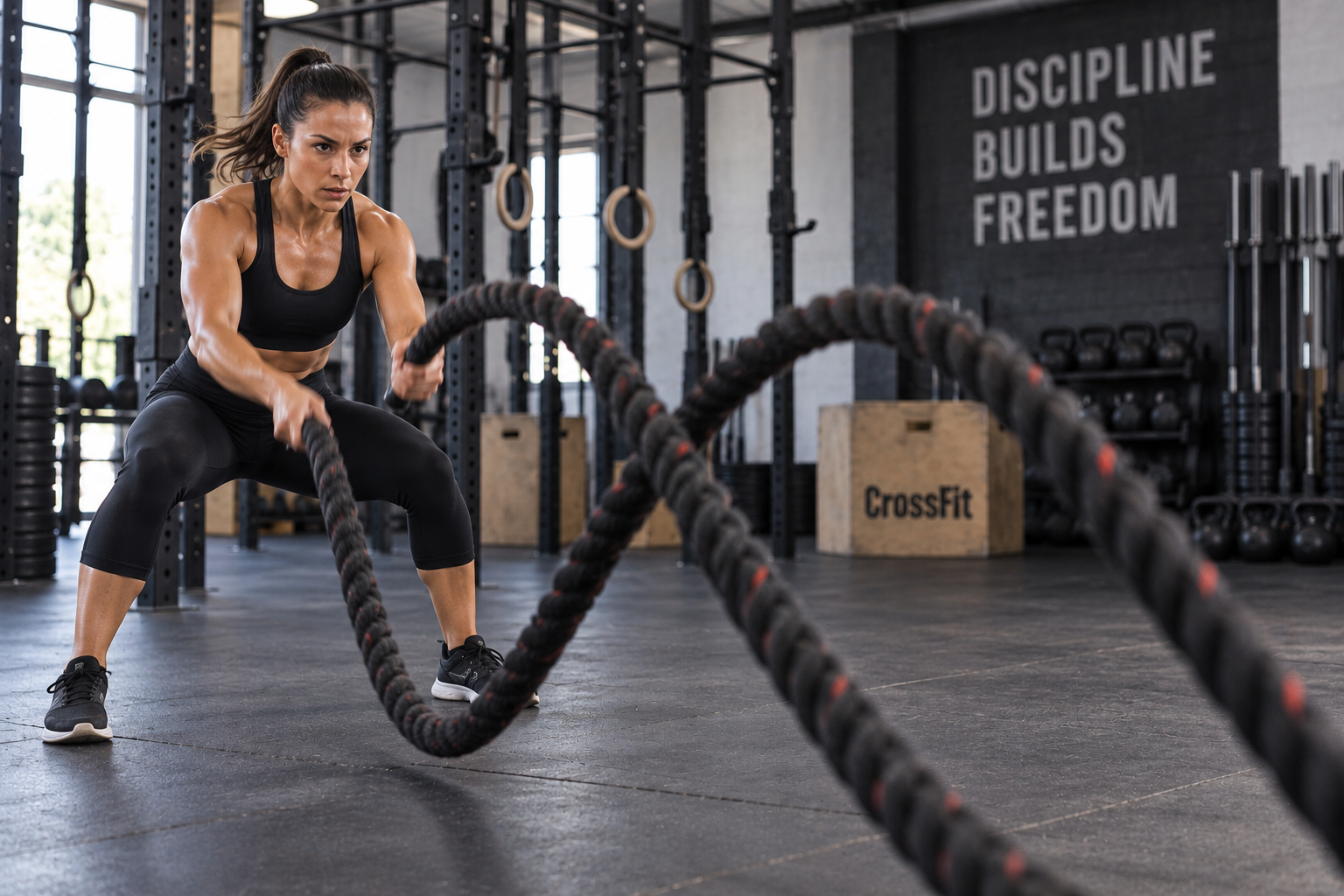
Battle rope: what it is and what it is used for
The battle rope is a piece of equipment used in functional training consisting of a high-resistance rope fixed to a stable anchor point. Through rhythmic arm movements, it is possible to generate continuous waves that simultaneously involve the upper body, core, and lower limbs. Its use is widespread in both home gyms and professional fitness centers thanks to its versatility and the ability to adapt training intensity by modifying rhythm, duration, and the type of exercises.
The battle rope is not exclusively intended for expert athletes. By choosing an appropriate length and diameter, it can also be included in beginner training programs, allowing a progressive improvement in technique and workload. To obtain concrete benefits, however, it is essential to use a rope suited to your level and to set up a properly organized training area.
Understanding how a battle rope works, what goals it allows you to achieve, and what mistakes to avoid helps you make a more informed choice and make the most of this equipment over the long term.
- Quick answer
- What a battle rope is
- What it is used for
- How to use it correctly
- Application table
- How to choose based on use
- Mistakes to avoid
- FAQ
- How to evaluate the investment
What is a battle rope and what is it used for?
The battle rope is a rope designed to perform exercises in which arm movement generates waves that propagate along its entire length. Training intensity depends on execution speed, rope length and diameter, as well as the user's technique.
It can be used for workouts dedicated to physical conditioning, strength endurance, and functional circuits, both as a main exercise and as a station within more structured programs.
To achieve effective results, it is important to choose a rope proportioned to the available space and your level of experience.
Definition
A battle rope consists of a long, resistant rope, generally fixed in the center by an anchor point that allows working with two ends gripped by the user.
How it works
Arm movement transmits energy along the rope, creating waves that require coordination, control, and continuity of execution.
What are the characteristics of a battle rope?
Battle ropes are available in different lengths and diameters, elements that directly influence the difficulty of the exercises and the rope's response during movement.
A longer rope has greater inertia, while a larger diameter generally requires a more demanding grip and greater involvement of the forearm muscles.
The choice of configuration should always be consistent with the user's technical level and the type of training planned.
Importance of length
Length affects the amount of rope to be set in motion and the space needed to use the equipment effectively.
Why diameter matters
Diameter modifies grip comfort and helps determine the overall difficulty of the exercise.
What is a battle rope used for?
The battle rope finds application in numerous functional training programs thanks to the ability to modulate the intensity and duration of sets.
It can be used in metabolic circuits, workouts dedicated to strength endurance, and sessions aimed at improving motor coordination.
Its versatility also allows it to be easily integrated with other physical conditioning equipment.
Individual training
The battle rope allows you to perform individual exercises by varying rhythm, wave amplitude, and set duration according to training goals.
Functional training
It can be included within circuits comprising sled pushes, slam balls, and other exercises dedicated to general conditioning.
How to use it correctly?
Correct use starts with preparing the station. The rope must be fixed to a stable anchor, and the work area must be free of obstacles.
During exercises, it is important to maintain a stable posture and generate continuous movements while avoiding uncontrolled oscillations.
Progression should happen by gradually increasing the intensity and complexity of the exercises without sacrificing technical quality.
Wave technique
The wave technique represents the basic movement from which numerous variants used in functional training derive.
Training progression
It is advisable to start with simple exercises to acquire coordination and control before introducing more complex movements.
Table of main applications
The following table summarizes the most frequent uses of the battle rope.
| Goal | Application | Main characteristic |
|---|---|---|
| Conditioning | Continuous sets | Rhythmic work |
| Strength endurance | Prolonged waves | Constant muscle engagement |
| Functional circuits | Training station | Integration with other equipment |
| Individual training | Dedicated exercises | Customizable progression |
| Athletic preparation | Specific work | High versatility |
This summary helps understand how the battle rope can adapt to different training programs without changing the equipment structure.
How to interpret the table
The most suitable use depends on the training goals and the user's level.
Integration into programs
The battle rope can occupy the role of the main exercise or be included within more structured circuits.
How to choose a battle rope based on use?
The choice should consider length, diameter, available space, and frequency of use.
Those who train in small spaces can favor more compact configurations, while professional facilities can evaluate multiple sizes to satisfy different types of users.
The quality of the anchor point and the support surface also contributes to the correct use of the equipment.
Home gym use
A versatile configuration facilitates training without unnecessarily occupying available space.
Gym use
In functional areas, it is useful to set up dedicated stations that allow continuous use of the battle rope.
What mistakes are best avoided?
One of the most frequent mistakes is choosing a rope exclusively based on weight or length without considering one's technical level.
Using an inadequate anchor point or training in insufficient space can also compromise the quality and safety of the exercise.
Finally, it is important not to neglect rope maintenance and periodic checks of the grips and fastening system.
Neglecting technique
Correct technique represents the prerequisite for effectively using the battle rope regardless of its length.
Using unsuitable surfaces
An anti-shock gym flooring helps limit rope wear and protects the floor during repeated workouts.
FAQ
Is the battle rope suitable for beginners?
Yes, by choosing a configuration consistent with your level and progressively learning the execution technique.
Does it require a lot of space?
The space required depends on the length of the rope and the layout of the training area.
Which muscles does it involve?
The exercises simultaneously engage the upper limbs, core, and lower limbs through coordinated movements.
Can it be used in functional circuits?
Yes. The battle rope is frequently included as a station within functional training programs.
How to evaluate the investment before purchasing
Choosing a battle rope means evaluating the usage context, available space, and user level rather than focusing exclusively on the dimensional characteristics of the rope. A configuration consistent with training goals allows you to make the most of this equipment both in home gyms and professional fitness centers.
For fitness facilities, it can be useful to set up multiple dedicated stations to satisfy different needs, while private users can lean towards a versatile solution capable of accompanying training progression over time.
Carefully analyzing length, diameter, work area, anchoring system, and maintenance allows you to make an informed choice and use the battle rope effectively, safely, and continuously.
Comments (0)