
Trolley
You have no items in your shopping cart

 Budgets
 Dumbers
 Discs
Discs
 Benches
 Racks and Rigs
 Weights Holders
 Isotonic machines
 Calisthenics
 Cardio
 Kettlebells
 Flooring
 Gym Set
 Accessories
 Combat
 ARTI MARZIALI
 CONTAINER GYM
 Tug-Of-War
 Used Gym Equipment
 PILATES MACCHINARI
 GINNASTICA ARTISTICA
 CAMPI DA PADEL
 Prodotti in Pronta Consegna
 Informazioni
 IRONMAN
 Gift Card
- Donatif
- General information
- 0 I like it
- 12 Views
- 0 comments
- gym flooring, safety flooring, gym safety, shock-absorbing materials
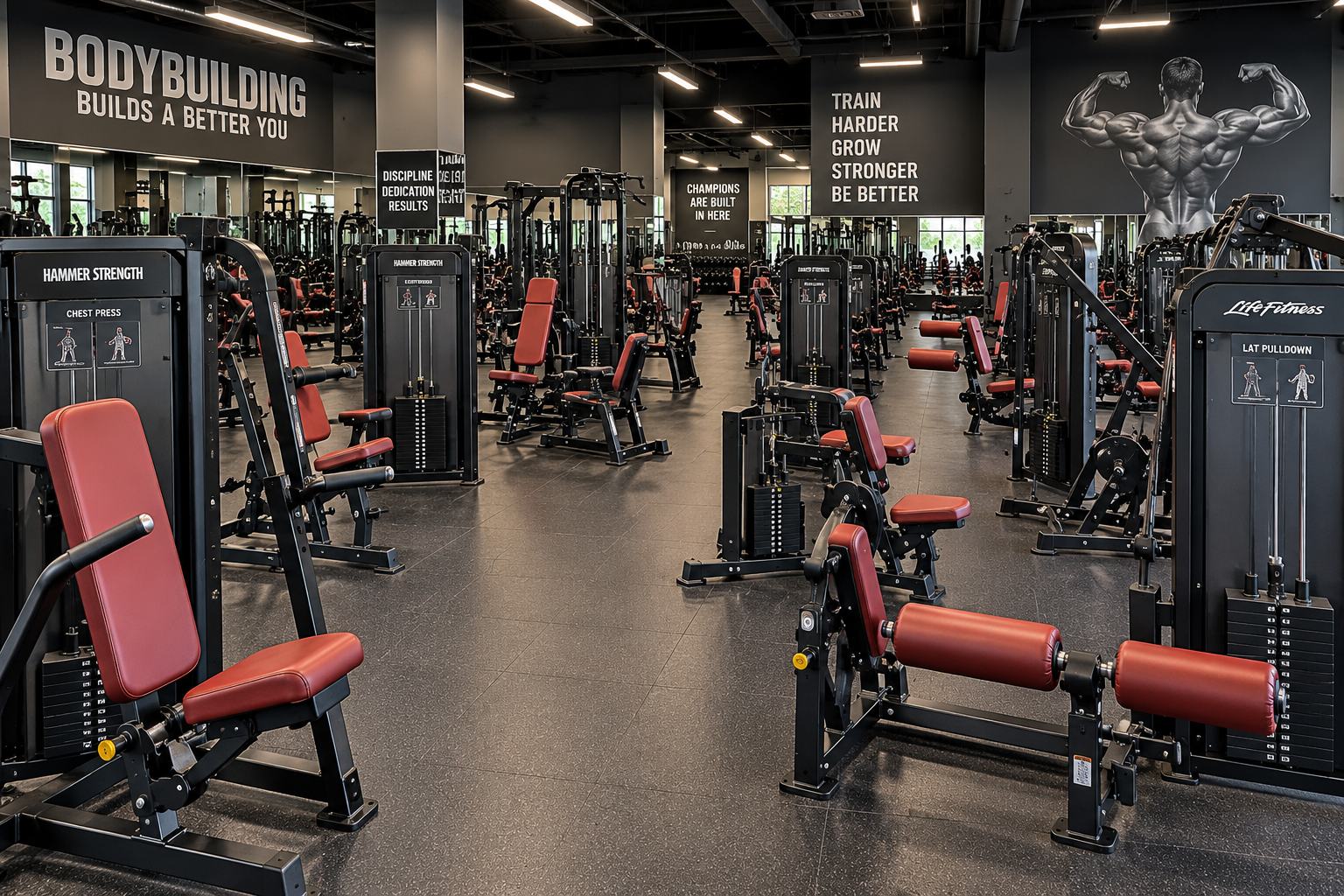
Isotonic room for bodybuilding: requirements and usage
An isotonic room dedicated to bodybuilding is an area designed to allow workouts with guided-resistance machines oriented toward the development of strength and muscle hypertrophy. To be truly functional, it must offer a balanced selection of equipment, a rational arrangement of stations, and adequate space for the use and maintenance of the machines.
In bodybuilding, isotonic machines represent a complementary tool compared to free weights. In fact, they allow for isolating specific muscle groups, performing exercises with controlled trajectories, and organizing easily repeatable training programs. However, effective design must consider the profile of the users, the expected volume of use, and the characteristics of the available space.
This guide analyzes the main requirements of an isotonic room dedicated to bodybuilding, illustrating how to organize the layout, which criteria to follow in choosing the machines, how to correctly use the area, and which mistakes to avoid during design.
- What is an isotonic room for bodybuilding
- What requirements it must have
- How to use the machines
- How to organize the layout
- Integration with free weights
- Safety and correct usage
- Mistakes to avoid
- How to evaluate the investment
What is an isotonic room for bodybuilding
An isotonic room dedicated to bodybuilding includes machines designed to targetedly train the main muscle groups through guided movements and easily manageable load adjustments.
This type of area makes it possible to include complementary exercises to free weights and to develop programs oriented toward working on single muscle districts while maintaining high repeatability of the technical movement.
For many facilities, the isotonic room represents an essential component of the offering dedicated to bodybuilding because it allows responding to the needs of users with different levels of experience.
Role of isotonic machines
Guided machines make it possible to focus on the movement provided by the equipment, facilitating load adjustment and the execution of specific exercises.
Who it is aimed at
The area is used both by beginners and by advanced users who wish to integrate the work done with barbells and dumbbells.
What requirements it must have
A room dedicated to bodybuilding should offer a balanced coverage of the main muscle groups through a coherent selection of equipment, avoiding unnecessary duplication and functional shortcomings.
The design must also guarantee sufficient operating areas for each machine, orderly circulation paths, and ease of access for maintenance interventions.
The choice of equipment should be made considering the type of clientele, the number of simultaneous users, and the growth prospects of the gym.
Muscle group coverage
The distribution of the machines should allow for a complete workout of the lower limbs, torso, and upper limbs without excessively concentrating stations dedicated to the same district.
Space organization
An orderly layout facilitates the construction of training programs and makes supervision by the staff simpler.
How to use the machines
Before executing any exercise, it is advisable to adjust the seat, backrest, and support systems according to the user's characteristics, following the manufacturer's instructions.
Load adjustment must allow for controlled execution while maintaining correct technique during all repetitions provided by the training program.
Machines can be used both as main exercises and as a complement to free-weight work, depending on the programming set up by the trainer.
Station adjustment
A correct configuration of the machine improves comfort, movement precision, and exercise repeatability.
Load management
Progression should be planned while maintaining technical quality and movement control throughout all sets.
How to organize the layout
The arrangement of the machines should follow a functional criterion, grouping stations dedicated to the main muscle groups or organizing coherent paths with training programs.
Operating areas must be kept free of obstacles and dimensioned according to the instructions in the equipment manuals.
It is advisable to provide dedicated spaces for accessories and clearly identifiable paths that facilitate user movement.
Training paths
A logical distribution of stations makes it simpler to follow articulated programs without continuously crossing the entire room.
Accessories and service areas
Accessories should be collected in dedicated zones, avoiding occupying the operating spaces of the machines.
Integration with free weights
In bodybuilding, the isotonic room is frequently flanked by an area dedicated to free weights. The two configurations perform complementary functions and allow for greater variety in workout programming.
Guided machines can be used for targeted exercises, while barbells and dumbbells allow for greater freedom of movement and numerous execution variants.
A balanced design should allow for natural transition between the two areas while maintaining orderly and easily recognizable paths.
Complete programming
Integrating machines and free weights broadens the possibilities of building programs adaptable to the needs of different users.
Training continuity
A well-organized layout reduces movement and facilitates the succession of exercises provided by the routine.
Safety and correct usage
Each machine must be installed respecting the instructions contained in the manufacturer's technical documentation, leaving the necessary spaces for use and maintenance.
Before training, it is advisable to check adjustments, load selection systems, and the general state of the equipment, reporting any anomalies to the staff.
An adequate anti-shock flooring helps improve stability, comfort, and surface durability in areas intended for intensive training.
Pre-use checks
A quick check of adjustments and the correct functioning of the machine represents a good practice before starting any exercise.
Importance of maintenance
Following the maintenance plan provided by the manufacturer helps maintain constant performance and equipment safety.
Mistakes to avoid
One of the most frequent mistakes consists in selecting machines without an overall strategy, creating functional overlaps and leaving some muscle groups uncovered.
Another critical issue concerns the positioning of equipment without considering the operating spaces necessary during use and maintenance activities.
Neglecting integration with the weight room can also limit the facility's flexibility and the training opportunities offered to users.
Excessive number of machines
Saturating available space reduces operational comfort and makes daily room management more complex.
Unplanned layout
A random arrangement of stations makes the training path less intuitive and increases movement within the area.
How to evaluate the investment
The design of an isotonic room for bodybuilding should start from the analysis of the target audience, available surface area, and the training model the gym intends to propose.
In addition to the construction quality of the equipment, it is advisable to evaluate spare parts availability, maintenance simplicity, the possibility of expanding the layout over time, and compatibility among the various machines foreseen by the project.
To explore the various solutions dedicated to guided training, you can consult the category of isotonic machines. A planned investment based on the operational needs of the facility and the technical specifications of the manufacturers allows for creating a functional, orderly room suitable for continuous use.
Comments (0)