
Trolley
You have no items in your shopping cart

 Budgets
 Dumbers
 Discs
Discs
 Benches
 Racks and Rigs
 Weights Holders
 Isotonic machines
 Calisthenics
 Cardio
 Kettlebells
 Flooring
 Gym Set
 Accessories
 Combat
 ARTI MARZIALI
 CONTAINER GYM
 Tug-Of-War
 Used Gym Equipment
 PILATES MACCHINARI
 GINNASTICA ARTISTICA
 CAMPI DA PADEL
 Prodotti in Pronta Consegna
 Informazioni
 IRONMAN
 Gift Card
- Donatif
- General information
- 0 I like it
- 21 Views
- 0 comments
- gym flooring, safety flooring, gym safety, shock-absorbing materials
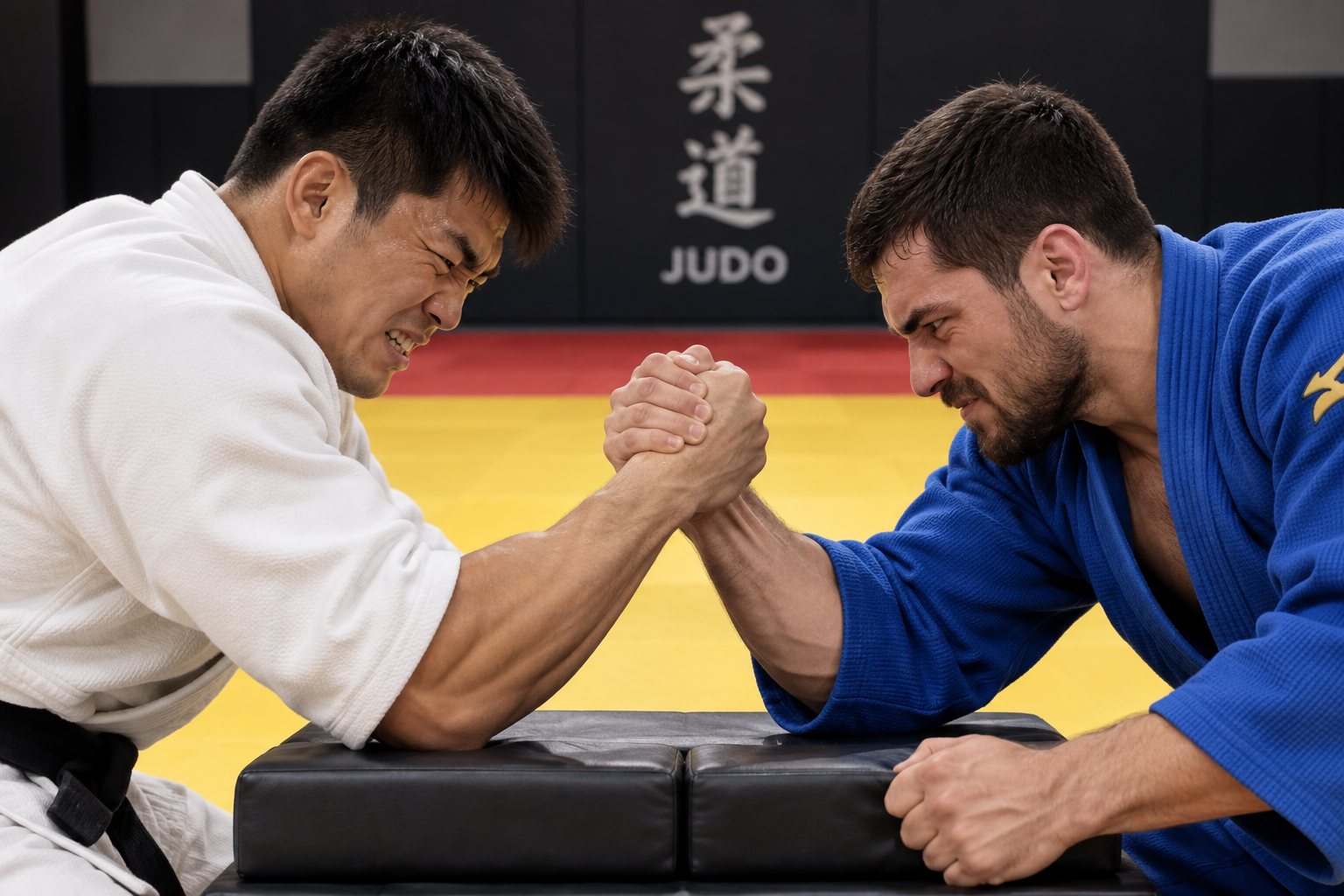
Arm wrestling safety: technique and table stability
Safety in arm wrestling depends on the combination of correct technique, a stable table, and control procedures performed before each workout. A well-designed and maintained station reduces the risk of incidents and allows athletes to focus on the quality of technical execution.
Table stability represents only one aspect of safety. The arrangement of the area, periodic inspection of components, scheduled maintenance, and compliance with the manufacturer's instructions also contribute to creating a reliable environment for individual workouts, group sessions, and any demonstrations.
This guide provides operational criteria for checking the technique and stability of the arm-wrestling table, proposing a practical checklist dedicated to athletes, sports associations, and gym managers without replacing federal regulations or the manufacturer's technical documentation.
- Quick answer
- What are the main risks?
- What safety requirements should be checked?
- What controls to perform before use?
- Why does technique affect safety?
- Errors to avoid
- FAQ
- Long-term safety management
How to improve safety in arm wrestling?
Safety in arm wrestling is achieved by checking table stability, periodically inspecting pads, fastening systems, and the supporting structure, using technique in accordance with the coach's instructions, and respecting the manufacturer's instructions. For competitive activities, it is also appropriate to refer to the regulations of the competent federation.
Decision-making criteria must include documented technical checks and shared operational procedures.
A check before each use allows any anomalies to be identified before the session begins.
Objective of safety
The objective consists of creating a stable and controlled station that promotes regular workouts and organized management of the technical area.
Reference documentation
Manufacturer manuals, assembly instructions, and federal regulations constitute the main sources to consult when applicable.
What are the main risks?
The most common risks are linked to table instability, worn components, unverified fasteners, unsuitable flooring, and use of the station without preliminary checks.
Even a disorderly organized area can increase interference during workouts.
technical training and scheduled maintenance represent two complementary elements in the prevention of operational problems.
Structural stability
The structure should remain stable during all phases of use without abnormal movements or loose components.
Area organization
Clear paths and sufficient space around the station facilitate the work of athletes and staff.
What safety requirements should be checked?
Before use, it is advisable to check the supporting structure, fastening systems, pads, handles, and the supporting surface of the table.
The flooring should be uniform and maintained in good condition according to the manufacturer's instructions.
To create a complete station, it is possible to integrate the project with dedicated arm wrestling equipment.
Structure check
Every element should be visually inspected before the start of the workout.
Component verification
table pads, handles, and fasteners must be intact and correctly installed.
What controls to perform before use?
An operational checklist helps make checks systematic and reduces the risk of oversights.
| Control | Verification | Reference |
|---|---|---|
| Structure | Absence of abnormal movements | Visual inspection |
| Fasteners | Correct tightening | Manufacturer manual |
| Pads | Integrity and stability | Visual check |
| Flooring | Regular surface | Area verification |
| Space | Clear paths | Operational floor plan |
Recording checks
Noting verifications facilitates scheduled maintenance and structure management.
Scheduling inspections
In addition to daily checks, it is useful to plan more in-depth periodic verifications.
Why does technique affect safety?
Correct technique reduces uncontrolled movements and allows the station to be used consistently with training objectives.
Learning should be supervised by qualified instructors, respecting progressions appropriate to the athlete's level.
table height and station configuration should be compatible with the model used and the manufacturer's instructions.
Learning progression
Exercises should increase in complexity gradually.
Technical supervision
The presence of qualified personnel promotes correct execution and compliance with operational procedures.
What mistakes should be avoided?
Among the most frequent errors are using the table without preliminary checks, lack of maintenance, disorderly arrangement of the area, and the absence of shared procedures.
It is also advisable to avoid modifications not foreseen by the manufacturer or the use of incompatible components.
Skipping verifications
A quick check before each workout represents a good organizational practice.
Neglecting maintenance
Following the manufacturer's maintenance plan helps preserve the efficiency and reliability of the station.
Frequently asked questions
How often should the table be checked?
It is advisable to perform a visual check before each use and schedule periodic inspections according to the manufacturer's instructions.
Does technique affect safety?
Yes. Correct and supervised technique contributes to more controlled use of the station.
Are there specific requirements for official events?
For competitions, it is appropriate to consult the regulations of the competent federation and verify that equipment and configuration comply with applicable provisions.
Long-term safety management
Safety should be considered an integral part of arm-wrestling area management. Documented procedures, preventive maintenance, operator training, and periodic verifications allow the station to remain efficient over time.
To compare different solutions, it is useful to prepare a technical specification document that includes construction characteristics, installation methods, a maintenance plan, and spare parts availability. This approach makes it possible to evaluate proposals using objective and verifiable criteria.
Structured management of arm wrestling helps create an organized, reliable training environment consistent with the technical objectives of the discipline.
Comments (0)