
Trolley
You have no items in your shopping cart

 Budgets
 Dumbers
 Discs
Discs
 Benches
 Racks and Rigs
 Weights Holders
 Isotonic machines
 Calisthenics
 Cardio
 Kettlebells
 Flooring
 Gym Set
 Accessories
 Combat
 ARTI MARZIALI
 CONTAINER GYM
 Tug-Of-War
 Used Gym Equipment
 PILATES MACCHINARI
 GINNASTICA ARTISTICA
 CAMPI DA PADEL
 Prodotti in Pronta Consegna
 Informazioni
 IRONMAN
 Gift Card
- Donatif
- General information
- 0 I like it
- 24 Views
- 0 comments
- gym flooring, safety flooring, gym safety, shock-absorbing materials
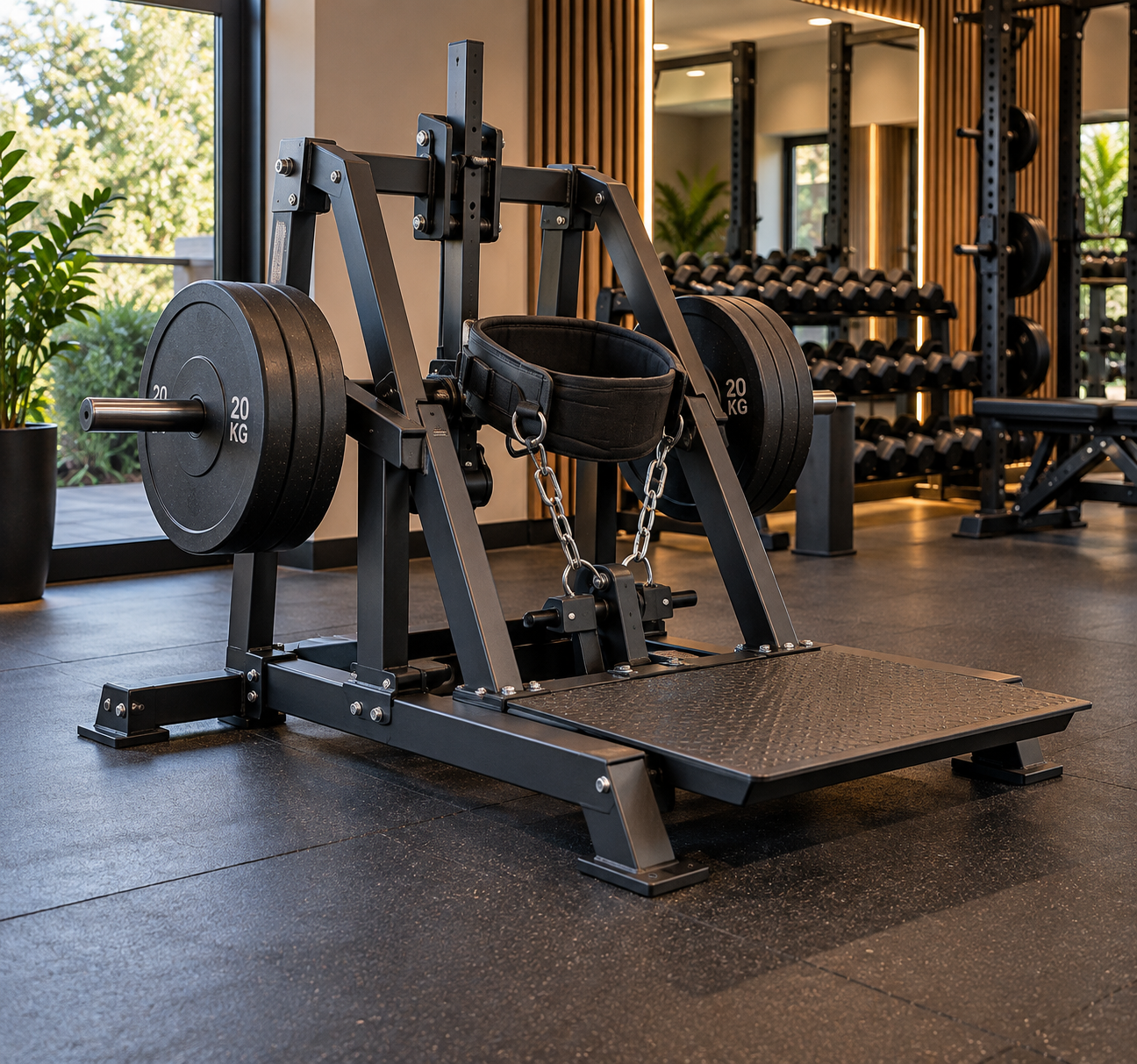
Belt squat safety: belt alignment and range of motion
The belt squat allows you to train the squat by transferring the load through a belt connected to the machine rather than directly onto the spine. To achieve effective and safe execution, it is essential to properly adjust the belt alignment, verify the range of motion, and check that the machine is configured according to the manufacturer's instructions.
Safety does not depend solely on the quality of the equipment, but also on the user's preparation and compliance with correct operating procedures. An improperly adjusted belt or a range of motion incompatible with the athlete's characteristics can compromise comfort, stability, and movement quality.
Before each workout, it is therefore advisable to perform a series of simple checks that allow you to use the machine under the conditions intended by the manufacturer and reduce the most common errors.
- Quick answer
- What are the main risks
- What requirements improve safety
- Pre-use checks
- How to adjust belt and range of motion
- Errors to avoid
- Why invest in a correct setup
How to use the belt squat safely
To use the belt squat safely, it is necessary to verify the correct positioning of the belt, the stability of the platform, the functioning of the loading system, and a range of motion compatible with your mobility. Each adjustment should be performed following the manufacturer's instructions and maintaining a controlled technique throughout the execution.
Before increasing the load, it is advisable to become familiar with the movement using moderate resistance and focusing on execution quality.
An accurate adjustment helps improve comfort, movement continuity, and exercise control.
Decision-making criteria
The main criteria concern belt position, platform stability, fluidity of the lever or cable system, freedom of movement, component status, and correct squat execution.
Technical references
It is advisable to follow the machine manual and the manufacturer's instructions for adjustments, maintenance, and use. For fitness equipment, the EN ISO 20957 series standards can also represent a reference when applicable.
What are the main risks
The most frequent risks stem from an incorrectly positioned belt, an unverified attachment system, or a movement performed with a range of motion incompatible with the user's mobility.
Excessive loading relative to the level of preparation can also compromise movement control and make it harder to maintain correct technique during all repetitions.
Insufficient machine maintenance can also affect the fluidity of the load transmission system and comfort during the exercise.
Incorrectly adjusted belt
A belt that is too loose or excessively tight can reduce stability and comfort during the execution of the squat.
Uncontrolled range of motion
Going beyond a range of motion that the user can manage while maintaining technique and control can compromise movement quality.
What requirements improve safety
A stable machine, a platform with a non-slip surface, and a belt in good condition are fundamental elements for correct use.
The quality of the surface on which the machine is installed also contributes to overall stability and floor protection during intensive use.
It is also advisable to keep the surrounding area free of obstacles to facilitate access, exit, and supervision by instructors.
Platform stability
A stable platform promotes uniform support and contributes to movement control throughout the entire range of motion.
Flooring
An anti-shock flooring suitable for strength training areas improves stability and floor protection. To explore available solutions, you can consult anti-shock gym flooring.
Pre-use checks
Before starting the workout, it is advisable to verify that the belt is intact, that the connection system is securely fastened, and that the machine's movement is smooth along the entire range of motion.
It is also necessary to check the stability of the structure, the correct loading of weights, and the absence of obstacles in the usage area.
A simple checklist before each session helps reduce numerous operational issues.
Belt check
Checking seams, attachment points, closure systems, and the general condition of the belt allows you to identify any signs of wear.
Machine check
It is advisable to verify that levers, pulleys, guide systems, and moving components function regularly as intended by the manufacturer.
How to adjust belt and range of motion
The belt should be positioned stably around the pelvis without creating excessive pressure points. Correct adjustment allows the load to be distributed evenly during the movement.
The range of motion should be adapted to individual capabilities while maintaining control, posture, and alignment for the entire duration of the exercise. It is preferable to gradually increase depth and load only after consolidating correct technique.
During each repetition, it is important to perform the movement smoothly, avoiding sudden accelerations or uncontrolled direction changes.
Belt adjustment
The adjustment should allow freedom of movement without compromising stability and safety during the squat.
Range of motion management
The amplitude of the movement should be compatible with the user's mobility and the machine's characteristics.
Errors to avoid
One of the most frequent errors is using a belt that is not properly adjusted or modifying the attachment system against the manufacturer's instructions.
It is also advisable to avoid sudden load increases without adequate technical progression and neglecting periodic machine maintenance.
Using the belt squat without verifying platform stability or component status can also compromise workout quality.
Excessive load
Increasing the load only when the movement is stable and technically correct helps maintain greater control of the exercise.
Neglected maintenance
Periodically checking wear, connection systems, and moving components helps preserve reliability and continuity of use.
Why invest in a correct setup
Accurate adjustment of the belt squat allows you to make the most of the machine's characteristics and maintain high safety standards during workouts.
For gyms and fitness centers, a correct initial setup, accompanied by periodic checks and scheduled maintenance, helps improve the user experience and preserve equipment efficiency over time.
Following the manufacturer's instructions, regularly checking the belt, load system, and mechanical components, and using the machine with a coherent technical progression represents the most effective method for reliable and continuous use.
Comments (0)