
Trolley
You have no items in your shopping cart

 Budgets
 Dumbers
 Discs
Discs
 Benches
 Racks and Rigs
 Weights Holders
 Isotonic machines
 Calisthenics
 Cardio
 Kettlebells
 Flooring
 Gym Set
 Accessories
 Combat
 ARTI MARZIALI
 CONTAINER GYM
 Tug-Of-War
 Used Gym Equipment
 PILATES MACCHINARI
 GINNASTICA ARTISTICA
 CAMPI DA PADEL
 Prodotti in Pronta Consegna
 Informazioni
 IRONMAN
 Gift Card
- Donatif
- General information
- 0 I like it
- 508 Views
- 0 comments
- gym flooring, safety flooring, gym safety, shock-absorbing materials
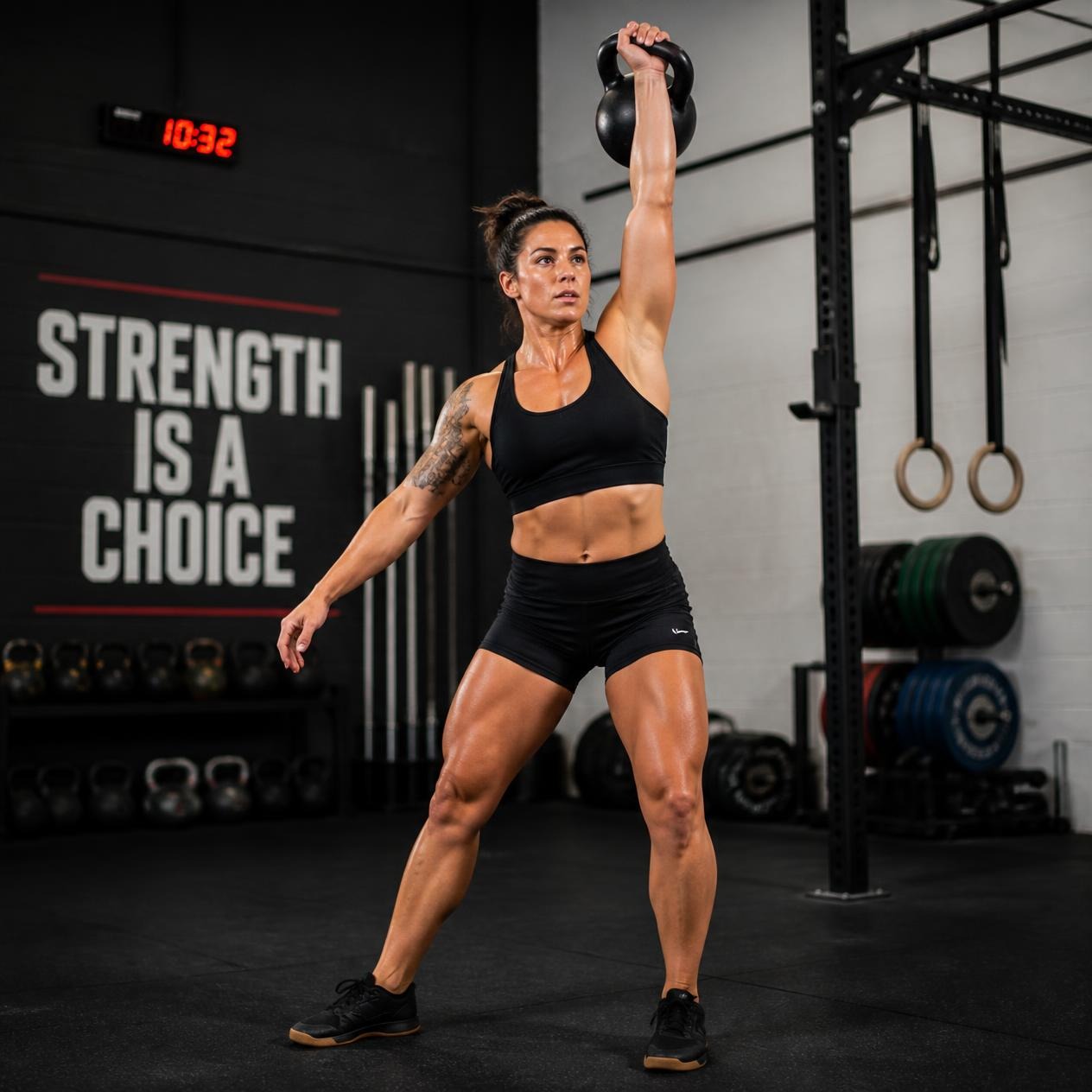
Kettlebell Snatch: The Ultimate Guide to Technique and Power
The kettlebell snatch technique is considered one of the most complete and spectacular exercises in functional training. It combines strength, explosiveness, coordination, cardiovascular endurance, and motor control into a single continuous movement. Contrary to what many believe, the kettlebell snatch does not simply consist of bringing the weight overhead: it is a perfectly synchronized sequence of acceleration, relaxation, rotation, and stabilization that transforms a seemingly simple gesture into a true demonstration of athletic efficiency.
Many practitioners avoid this exercise because after a few repetitions they find themselves with sore wrists, marked forearms, and a lack of fluid technique. In almost all cases, the problem is not the kettlebell, but the way it is guided during the trajectory. The snatch must never be fought: it must be accompanied. The more harmonious the movement becomes, the lower the impact on the forearm and the greater the amount of energy transferred to the final phase.
For enthusiasts of advanced Home Gyms and sports performance, mastering the snatch means taking a leap in quality. In addition to developing an extraordinary capacity for force production, it allows for improvements in metabolic conditioning, body control in space, and the ability to express power repeatedly. As is often said among the most experienced instructors, the snatch is not a simple lift: it is a dance with the weight.
- What is the kettlebell snatch
- The benefits of the snatch
- Complete step-by-step technique
- Breathing and efficiency
- The most common mistakes
- How to avoid forearm pain
- Incorporating the snatch into your training program
- Choosing the right kettlebell
What is the kettlebell snatch
The kettlebell snatch consists of bringing the weight from the floor to the overhead position in a single explosive and continuous movement. Unlike the Olympic barbell snatch, the kettlebell follows a circular trajectory that exploits the inertia generated by the swing and allows for an extremely fluid transition.
The goal is not to pull the kettlebell upward using only the arm. True strength comes from the explosive extension of the hips, the transmission of energy along the entire kinetic chain, and the ability to quickly "insert" the hand inside the handle during the final phase.
When the technique is correct, the kettlebell rotates around the hand without violently hitting the forearm. This characteristic immediately distinguishes efficient execution from an approximate one.
A ballistic gesture
The snatch belongs to the family of ballistic movements, which are exercises in which the load is rapidly accelerated by utilizing the power of the entire body. The arm becomes primarily a connection between the weight and the rest of the muscular chain.
Total coordination
Every repetition requires synchronization between the hips, torso, shoulders, breathing, and grip. This very integration makes the snatch one of the most technically advanced exercises in functional training.
The benefits of the snatch
The kettlebell snatch benefits are numerous and involve both the muscular and cardiovascular components. In few exercises is it possible to simultaneously obtain improvements in explosive strength, endurance, coordination, and stabilization capacity.
The snatch significantly develops the glutes, hamstrings, back, lats, shoulders, forearms, and core. At the same time, it increases the ability to maintain high force production even during long sets or intense metabolic circuits.
From an energy perspective, it represents one of the exercises with the best ratio between time invested and results obtained, which is why it is frequently used in athletic preparation as well.
Power development
The explosive extension of the hips improves the ability to generate force rapidly, a fundamental quality in numerous sports.
Metabolic conditioning
Prolonged sets of snatches rapidly elevate the heart rate, simultaneously improving aerobic and anaerobic endurance.
Complete step-by-step technique
Technique represents the true discriminating element between an effective snatch and a potentially annoying one. Each phase must be executed without rigidity and with continuity.
The movement begins with a correct hip hinge, followed by the swing, vertical acceleration, kettlebell rotation, and the final lockout with the arm fully extended overhead.
Fluidity must prevail over force. Trying to "pull" the kettlebell with the arm inevitably leads to a loss of efficiency and greater impact on the forearm.
The swing phase
The swing represents the engine of the snatch. It is the thrust of the hips that gives the kettlebell the speed necessary to rise. Without a powerful swing, the entire subsequent phase becomes inefficient.
The overhead lockout
In the final position, the arm must be completely extended, the shoulder stable, and the core contracted. The kettlebell should not be supported with excessive hand tension but remain balanced over the body.
Breathing and efficiency
One of the most underestimated aspects concerns breathing. Inefficient breath management quickly limits the duration of the set and unnecessarily increases fatigue.
Many athletes use a short exhalation during the explosive phase of the extension and a controlled inhalation during the descent of the kettlebell. This rhythm allows for maintaining continuity and reducing cardiovascular stress.
Breathing must become an integral part of the movement, just as it happens in running or swimming.
Building rhythm
A regular breathing rhythm improves energy efficiency and allows for tackling much longer sets without losing technical quality.
Reducing unnecessary tension
Breathing correctly also helps to relax the shoulders and grip, avoiding premature accumulation of fatigue.
The most common mistakes
The main mistake consists of turning the snatch into a slow arm lift. In this way, all the advantages of the hip thrust are canceled out, and the load falls almost completely on the shoulder.
Another frequent mistake is maintaining an excessively rigid grip. Constantly squeezing the handle slows down the rotation of the kettlebell and increases the risk of impact on the forearm.
Also, a trajectory too far from the body reduces the efficiency of the movement and makes it much more difficult to control the final lockout.
Pulling instead of accompanying
The snatch must be guided and not dragged. The hand changes position during the ascent, allowing the kettlebell to rotate naturally.
Accelerating at the wrong time
Maximum acceleration must come from the hips. Seeking speed with the arm alone only produces greater fatigue.
How to avoid forearm pain
Kettlebell forearm pain represents one of the main reasons why many practitioners abandon this exercise. Fortunately, in most cases, the problem is exclusively technical.
The kettlebell must not flip onto the forearm. Instead, it is the hand that must quickly insert itself into the handle window while the weight continues its natural rotation. When this synchronization is learned, the impact practically disappears.
The quality of the equipment also affects the training experience. Ergonomic handles, uniform finishes, and a well-made grip facilitate the rotation of the kettlebell and make the movement more natural.
An intelligent grip
The hand should not remain completely closed throughout the entire trajectory. A controlled opening allows for a much more fluid rotation.
The importance of the surface
Kettlebells with well-crafted handles and homogeneous finishes improve comfort and reduce friction during high-intensity repetitions.
Incorporating the snatch into your training program
The snatch can be used with different goals. Short and heavy sets develop explosiveness and power, while longer protocols improve endurance and metabolic capacity.
It can be inserted at the beginning of the session as a power exercise, within conditioning circuits, or as part of programs dedicated to advanced kettlebell exercises.
The progression should be gradual, starting with swings, high pulls, and cleans before moving on to the full snatch.
Volume management
Increasing repetitions and weight simultaneously is a common mistake. It is preferable to first develop a stable technique and subsequently increase the load.
How often to train it
Two or three sessions per week are generally sufficient to improve rapidly without compromising recovery.
Choosing the right kettlebell
The quality of the kettlebell directly influences the learning of the technique. Correct balance, ergonomic grip, and precise finishes allow you to focus on the movement without distractions caused by the equipment.
For those who wish to improve in the snatch, it is advisable to invest in tools specifically designed for functional training. To learn more about the characteristics of professional equipment, you can consult kettlebell snatch technique, evaluating solutions developed to offer a secure grip, comfort, and high construction quality.
The snatch represents one of the most complete movements that can be performed with a kettlebell. It requires patience, precision, and consistency, but once the technique is acquired, it yields evident improvements in terms of strength, coordination, endurance, and body control. More than a simple exercise, it becomes a demonstration of movement efficiency, in which every detail contributes to transforming the weight into a natural extension of the athlete.
Comments (0)