
Trolley
You have no items in your shopping cart

 Budgets
 Dumbers
 Discs
Discs
 Benches
 Racks and Rigs
 Weights Holders
 Isotonic machines
 Calisthenics
 Cardio
 Kettlebells
 Flooring
 Gym Set
 Accessories
 Combat
 ARTI MARZIALI
 CONTAINER GYM
 Tug-Of-War
 Used Gym Equipment
 PILATES MACCHINARI
 GINNASTICA ARTISTICA
 CAMPI DA PADEL
 Prodotti in Pronta Consegna
 Informazioni
 IRONMAN
 Gift Card
- Donatif
- General information
- 0 I like it
- 499 Views
- 0 comments
- gym flooring, safety flooring, gym safety, shock-absorbing materials
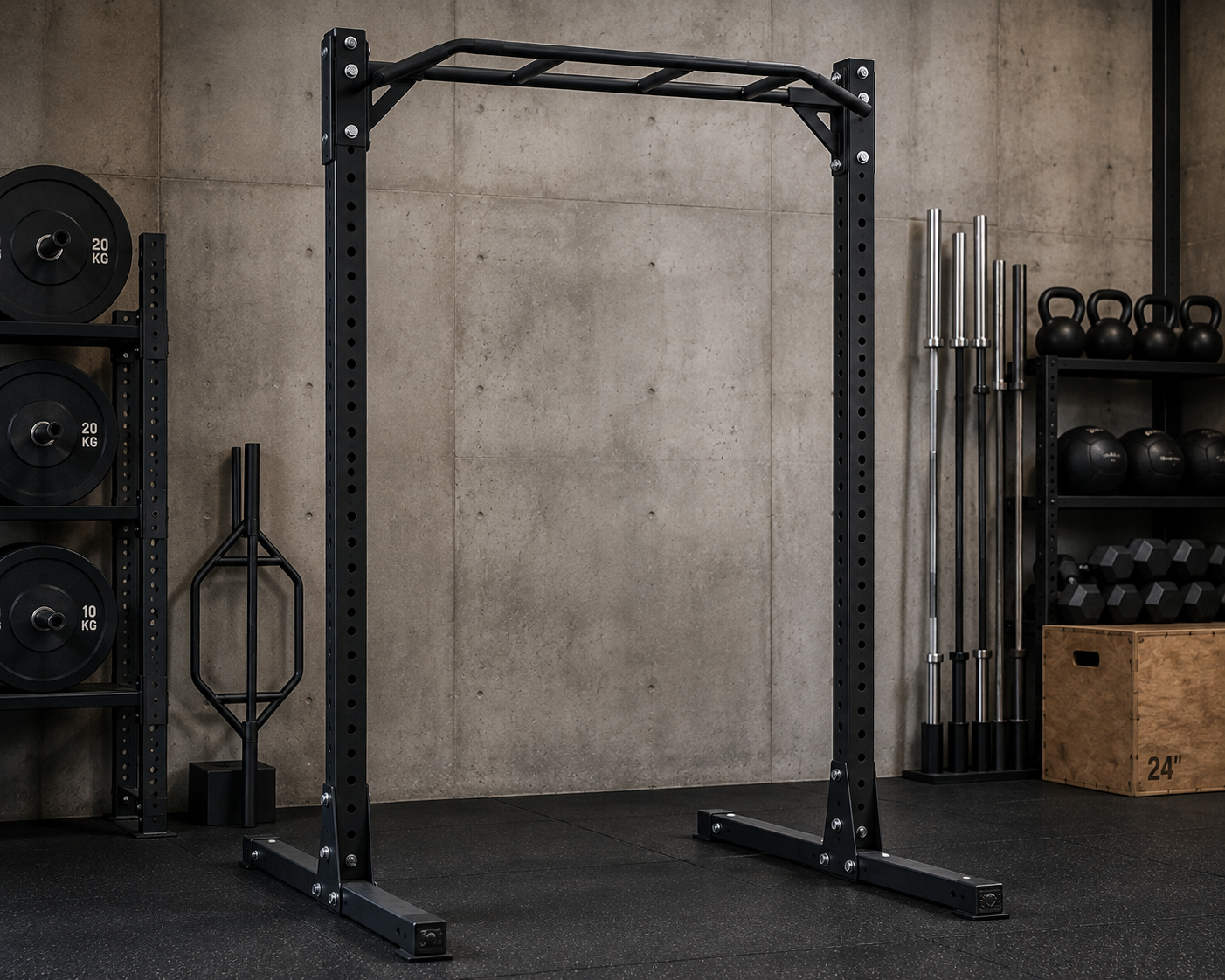
Freestanding Pull-Up Rack: The Solution for Those Who Don't Want to Drill Walls
A freestanding pull-up rack represents the ideal choice for those who want a complete training station without interfering with the walls or ceiling of their home. More and more calisthenics, fitness, and athletic training enthusiasts live in rented apartments, modern homes with drywall, or environments where permanent drilling is not possible. In all these cases, a freestanding rack allows you to achieve professional stability without modifying the building's structure.
Unlike traditional wall-mounted bars, a freestanding structure distributes loads directly onto the floor through a base designed to ensure rigidity and safety even during intense workouts. This means you can perform pull-ups, dips, ring exercises, and numerous calisthenics variations without depending on the strength of the masonry.
Modern professional pull-up stations also offer high modularity, allowing you to customize the configuration with dedicated accessories and adapt the station to the evolution of your training. In this guide, we analyze when it is worth choosing a freestanding rack, which technical characteristics to evaluate, and why it represents one of the most complete solutions for creating a professional home gym.
- Why choose a freestanding rack
- How it ensures stability
- The exercises you can perform
- Modularity and customization
- How to choose the right model
- Maintenance and durability
- Mistakes to avoid
- Why it is a smart investment
Why choose a freestanding rack
The main advantage of a freestanding structure consists of complete independence from the building's walls. There is no need to drill walls, install anchors, or verify the load-bearing capacity of the masonry, making this solution perfect for rented apartments, homes with light walls, and rooms where permanent modifications are not allowed.
The ability to move the structure represents a further strong point. If the layout of the home gym changes or you move to a new home, the rack can be disassembled, transported, and reinstalled without leaving marks on the surfaces.
This flexibility also allows you to rethink the organization of your home gym over time, adding new equipment or changing the layout of the space without structural constraints.
The ideal solution for those living in rentals
Many lease agreements limit the ability to drill into walls and ceilings. A freestanding rack completely eliminates this problem while maintaining high safety standards.
Perfect for drywall
Modern homes often use light partitions that are not designed to support the high stresses generated during pull-ups. An independent structure avoids any critical issues related to wall support.
How a freestanding structure ensures maximum stability
The stability of a rack does not depend on fixing it to a wall, but on the design of the entire structure. Frame geometry, base width, material quality, and load distribution work together to keep the system stable even during dynamic exercises.
Professional models use high-strength steel tubing, robust joints, and stiffening systems that minimize oscillations and vibrations. This allows you to train safely even during weighted pull-ups, muscle-ups, explosive exercises, and high-intensity sessions.
Accurate design also improves the feel during training. A rigid structure transmits greater control, allows for better technical execution, and increases the athlete's confidence during every repetition.
Weight distribution on the base
A wide base allows the load to be distributed evenly on the floor, reducing unwanted movements even when high forces are applied.
Structural rigidity
Structural steels, quality welds, and correct tubing sizing allow for high stability to be maintained during years of intensive use.
A complete station for strength and calisthenics
A modern pull-up and dip station allows you to perform much more than just classic pull-ups. Thanks to the presence of parallel bars, multi-grip supports, and the possibility of installing additional accessories, the structure becomes a true multifunctional gym.
It is possible to train the back, chest, shoulders, arms, abdomen, and lower limbs through a wide range of bodyweight exercises. Pull-ups, chin-ups, dips, leg raises, Australian pull-ups, and numerous calisthenics variations can be performed without the need for additional equipment.
Many models also allow for the use of gymnastic rings, resistance bands, suspension trainers, and other accessories that further expand training possibilities.
Strength training
Professional structures are designed to support training with heavy loads and programs dedicated to the development of maximal strength.
Versatility in a single structure
A single station allows you to train numerous muscle groups while reducing the overall footprint of your home gym.
Modularity and customization possibilities
One of the most interesting aspects of professional racks is the possibility of expanding the structure over time. Modularity allows you to add accessories, additional stations, and dedicated components based on the evolution of your training.
This feature allows you to avoid completely replacing equipment when technical requirements increase. It is possible to transform a simple pull-up station into a complete multifunctional gym while keeping the same base structure.
Many manufacturers also offer aesthetic customizations, different finishes, and RAL colors, allowing you to perfectly integrate the rack into your home gym.
Structure expansion
Adding dedicated accessories allows you to progressively expand training possibilities without replacing the existing rack.
Custom configuration
The ability to choose accessories and finishes makes every station consistent with the available space and the user's goals.
How to choose the most suitable rack
The choice depends mainly on the available space, frequency of use, and the athlete's technical level.
Those who have a dedicated room can opt for larger structures with numerous integrated stations, while smaller environments require compact configurations that still maintain high functionality.
To compare professional models designed for different needs, you can consult the selection of freestanding pull-up racks available in the Donatif catalog, where there are solutions dedicated to both home gyms and sports centers.
Evaluating dimensions
Before purchasing, it is important to check ceiling height, available surface area, and the space required to perform all exercises safely.
Intensity of use
Daily training and professional use require particularly robust structures, designed to support heavy loads over time.
Maintenance and durability of the structure
A professional freestanding structure requires limited but constant maintenance. Periodically checking the tightness of the bolts and the condition of the joints allows you to preserve rigidity and safety.
Regular cleaning of the surfaces also contributes to keeping the equipment in the best aesthetic and functional conditions, especially in environments with high humidity or intensive use.
Quality materials, resistant coatings, and professional components allow for high performance to be maintained even after many years of use.
Checking connections
A simple periodic check of the tightness ensures that the structure maintains the characteristics intended by the original design.
Preserving quality over time
Preventive maintenance reduces wear and contributes to preserving stability and safety during every workout.
The most common mistakes in choosing
One of the most frequent mistakes consists of evaluating only the price without considering construction quality, structural rigidity, and the possibility of future expansion.
Many users also underestimate the space actually needed to train. It is not enough for the rack to fit in the room: it is essential to leave sufficient margins to move freely during exercises.
Another mistake consists of choosing a structure without modularity. When the athlete's level grows, an expandable configuration allows you to add new features without replacing the entire system.
Looking only at the price
Evaluating material quality, warranty, support, and upgrade possibilities allows you to obtain a more cost-effective investment in the long run.
Not planning for growth
Choosing a structure prepared for future accessories allows you to adapt the gym to new needs without starting from scratch.
Why a freestanding rack is a smart investment
A freestanding rack represents one of the most versatile solutions for those who want a complete gym without interfering with the building's structure. It offers stability, safety, and freedom of installation that is difficult to achieve with traditional wall-mounted bars.
The ability to move the structure, customize it over time, and progressively expand its functionality makes this type of equipment particularly interesting for both home gym enthusiasts and fitness professionals.
Investing in a professional pull-up station designed with quality materials means obtaining a reliable station, ready to accompany years of intense training and capable of evolving along with the athlete's goals.
Comments (0)