
Trolley
You have no items in your shopping cart

 Budgets
 Dumbers
 Discs
Discs
 Benches
 Racks and Rigs
 Weights Holders
 Isotonic machines
 Calisthenics
 Cardio
 Kettlebells
 Flooring
 Gym Set
 Accessories
 Combat
 ARTI MARZIALI
 CONTAINER GYM
 Tug-Of-War
 Used Gym Equipment
 PILATES MACCHINARI
 GINNASTICA ARTISTICA
 CAMPI DA PADEL
 Prodotti in Pronta Consegna
 Informazioni
 IRONMAN
 Gift Card
- Donatif
- General information
- 0 I like it
- 490 Views
- 0 comments
- gym flooring, safety flooring, gym safety, shock-absorbing materials
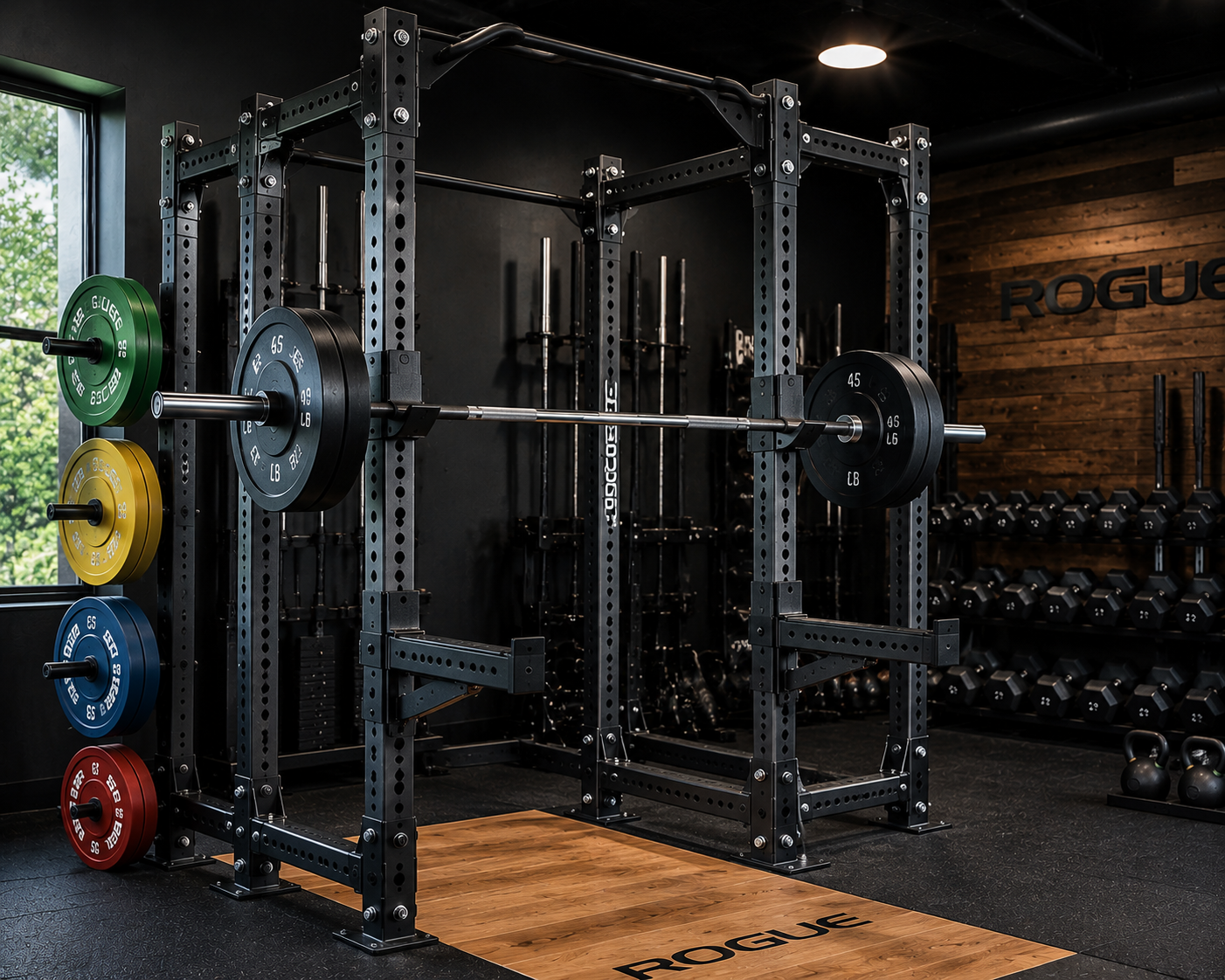
Squat Racks for Low Ceilings: Solutions for Basements and Attics
Building a home gym in a basement, an attic, or a garage with a low ceiling might seem like a challenge, but today there are numerous solutions designed specifically for these environments. Many enthusiasts give up on the idea of training with a barbell because they think a traditional rack requires very high ceilings. In reality, by choosing the correct model and carefully planning the space, it is possible to create a complete workstation even with a height of about two meters.
The most common mistake consists of evaluating only the declared height of the rack without considering the movement of the barbell, the position of the head during pull-ups, the possible use of an adjustable bench, and the space needed to mount future accessories. Careful planning instead allows you to make the most of every available centimeter without compromising safety and functionality.
In this guide, we analyze how to choose the best low ceiling squat rack, what features to look for, when to prefer a short rack or independent stands, and what precautions to adopt to transform even the most difficult environments into an efficient and professional gym.
- The challenges of environments with low ceilings
- How to correctly measure the available space
- Why choose a short power rack
- When independent stands are convenient
- How to position the rack correctly
- Recommended accessories and configurations
- Errors to avoid during planning
- How to choose the best rack for the long term
The challenges of environments with low ceilings
Basements, garages, and many attics have reduced heights that limit the choice of equipment. In some cases, the ceiling may be only two meters from the floor, making it impossible to install a standard rack designed for commercial gyms.
This limitation does not only concern the assembly of the structure. The execution of exercises must also be evaluated carefully, considering the height of the athlete, the diameter of the plates, and the movement of the barbell during squats, military presses, and pull-ups.
Proper planning still allows you to train effectively without sacrificing fundamental exercises, provided that a solution designed for these contexts is chosen.
Why useful height matters more than nominal height
Knowing the height of the room is not enough. It is necessary to check for any beams, pipes, lamps, garage openings, and any element that could interfere with the movement of the barbell or the installation of the rack.
Basements, garages, and attics
Each environment presents different critical issues. Attics may have sloped roofs, while garages and basements often house technical systems that further reduce the available space.
How to correctly measure the available space
Before purchasing any rack, it is fundamental to take precise measurements. Height is only one of the parameters to consider: width and depth must also allow for comfortable use of the structure.
You must also provide enough space to insert and remove plates from the barbell, use an adjustable bench, and move freely during exercises.
Accurate planning avoids costly mistakes and allows you to choose a solution that is truly compatible with your environment.
The space in front of the rack
It is important to keep an area clear in front of the structure to perform squats, deadlifts, and other exercises without movement limitations.
Leave a safety margin
Even if a rack theoretically fits within the available height, it is advisable to maintain a few centimeters of margin to facilitate assembly and compensate for any floor irregularities.
Why choose a short power rack
The most popular solution for low environments is the short power rack. These models maintain most of the functionality of a traditional power rack but use shorter uprights, allowing for installation even in rooms with limited height.
A short rack allows you to perform squats, bench presses, adapted pull-ups, and numerous other exercises without giving up the safety systems typical of professional structures.
The best models maintain high structural rigidity thanks to robust tubing, reinforced welds, and crossbars designed specifically to ensure stability even with heavy loads.
The main advantages
A short rack allows you to make the most of the available vertical space, maintaining safety, modularity, and the possibility of installing compatible accessories.
The limits to consider
In some cases, the reduction in height may limit the use of certain accessories or require adaptations during the execution of pull-ups.
When independent stands are convenient
If the available height is particularly reduced or the space must also be used for other activities, independent stands represent a valid alternative.
Modern adjustable barbell stands allow you to train with squats, bench presses, and military presses while occupying very little space. At the end of the session, they can be moved and stored easily, leaving the environment free.
This solution is particularly appreciated by those who use the garage as a parking space or have a multi-purpose basement.
Maximum flexibility
The ability to quickly change the layout of the training area is one of the main advantages of independent stands.
When to choose a rack instead of stands
For training with very heavy loads or frequent sessions without a spotter, a rack equipped with integrated safety systems generally offers superior protection.
How to position the rack correctly
The position of the rack influences both safety and comfort during workouts. It is advisable to install it in the highest area of the room, avoiding points where beams or sloped roofs could interfere with the movement of the barbell.
The orientation of the structure can also make a difference. In some attics, for example, rotating the rack ninety degrees allows you to better utilize the central part of the ceiling.
Stable and perfectly leveled flooring also contributes to improving the safety and durability of the equipment.
Utilizing the geometry of the environment
Carefully analyzing the shape of the room often allows you to identify more efficient configurations compared to the initially planned layout.
Lighting and ventilation
Good lighting and adequate air exchange make the home gym more comfortable and encourage regular training throughout the year.
Recommended accessories and configurations
Even in a compact gym, it is possible to create a complete workstation by choosing truly useful accessories. Integrated plate holders, safety spotters, dip stations, and adjustable benches increase functionality without taking up unnecessary space.
Before purchasing, it is worth checking the compatibility of the accessories with the chosen rack, so you can gradually expand your home gym without replacing the main structure.
A modular configuration allows you to adapt the gym to the evolution of your training goals, maintaining an efficient investment over time.
Thinking about future developments
Choosing a rack compatible with additional accessories allows you to progressively improve the workstation without radical interventions.
Space organization
Using plate holders and integrated storage systems helps keep the environment tidy and facilitates every training session.
Errors to avoid during planning
One of the most frequent mistakes is purchasing a rack based exclusively on the dimensions reported in the technical sheet, without considering the space needed to use it correctly.
Another mistake is underestimating the possibility of future upgrades. An apparently cheap structure could become limiting after a few months if it does not allow you to add accessories or change the configuration.
It is equally important to avoid sacrificing safety by choosing models that are too compact but lack adequate protection systems for your training level.
Neglecting real measurements
Taking approximate measurements can lead to the purchase of equipment that is incompatible with the room, generating avoidable costs and delays.
Evaluating only the price
Materials, stability, build quality, and customization options affect long-term satisfaction much more than the simple initial cost.
How to choose the best rack for the long term
A carefully designed home gym allows you to train effectively even in spaces that seem unsuitable. Evaluating available height, room configuration, and future prospects allows you to choose a truly functional solution.
For those who wish to find models designed for complex environments, it is possible to consult the selection of low ceiling squat racks available in the Donatif catalog, where there are compact, modular solutions designed to ensure high performance even in basements, garages, and attics.
Investing in the correct rack means making the most of every available centimeter, obtaining a safe training environment, and creating a home gym destined to grow along with your goals, without giving up the fundamental exercises of barbell work.
Comments (0)