
Trolley
You have no items in your shopping cart

 Budgets
 Dumbers
 Discs
Discs
 Benches
 Racks and Rigs
 Weights Holders
 Isotonic machines
 Calisthenics
 Cardio
 Kettlebells
 Flooring
 Gym Set
 Accessories
 Combat
 ARTI MARZIALI
 CONTAINER GYM
 Tug-Of-War
 Used Gym Equipment
 PILATES MACCHINARI
 GINNASTICA ARTISTICA
 CAMPI DA PADEL
 Prodotti in Pronta Consegna
 Informazioni
 IRONMAN
 Gift Card
- Donatif
- General information
- 0 I like it
- 454 Views
- 0 comments
- gym flooring, safety flooring, gym safety, shock-absorbing materials
Acoustic Underlay for Gyms: How to Eliminate Vibrations
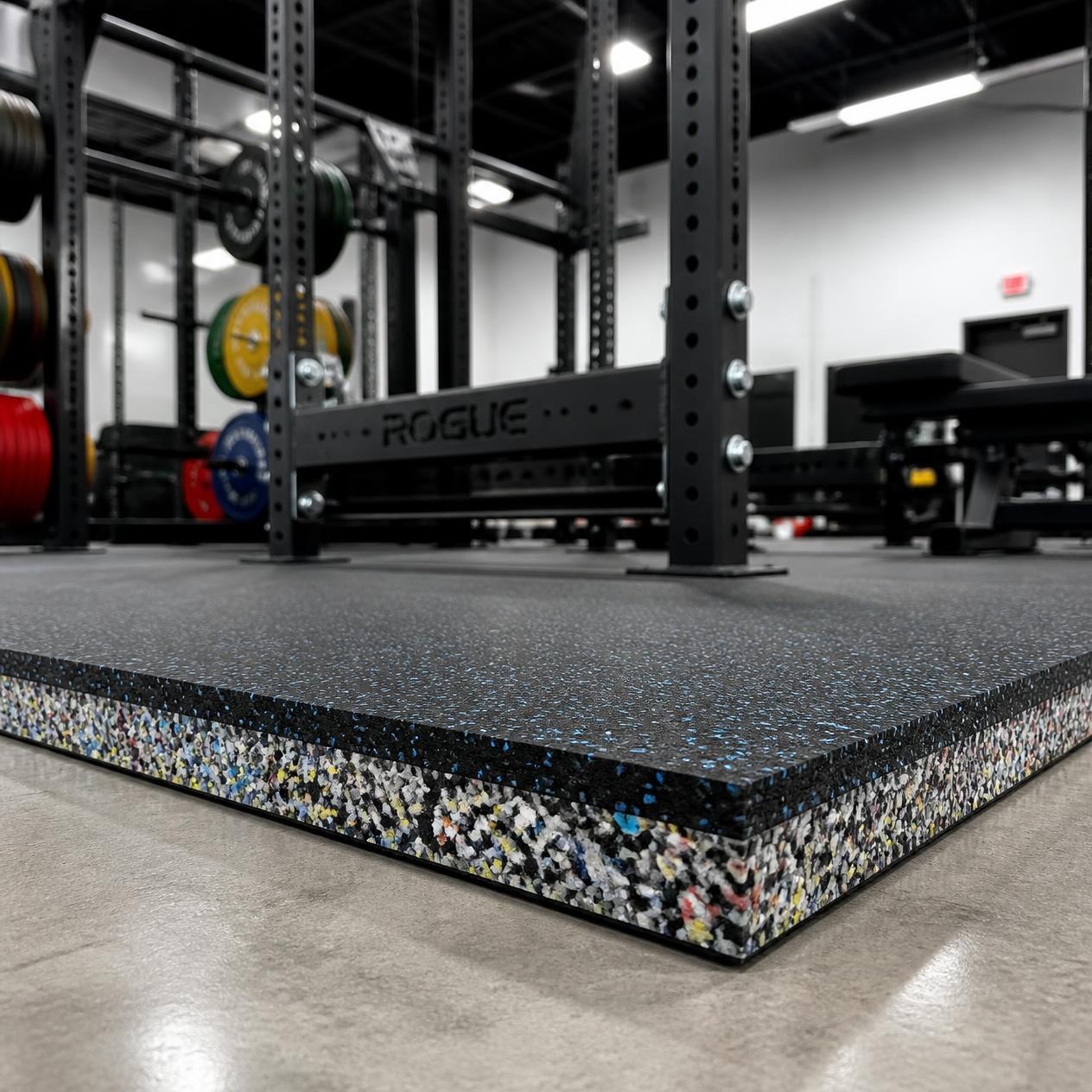
When designing a professional gym or a home gym, the choice of flooring is often associated exclusively with impact resistance and protection of the screed. In reality, the true element that determines the acoustic comfort of the environment is found beneath the walking surface. An acoustic gym underlay is, in fact, the most effective technical solution for limiting the transmission of vibrations generated by dropping weights, jumping, and high-impact activities.
Many property owners, fitness center managers, and condominium administrators discover too late that simple SBR rubber flooring is not always sufficient to prevent the propagation of structural noise. Complaints from neighbors, condominium disputes, and, in the worst cases, the suspension of business can stem precisely from poorly designed acoustic insulation.
Understanding how a system composed of technical flooring and a sound-insulating underlay works allows for the creation of a quieter, safer gym that complies with the requirements of residential, commercial, and multi-story buildings. In this guide, we analyze the available technologies, selection criteria, and aspects to evaluate before investing.
- Why an acoustic underlay is needed
- How vibration isolation works
- Why SBR rubber alone is not enough
- Available materials and technologies
- How to design a quiet gym
- Errors to avoid
- Benefits for managers and owners
- Correctly evaluating the investment
Why an acoustic underlay is needed
Every barbell that falls, every kettlebell placed down energetically, and every plyometric jump generates mechanical energy that propagates into the building's structure. These vibrations do not remain inside the weight room but are transmitted through the floor slab, reaching the rooms below and adjacent to it.
The problem mainly concerns structures located in condominiums, mixed-use buildings, or commercial premises. Even when the noise perceived inside the gym is acceptable, structural transmission can be very high on the floors below.
Installing a specific isolation system means interrupting the path of vibrations before they reach the floor slab, significantly improving the acoustic comfort of the entire building.
Structural noise
Structural noise is different from simple airborne noise. It does not propagate through the air but through the building's construction elements, making it much more difficult to eliminate with subsequent interventions.
Prevention is less expensive
Integrating an underlay during the construction of the gym entails much lower costs compared to corrective intervention after the business has opened, when potential disputes may already compromise the normal use of the spaces.
How vibration isolation works
The main objective is to create an elastic discontinuity between the technical flooring and the building's load-bearing structure. This principle reduces the amount of energy transmitted to the floor slab during impacts.
Modern systems use materials with high dynamic absorption capacity that, by deforming, dissipate part of the energy produced by the most intense exercises.
Performance depends on the entire construction package and not on a single component. For this reason, every element must be sized according to the type of training planned.
Vibration isolation
Effective weight vibration isolation reduces the propagation of impacts while maintaining high performance even during continuous use of the weight room.
Balance between mass and elasticity
A system that is too rigid transmits energy to the structure, while one that is excessively soft can compromise stability and safety. Design must therefore find the correct balance between absorption capacity and mechanical resistance.
Why SBR rubber alone is not enough
Recycled rubber tiles represent an excellent solution for protecting the floor from impacts and increasing comfort during training, but they do not always guarantee sufficient levels of acoustic insulation.
Many users mistakenly believe that simply increasing the thickness of the rubber will automatically result in a significant reduction in vibrations. In reality, acoustic performance depends primarily on the complete system and the presence of a specifically designed elastic layer.
When the load is particularly high, such as in areas dedicated to weightlifting or functional training, the surface covering alone may not be sufficient.
The limits of traditional rubber
Rubber absorbs part of the impact but continues to transfer a significant portion of the energy to the floor slab, especially in the presence of high dynamic loads.
Integrated system
Combining technical flooring with a gym sound-insulating mat allows for significantly superior results compared to using a single material.
Available materials and technologies
The market offers different solutions depending on the level of insulation required, the available thickness, and the intended use of the gym.
There are elastomeric underlays, high-density technical rubber mats, multilayer systems, and panels specifically designed to reduce the transmission of low frequencies generated by dropping weights.
The choice must always be made considering the expected loads, the type of building, and performance objectives.
Elastic materials
High-elasticity materials allow for greater energy dissipation while maintaining their mechanical characteristics over time.
Professional solutions
For high-intensity environments, it is advisable to look toward systems certified for home gym soundproofing and professional gyms, designed to support repeated loads without loss of performance.
How to design a quiet gym
Correct design starts with an analysis of the building. Not all structures require the same level of insulation, and every intervention should be sized based on the construction characteristics of the floor slab.
It is also necessary to evaluate the type of activity performed, the frequency of impacts, the maximum weight used, and the presence of sensitive environments in adjacent rooms.
A well-studied project allows for the avoidance of subsequent interventions, reducing the risk of disputes and improving the quality perceived by users.
Preliminary analysis
An initial technical assessment allows for the identification of critical issues and the definition of the system best suited to the structure's needs.
Relying on specialists
Consulting specialized companies like acoustic gym underlay allows you to choose solutions specifically designed for fitness environments and weight rooms.
Errors to avoid
One of the most frequent errors consists of evaluating exclusively the initial cost of materials without considering the economic consequences deriving from insufficient insulation.
Even incorrect installation can completely compromise the performance of the system, creating rigid bridges that facilitate the transmission of vibrations.
Finally, underestimating the future use of the spaces can make an expensive renovation of the flooring necessary after a few years.
Importance of installation
The quality of the installation affects performance as much as the quality of the materials used and must comply with the manufacturer's instructions.
Correct sizing
Every gym requires a customized solution based on dynamic loads and the characteristics of the building.
Benefits for managers and owners
Reducing vibrations means decreasing the risk of complaints, improving the reputation of the facility, and offering a more professional environment to clients.
From a real estate perspective, a well-designed acoustic system also contributes to the protection of the structure, limiting the stress transmitted to construction elements.
For those building a home gym, investing in insulation allows for training with greater freedom without compromising relationships with neighbors and family members.
Increased investment value
A gym designed with attention to acoustic aspects represents a distinctive element that can increase the overall value of the business.
Operational continuity
Reducing the risk of disputes means ensuring greater business continuity and limiting possible interruptions due to noise-related issues.
Correctly evaluating the investment
The choice of an isolation system should not be based exclusively on the price of materials. It is necessary to consider durability, performance, ease of installation, and the ability to maintain characteristics unchanged over time.
A correctly designed underlay allows you to protect your investment in the gym, improve user comfort, and significantly reduce the risk of complaints from neighbors or the condominium administration.
Carefully analyzing the construction package, relying on specialized suppliers, and choosing materials specific to fitness activity represents the most effective strategy for obtaining a truly quiet, durable, and high-performing environment in the long term.
Comments (0)